

How to verify international trade intelligence updates
International trade intelligence updates can help researchers track regulatory changes, supply chain disruptions, and emerging market trends—but not every update is accurate, current, or relevant.
Verifying the original source, publication date, geographic scope, and supporting evidence is essential before using information in a report or business decision.
This guide explains how to cross-check trade data and assess its reliability, helping you turn complex global developments into useful, well-founded insights.
Start With the Claim, Not the Headline
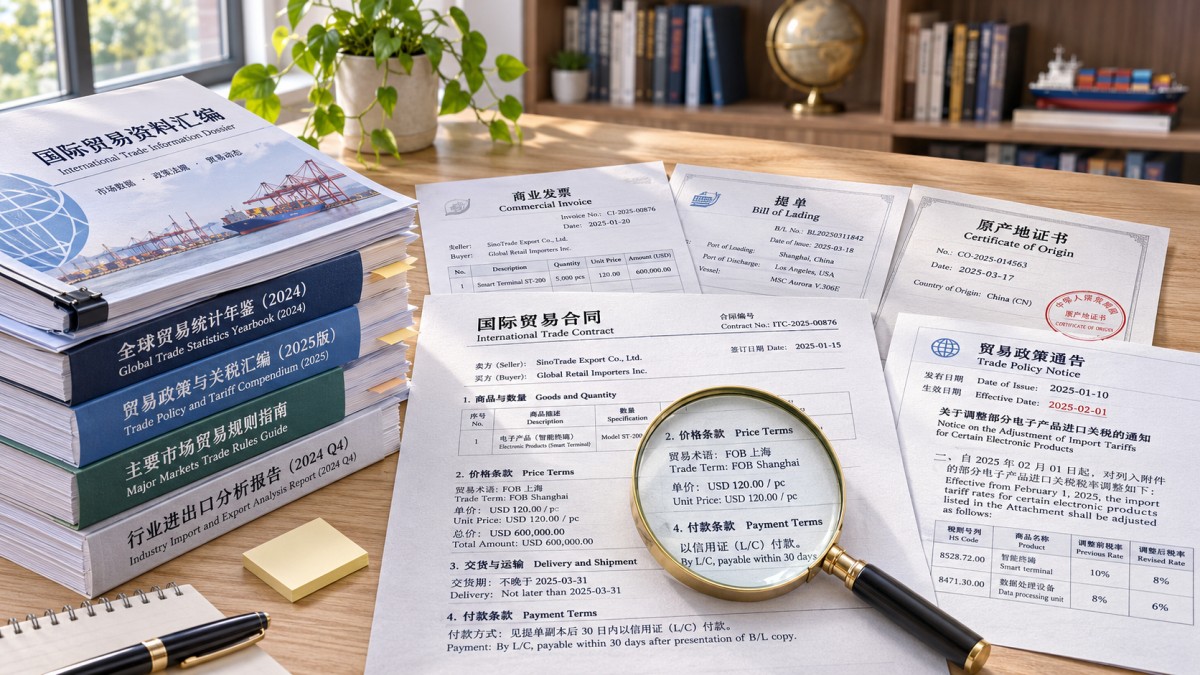
The fastest way to verify an update is to identify its precise claim, locate the underlying evidence, and confirm that the evidence supports its stated implications.
Rewrite the claim as a checkable statement: who or what is affected, in which jurisdiction, from what date, and under which conditions?
For example, “a country increased import duties” is incomplete. A useful claim identifies the products, tariff classification, origin, applicable rate, and effective date.
Next, decide what evidence would establish the claim. A tariff announcement requires a legal instrument or customs schedule; a market-growth claim requires comparable data.
Record the update’s publication date separately from the event date and the period covered by its data. These dates often answer different questions.
Use this initial screen to prioritize material with consequences for your research question. An interesting development may still be irrelevant to your specific products or markets.
Find the Original Source and Follow the Evidence
Start with the link or citation in the update. If it points to another article, follow the chain until you reach the underlying document or dataset.
For regulations, the strongest evidence is generally the published legal instrument and any official amendments. Agency guidance can clarify implementation but may not replace binding text.
For trade statistics, seek the issuing customs authority, national statistical office, or international database, along with its methodology, reporting period, and revision history.
For company announcements, review the original filing, press release, or official statement. Distinguish what the company reported from what an article inferred.
Check whether the source actually contains the quoted figure or conclusion. A citation can be genuine while supporting only part of the claim.
When an original source is unavailable, label the finding as unverified or attributed to a secondary source. Do not present a summarized claim as established fact.
Archive the document or record its stable link, title, issuing body, publication date, and relevant page or table. This makes later review and correction easier.
Check Whether Regulatory Updates Actually Apply
A regulatory announcement can describe a proposal, consultation, adopted rule, phased obligation, temporary measure, or repeal. Those stages have different implications for research and compliance.
Read the official text for its legal status and effective date. Also look for transition periods, implementation deadlines, exemptions, and provisions that apply retrospectively.
Confirm the jurisdiction carefully. A regional measure may apply across participating countries, while national implementing rules or enforcement practices can still differ.
Product scope matters just as much. Check the applicable product descriptions, technical criteria, and tariff codes instead of assuming a broad industry label covers every item.
Tariff treatment may also depend on origin, preferential trade agreements, quotas, trade remedies, or the date goods are entered for customs purposes.
For a claim involving sanctions or export controls, check the relevant authority’s current rules and lists, including any licensing requirements and jurisdictional conditions.
Official notices can be amended or superseded. Search the issuing authority’s later publications and consolidated materials before describing a measure as currently applicable.
If the legal text is ambiguous, report the uncertainty and seek qualified customs or legal advice. A research summary should not substitute for a product-specific determination.
Cross-Check Trade Data Without Comparing Unlike Figures
Two credible sources can report different numbers without either being wrong. Before comparing figures, check whether they measure the same flows and use consistent definitions.
Identify whether the figure covers exports, imports, re-exports, or domestic production. Note the reporting economy, partner economy, product classification, and reference period.
Compare the units and valuation basis. A shipment measured by weight cannot directly validate a claim about revenue, and transaction values may use different customs valuation conventions.
Check currency conversion, seasonal adjustment, and whether values are nominal or inflation-adjusted. A rise in trade value does not necessarily mean more physical goods moved.
Confirm the classification version and level of detail. Harmonized System codes can change between editions, and national tariff subdivisions may differ beyond internationally standardized digits.
Mirror statistics offer a useful sense check: compare one economy’s reported exports with its partner’s reported imports for the same product and period.
Expect some differences because of valuation, timing, routing, reporting practices, and incomplete coverage. Investigate large gaps rather than treating either side as automatically correct.
Review data revisions and missing observations. A recent release may contain provisional figures, while a later update can revise earlier months substantially.
Useful starting points include national customs databases, UN Comtrade, the World Trade Organization, and relevant statistical agencies. Check each dataset’s coverage and release schedule.
Verify Supply Chain Disruption and Market Trend Claims
Operational claims require a different evidence trail. For a reported port disruption, check the port operator, shipping lines, customs notices, and credible local reporting.
Establish what actually stopped: a terminal, a transport route, customs processing, or all port operations. Then confirm the start time and latest operational status.
A disruption at one facility does not automatically mean a national supply shortage. Look for evidence of capacity constraints, rerouting, delays, and affected cargo categories.
For pricing updates, identify the product specification, location, currency, unit, delivery terms, and observation date. Prices from different transaction levels are rarely interchangeable.
Separate spot quotes, contract prices, producer indexes, and forecasts. A quoted increase may describe one supplier or market rather than a representative global change.
Market forecasts deserve particular scrutiny. Identify the publisher, underlying data, assumptions, forecast horizon, and whether the estimate is independently verifiable or commercially motivated.
Where possible, compare several independent indicators, such as production, orders, inventories, and trade volumes. Explain when the indicators disagree instead of forcing a single narrative.
For fast-moving events, note when the information was last checked and specify what remains unknown. An accurate morning update may be outdated by afternoon.
Assess Source Independence and Potential Bias
Cross-checking is useful only when sources provide independent evidence. Several articles repeating the same press release do not constitute several confirmations.
Trace each report to its underlying source. Group reports that rely on the same dataset, announcement, interview, or wire story before counting corroboration.
Consider what the publisher knows directly and what it may gain from the claim. Suppliers, trade associations, governments, and analysts can all have legitimate but partial perspectives.
A commercial interest does not automatically invalidate a source. It does mean important claims should be checked against documents or data with different incentives and methods.
Assess transparency as well as reputation. A source that explains definitions, methods, limitations, and corrections is generally easier to evaluate than one offering unsupported certainty.
Anonymous sources can provide valuable leads, especially during developing events. Treat consequential claims as provisional until corroborated or supported by documentary evidence.
Use a Practical Verification Record
A short verification record makes research reproducible and helps colleagues understand why a finding can, or cannot, support a decision.
For each material claim, capture the following fields in a spreadsheet, research note, or shared intelligence system:
- Claim: The specific development, affected product or market, and stated consequence.
- Original evidence: The issuing organization, document title, link, and relevant page, section, or dataset table.
- Dates: Publication date, event or effective date, data period, and time last checked.
- Scope: Jurisdiction, trading partners, product definition, classification, and applicable exceptions.
- Cross-check: Independent sources reviewed, discrepancies found, and any explanation for those discrepancies.
- Assessment: Confidence level, unresolved questions, intended use, and person responsible for follow-up.
Keep confidence labels meaningful. “High” might mean a current primary source directly supports the claim; “low” might mean the evidence is indirect or incomplete.
Confidence in the evidence is separate from business impact. A low-confidence claim with potentially severe consequences may justify immediate monitoring and further investigation.
Set a review date based on how quickly the situation can change. Live shipping disruption may require frequent checks; a stable historical dataset may not.
Example: Checking a Reported Tariff Increase
Suppose an industry article says that Country A has imposed a 15% tariff on imported industrial pumps from Country B, effective next month.
First, find the official measure or customs notice. Confirm whether the rate is a new additional duty or the total rate payable.
Then check the covered pump descriptions and tariff classifications, the relevant origin rules, the effective date, and any exclusions or transitional provisions.
Compare the notice with the current tariff schedule and any later amendments. If an official implementation guide exists, check how it explains the measure.
Next, ask whether the article concerns a proposal or an enacted measure. A consultation document alone does not establish that the tariff will take effect.
Finally, document the result precisely: “The published measure applies to specified pump classifications from Country B; applicability to a particular product requires classification and origin review.”
If the notice cannot be found, retain the article as a lead and mark the claim unverified. Avoid using its headline as a definitive cost assumption.
Turn Verified Findings Into Useful Research
Present the fact first, followed by its scope, evidence, and potential implications. Keep observed developments distinct from forecasts and your own interpretation.
For example, a verified freight increase may indicate cost pressure, but its effect on a buyer depends on contract terms, shipment timing, and available routes.
Where figures differ, show the relevant definitions and explain why a comparison may be limited. Include links so readers can inspect the evidence themselves.
Trade intelligence platforms such as GTIIN can help researchers organize developments across industries and markets. For consequential claims, follow citations to the original evidence.
When new information changes a conclusion, update the record and preserve the earlier assessment where appropriate. A correction history helps readers understand what changed.
Conclusion: Match Confidence to the Evidence
Reliable international trade intelligence updates are not simply recent or widely shared. They identify their sources, define their scope, and distinguish established facts from interpretation.
Verify primary documents, check dates and product coverage, compare genuinely independent evidence, and record uncertainties. The result is research that others can evaluate and use responsibly.
 How to verify international trade intelligence updatesVerify international trade intelligence updates with practical checks for sources, regulations, trade data, and disruptions. Turn complex claims into reliable insights.
 How investors can assess cyclicality in the manufacturing industryManufacturing industry analysis for investors: learn to assess cyclical demand, cash flow and downside risks to make more informed investment decisions.
 US ISM Manufacturing PMI Rises to 55.5% in October, Beating ForecastsUS ISM Manufacturing PMI rose to 55.5% in October 2026, beating forecasts. Explore what stronger orders and production could mean for manufacturers.
 China Manufacturing PMI Falls to 49.3 in OctoberChina manufacturing PMI fell to 49.3 in October, signaling renewed contraction. Explore the role of weak export orders and domestic demand.
 Can you trust flexible packaging market intelligence forecasts?Can you trust flexible packaging market intelligence forecasts? Learn how to verify sources, challenge assumptions, and assess demand before making costly investment or sourcing decisions.
 When is supply chain disruption management consulting worth the cost?When is supply chain disruption management consulting worth the cost? Learn how to compare fees, avoidable losses, and recovery options to make a confident investment decision.
 How to use macroeconomic analysis to forecast industrial demandApply an industrial macro analysis methodology to forecast demand, interpret economic signals, and plan inventory and capacity. Discover practical steps for smarter business decisions.
 How to assess Singapore suppliers with global supply chain intelligenceExplore international supply chain intelligence Singapore buyers can use to verify suppliers, assess capabilities and delivery risks, and make confident sourcing decisions.
 Which macroeconomic indicators help forecast U.S. industrial demand?Explore industrial macro analysis USA decision-makers can use to forecast demand. Track new orders, inventories, and credit signals to sharpen procurement and capacity decisions.
 Can a food processing manufacturer meet your small-batch needs?Can a food processing manufacturer meet your small-batch needs? Discover how to assess minimum orders, costs, packaging, and safety to choose the right partner for your launch.
 How to verify sourcing intelligence data before selecting suppliersVerify sourcing intelligence data before choosing suppliers. Learn how to check company records, certifications, and capacity to reduce procurement risk and build a reliable shortlist.
 How to use supplier risk analysis to spot financial warning signsUse supplier risk analysis to spot cash flow pressure, debt risks, and delivery warning signs. Learn practical steps to reduce exposure and protect supply continuity.
 When dual sourcing makes sense in a sourcing strategy for manufacturersSourcing strategy for manufacturers: learn when dual sourcing strengthens supply continuity, reduces disruption risk, and protects production without adding unnecessary complexity.
 How bulk commodities pricing affects long-term supply contractsBulk commodities pricing shapes long-term supply contracts through index rules, freight, quality, volume, and currency risk. Explore strategies for resilient costs and supply security.
 Which global manufacturing trends by sector matter most for sourcing plans?Global manufacturing trends by sector: identify sourcing risks, supplier resilience, compliance demands, and cost drivers to build smarter, more reliable procurement plans.
 What industrial trade intelligence pricing should include before you subscribeIndustrial trade intelligence pricing explained: compare coverage, data quality, access rights, and workflow value before choosing a subscription that supports smarter trade decisions.
 How an industrial trade intelligence dashboard can identify new supplier marketsDiscover how an industrial trade intelligence dashboard helps identify new supplier markets by comparing capacity, landed cost, logistics resilience, and compliance risk.
 Which global market entry barriers should exporters assess first?Global market entry barriers exporters should assess first: tariffs, compliance, buyer qualification, logistics, and payment risk. Build a practical strategy for confident market entry.
 How trade data aggregation analytics can reveal emerging supplier marketsTrade data aggregation analytics reveals emerging supplier markets by connecting trade flows, capacity signals, logistics, and compliance insights for smarter sourcing decisions.
 When an export market analysis platform can validate demand in a new marketExport market analysis platform insights help validate new-market demand through buyer fit, regulations, logistics, competition, and profitable entry conditions.
 What is driving the beauty and personal care market in the USA?Beauty and personal care in USA is driven by targeted solutions, selective premiumization, digital discovery, clean-label trust, diverse needs, and compliance. Explore key growth opportunities.


Global Trade Insights & Industry
Our mission is to empower global exporters and importers with data-driven insights that foster strategic growth.
Search News
Popular Tags
Industry Overview
The global commercial kitchen equipment market is projected to reach $112 billion by 2027. Driven by urbanization, the rise of e-commerce food delivery, and strict hygiene regulations.