

How Can You Compare Overseas Catalyst Suppliers’ Delivery Reliability?
Compare overseas catalyst suppliers by measuring how consistently they deliver usable material to the same agreed milestone. Quoted lead time alone is a weak basis for selection: a supplier promising a short production cycle may still have unpredictable batch release, export preparation, or freight arrangements. A supplier with a longer but more stable schedule may give your plant a better chance of keeping its production or shutdown plan intact.
A useful comparison combines four things: verified delivery history, the spread of actual lead times, readiness to manufacture and release your specific catalyst, and the ability to manage transport disruption. Give each supplier the same order assumptions and evidence requirements. Then assess both the likelihood of delay and the consequences for your operation. A routine replenishment order and a catalyst charge tied to a fixed turnaround date need different levels of assurance.
Agree on what “delivered on time” actually means
Before requesting performance figures, define the endpoint. Suppliers may measure delivery when goods leave the factory, reach an export terminal, or arrive at the buyer’s site. Those records answer different questions. Factory dispatch performance helps assess manufacturing execution; arrival at your receiving location captures the schedule you must plan around.
For catalyst procurement, arrival can still be an incomplete measure. Material may reach the site with missing documents, damaged packaging, an unresolved specification deviation, or insufficient time for incoming acceptance. Establish whether your comparison ends at physical receipt or at release for use. Keep these milestones separate so that a quality hold does not disappear inside an apparently successful delivery statistic.
Write a common comparison brief covering the catalyst grade, quantity, packaging, manufacturing location, destination, transport assumptions, and required delivery window. Specify when the lead-time clock starts. An order placed before technical approval, advance payment, or confirmation of buyer-supplied information cannot be compared fairly with an order that was ready for production immediately.
Use the agreed Incoterms rule and named place to clarify responsibilities, while recording the operational milestones separately. Incoterms allocate particular obligations, costs, and risks; they do not establish a complete production schedule or guarantee arrival by a particular date. If you arrange the main carriage, evaluate the supplier’s handover performance and your freight route as distinct parts of the total lead time.
Also distinguish stock supply from manufacture to order. A distributor holding an approved grade near your plant may offer dependable replenishment from existing inventory, but that tells you little about its next overseas replenishment cycle. A manufacturer’s strong record for a standard grade may not transfer to a custom formulation or a batch requiring additional customer approval.
Compare delivery records that can withstand scrutiny
Ask shortlisted suppliers for shipment-level records covering a common recent period and, where available, an earlier period that reveals seasonal or recurring constraints. The records should include the original confirmed delivery date, actual milestone dates, quantity ordered and delivered, and the reason for any delay. Redacted records can protect customer identities while preserving the evidence needed for comparison.
The original commitment matters. If a supplier repeatedly moves its promised date and then reports performance against the final revision, its on-time rate may look strong while your planning remains exposed. Track performance against the original accepted date and record subsequent changes separately, including whether the buyer requested them.
Use a small set of measures with consistent definitions:
- On-time delivery: The share of orders reaching the agreed milestone within the agreed window. Define whether early arrivals are acceptable, particularly where receiving or storage capacity is limited.
- On-time, in-full delivery: The share arriving on schedule with the complete required quantity. A partial shipment can meet a dispatch target while leaving a catalyst loading campaign unable to proceed.
- Typical and extended lead time: Compare the median with an upper percentile, such as the 90th percentile, where the dataset is large enough to support it. This exposes delays hidden by the average.
- Delay severity: Record how late missed orders were. A brief receiving delay and a shipment that misses a shutdown window should not carry identical operational significance.
- Documentation and acceptance failures: Track shipments held because paperwork, packaging, identification, or product acceptance requirements were not met.
Show the number of orders behind every percentage. A supplier with a handful of successful shipments offers less evidence of consistency than one with a substantial comparable record. Separate complete orders from individual shipment lines so that splitting one order into several consignments does not distort the result.
Relevance is equally important. Request records for comparable catalyst families, order sizes, production sites, and destination routes. Performance for small sample shipments sent by air offers limited evidence for a large commercial shipment moving by sea. Where a supplier cannot provide closely matched records, treat the evidence as less conclusive rather than automatically treating the supplier as unreliable.
Cross-check selected entries against order acknowledgments, dispatch records, transport documents, and proof of receipt. Customer references can provide context if they concern similar requirements, but broad assurances such as “deliveries are always prompt” cannot replace dated records. Where disclosure is restricted, an agreed review of redacted evidence may still support a meaningful assessment.
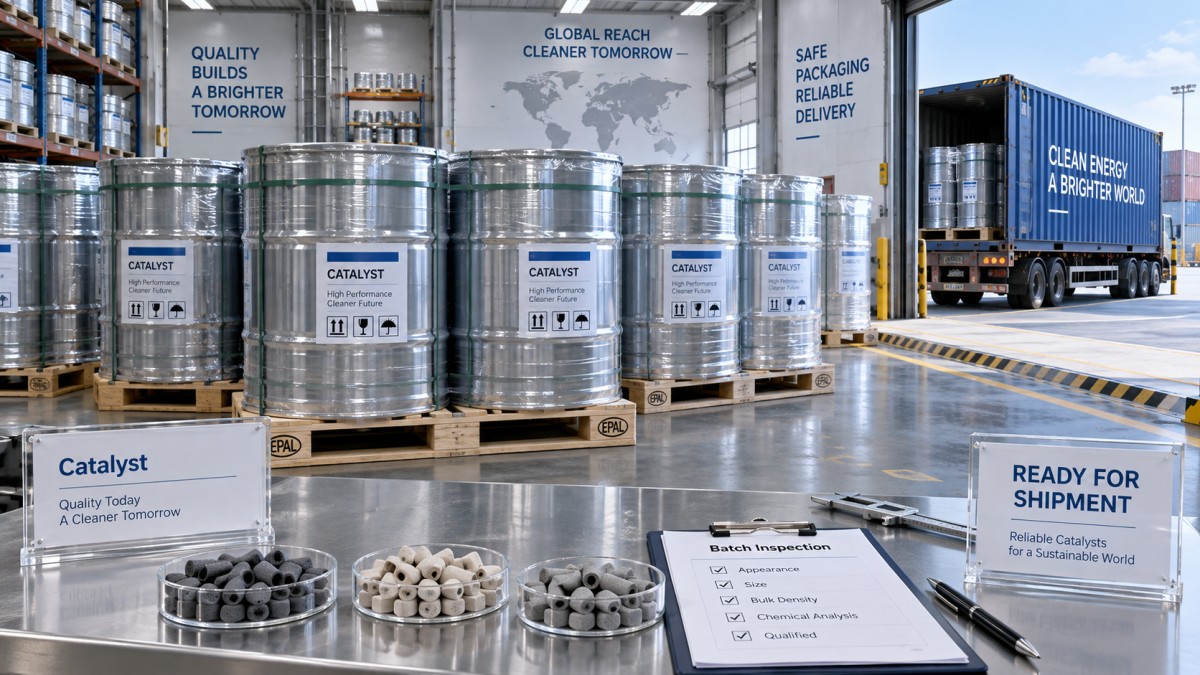
Read average lead time alongside its variability. A supplier with a shorter average and occasional long delays can require more protective inventory than a supplier with a slightly longer, predictable cycle. For shutdown purchasing, examine whether the longer observed lead times would have met your required arrival date with enough room for receiving checks and loading preparation.
Check what could prevent your catalyst from being ready
Historical performance establishes a baseline; the next order depends on actual readiness. Ask each supplier to explain the steps between order acceptance and shipment, including feedstock availability, production scheduling, processing, testing, batch release, packaging, and export preparation. The explanation should identify dependencies and show where schedule allowance exists.
Catalysts differ substantially, so the relevant constraints must follow the product. Depending on the grade, production may involve metal sourcing, support preparation, impregnation, drying, calcination, shaping, activation, or other specialized operations. A statement about total factory capacity does not demonstrate available capacity at the particular stage your order requires.
Ask whether the quoted lead time assumes materials already on hand, an unreserved production slot, or successful first-pass batch testing. Establish when capacity becomes committed and what evidence confirms that commitment. If the supplier relies on another company for a critical processing step, include that dependency in the assessment.
Quality release deserves explicit attention because accelerating shipment cannot resolve an unfinished or failed batch test. Confirm which acceptance criteria apply, who authorizes release, when the certificate of analysis becomes available, and whether buyer approval is required before dispatch. A realistic schedule includes these steps rather than placing them outside the advertised production lead time.
Inventory claims also need context. Ask whether available stock is the approved grade, is allocated to another customer, has complete traceability, and remains within applicable storage or shelf-life requirements. For products requiring particular moisture protection, temperature conditions, or inert handling, inspect how those conditions are maintained. Stock that needs requalification before use may offer little immediate schedule protection.
Packaging and transport classification can create additional constraints. Some catalyst products require dangerous-goods arrangements or specific handling precautions; others do not. Classification must be established for the actual product and its shipping condition. Confirm that the proposed carrier accepts the consignment and that packaging, labels, and shipping documents match the applicable requirements.
Review destination requirements with the importer and logistics provider early enough to influence the schedule. Relevant documents may include the commercial invoice, packing list, safety data sheet, certificate of analysis, and other product- or route-specific records. Ask for representative document sets and check their consistency. A supplier’s experience shipping elsewhere does not establish readiness for your destination.
Separate delay responsibility from exposure to delay
Classifying delays helps identify what can be improved. Production overruns, late batch release, incorrect paperwork, and missed booking cutoffs may fall within the supplier’s control. Port disruption, carrier schedule changes, border examinations, and buyer-side approval delays require a different analysis. Record the cause, supporting evidence, and response for each material exception.
Responsibility alone does not determine which supplier is safer for your operation. A shipment delayed by an external event still affects your plant. Compare suppliers’ total delivery outcomes, then assess how effectively they reduce exposure through route selection, booking discipline, schedule allowance, and early escalation. Avoid excusing every late arrival as a logistics issue without examining when the problem became visible.
A contingency plan is useful only if it can be executed for the actual catalyst. An alternative port may be available but require different documentation or inland transport. Airfreight may be constrained by classification, packaging, quantity, or carrier acceptance. A second production site may lack approval for your grade. Ask what would trigger the alternative, who would authorize it, and how its feasibility has been established.
Communication should be assessed through observable behavior. Does the supplier report a missed production milestone before the delivery date is threatened? Does an update distinguish confirmed events from estimated dates? Is there a named person who can coordinate manufacturing, quality, and logistics decisions? Prompt warning gives buyers time to adjust inventory, maintenance plans, or transport arrangements.
Supplier diversity also needs closer inspection. Two exporters may source from the same producer, depend on the same critical feedstock, or use the same freight corridor. Compare those dependencies before assuming that adding a second supplier provides effective backup.
Turn the evidence into an order decision
Apply minimum requirements before calculating an overall score. A supplier unable to meet your catalyst specification, acceptance requirements, or transport conditions should not compensate for that gap with a low price or an attractive average lead time. Among technically acceptable suppliers, weight delivery evidence according to the consequences of failure.
For a fixed shutdown, place greater emphasis on complete arrival, longer observed lead times, confirmed production allocation, and recovery options. For replenishment supported by adequate inventory, consistency and economical repeat supply may carry more weight. Keep evidence confidence beside the performance score: verified comparable records, partly relevant records, and unsupported promises should remain visibly different.
Where evidence is limited, a trial commercial order can test the full sequence of acknowledgment, production updates, batch documentation, transport preparation, and receipt. A successful trial supports further evaluation, but it does not establish capacity for a much larger order or performance during a constrained production period.
Translate the selected supplier’s commitments into the purchase agreement: delivery milestone, acceptable window, full-quantity requirements, document deadlines, progress reporting, and escalation responsibilities. Work backward from the date the catalyst must be available for use, allowing time for transport, receiving checks, and operational preparation.
The preferred supplier should offer a schedule your operation can support with credible evidence. If the remaining uncertainty exceeds your available buffer, change the arrangement before placing the critical order—reserve capacity earlier, secure qualified stock, or establish an approved alternative. That decision is more useful than a ranking built around the shortest quoted lead time.
 How investors can assess cyclicality in the manufacturing industryManufacturing industry analysis for investors: learn to assess cyclical demand, cash flow and downside risks to make more informed investment decisions.
 US ISM Manufacturing PMI Rises to 55.5% in October, Beating ForecastsUS ISM Manufacturing PMI rose to 55.5% in October 2026, beating forecasts. Explore what stronger orders and production could mean for manufacturers.
 China Manufacturing PMI Falls to 49.3 in OctoberChina manufacturing PMI fell to 49.3 in October, signaling renewed contraction. Explore the role of weak export orders and domestic demand.
 Can you trust flexible packaging market intelligence forecasts?Can you trust flexible packaging market intelligence forecasts? Learn how to verify sources, challenge assumptions, and assess demand before making costly investment or sourcing decisions.
 When is supply chain disruption management consulting worth the cost?When is supply chain disruption management consulting worth the cost? Learn how to compare fees, avoidable losses, and recovery options to make a confident investment decision.
 How to use macroeconomic analysis to forecast industrial demandApply an industrial macro analysis methodology to forecast demand, interpret economic signals, and plan inventory and capacity. Discover practical steps for smarter business decisions.
 How to assess Singapore suppliers with global supply chain intelligenceExplore international supply chain intelligence Singapore buyers can use to verify suppliers, assess capabilities and delivery risks, and make confident sourcing decisions.
 Which macroeconomic indicators help forecast U.S. industrial demand?Explore industrial macro analysis USA decision-makers can use to forecast demand. Track new orders, inventories, and credit signals to sharpen procurement and capacity decisions.
 Can a food processing manufacturer meet your small-batch needs?Can a food processing manufacturer meet your small-batch needs? Discover how to assess minimum orders, costs, packaging, and safety to choose the right partner for your launch.
 How to verify sourcing intelligence data before selecting suppliersVerify sourcing intelligence data before choosing suppliers. Learn how to check company records, certifications, and capacity to reduce procurement risk and build a reliable shortlist.
 How to use supplier risk analysis to spot financial warning signsUse supplier risk analysis to spot cash flow pressure, debt risks, and delivery warning signs. Learn practical steps to reduce exposure and protect supply continuity.
 When dual sourcing makes sense in a sourcing strategy for manufacturersSourcing strategy for manufacturers: learn when dual sourcing strengthens supply continuity, reduces disruption risk, and protects production without adding unnecessary complexity.
 How bulk commodities pricing affects long-term supply contractsBulk commodities pricing shapes long-term supply contracts through index rules, freight, quality, volume, and currency risk. Explore strategies for resilient costs and supply security.
 Which global manufacturing trends by sector matter most for sourcing plans?Global manufacturing trends by sector: identify sourcing risks, supplier resilience, compliance demands, and cost drivers to build smarter, more reliable procurement plans.
 What industrial trade intelligence pricing should include before you subscribeIndustrial trade intelligence pricing explained: compare coverage, data quality, access rights, and workflow value before choosing a subscription that supports smarter trade decisions.
 How an industrial trade intelligence dashboard can identify new supplier marketsDiscover how an industrial trade intelligence dashboard helps identify new supplier markets by comparing capacity, landed cost, logistics resilience, and compliance risk.
 Which global market entry barriers should exporters assess first?Global market entry barriers exporters should assess first: tariffs, compliance, buyer qualification, logistics, and payment risk. Build a practical strategy for confident market entry.
 How trade data aggregation analytics can reveal emerging supplier marketsTrade data aggregation analytics reveals emerging supplier markets by connecting trade flows, capacity signals, logistics, and compliance insights for smarter sourcing decisions.
 When an export market analysis platform can validate demand in a new marketExport market analysis platform insights help validate new-market demand through buyer fit, regulations, logistics, competition, and profitable entry conditions.
 What is driving the beauty and personal care market in the USA?Beauty and personal care in USA is driven by targeted solutions, selective premiumization, digital discovery, clean-label trust, diverse needs, and compliance. Explore key growth opportunities.
 How trade flow monitoring reports reveal changing regional demandTrade flow monitoring reports reveal changing regional demand through import volumes, sourcing shifts, product mix, logistics signals, and regulatory trends. Explore actionable market insights.


Global Trade Insights & Industry
Our mission is to empower global exporters and importers with data-driven insights that foster strategic growth.
Search News
Popular Tags
Industry Overview
The global commercial kitchen equipment market is projected to reach $112 billion by 2027. Driven by urbanization, the rise of e-commerce food delivery, and strict hygiene regulations.