

Sustainable Construction Materials: How to Balance Carbon Goals and Project Cost
Balancing carbon targets with budget pressure has become a practical procurement issue, not a branding exercise. For project managers and engineering leaders, the question is rarely whether sustainable construction matters in principle. The real question is how to make material choices that satisfy environmental expectations without creating cost overruns, delivery delays, or performance problems later in the project.
That is why this topic is receiving more attention across commercial buildings, infrastructure, industrial facilities, and public-sector development. Owners are under pressure from internal ESG targets, investor scrutiny, green finance conditions, and in some regions, tighter building standards. At the same time, contractors and project teams still have to deliver on schedule, protect margins, and manage procurement risk in markets where pricing, logistics, and compliance requirements can change quickly.
For many teams, the biggest mistake is to frame the issue too narrowly. Sustainable construction is not simply a choice between a “green” material and a conventional one. It is a project-level tradeoff involving embodied carbon, installation method, lead time, maintenance profile, local availability, certification credibility, and the likelihood of redesign if a specified product cannot be sourced on time. A lower-carbon material that causes procurement instability can become more expensive than a higher-carbon alternative that is regionally available and technically familiar.
What buyers are actually trying to decide
When a project team searches for ways to balance carbon goals and cost, it is usually trying to answer four business questions at once.
- Will this material choice help meet client or regulatory expectations in a defensible way?
- What is the true cost impact beyond the initial unit price?
- Can the supply chain support the specification at the required volume and schedule?
- If the team adopts a lower-carbon option, where are the technical or contractual risks likely to appear?
Those questions matter because sustainable construction decisions often fail at the handoff points. The design team may specify a greener product based on modeled carbon savings, but procurement later discovers limited supplier capacity, weak documentation, inconsistent quality, or local installers with little experience using it. In practice, cost control depends less on selecting the most sustainable material on paper and more on selecting the most executable sustainable option for the project context.
Not all low-carbon materials behave the same in procurement
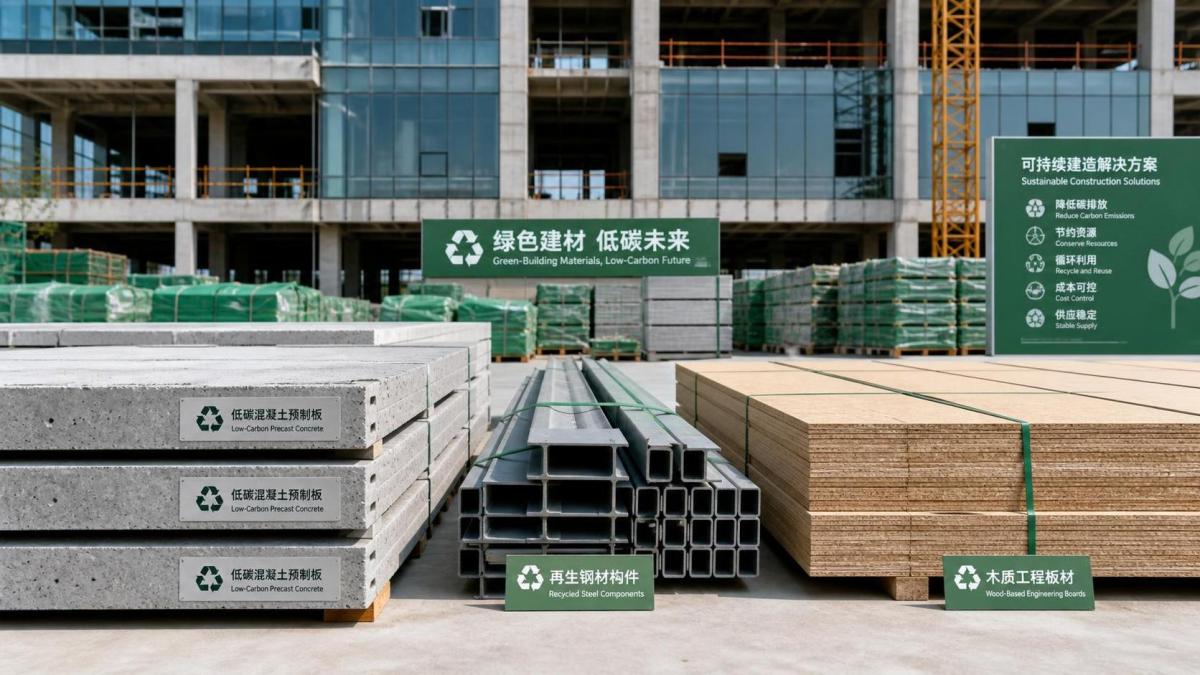
In market discussion, sustainable materials are often grouped together as if they create similar value. They do not. Recycled steel, supplementary cementitious materials, low-carbon concrete mixes, engineered timber, recycled aluminum, insulation with recycled content, modular facade systems, and regionally sourced finishes each affect project economics in different ways.
Some products mainly reduce embodied carbon through manufacturing changes and can fit existing construction methods with minimal disruption. Others require design adaptation, different handling procedures, new moisture controls, or revised approval processes. That difference matters more than many procurement discussions admit.
For example, a lower-carbon concrete strategy may depend on cement substitution ratios, curing time, structural performance requirements, and local plant capability. A timber-based solution may offer carbon benefits and prefabrication advantages, but it can also raise questions around code acceptance, fire engineering, insurance, moisture management, and regional supply depth. Recycled metal content may be easier to integrate into standard procurement, but documentation quality and chain-of-custody claims still need careful review. There is no single cost rule that applies across all these categories.
The more useful approach is to separate materials into three decision buckets: options that can be substituted with low operational disruption, options that require moderate redesign or supplier verification, and options that reshape the delivery model entirely. The first category usually provides the fastest path to practical carbon reduction. The third may still be worthwhile, but it belongs in earlier project planning, not late-stage value engineering.
Initial price is only one part of the cost equation
One of the most common misunderstandings is that sustainable materials are inherently more expensive. Some are. Some are not. Many are only more expensive when judged by invoice price alone.
Project leaders need to examine at least five cost layers:
- Material purchase price
- Freight and regional sourcing exposure
- Installation labor and learning curve
- Program impact, including lead time or curing time
- Lifecycle effects such as maintenance, replacement frequency, and energy interaction
That broader view often changes the conclusion. A product with a modest unit premium may lower installed cost because it arrives prefabricated, reduces waste, shortens site work, or avoids later compliance upgrades. By contrast, a nominally low-cost material can become expensive if it triggers extra structural work, quality failures, delayed approvals, or higher transport emissions from long-distance sourcing.
For procurement teams, this means material comparison should not stop at a supplier quotation sheet. It should include a short scenario analysis: base case, schedule-stress case, and replacement-risk case. On projects with thin float, the schedule-stress case may be the one that matters most.
Carbon claims are useful, but not equally reliable
As demand for greener materials grows, project teams are seeing more supplier claims around recycled content, lower embodied carbon, cleaner production, and environmental performance. Some of these claims are solid. Some are broad marketing statements with limited procurement value.
Buyers should distinguish between sustainability language and decision-grade evidence. In real projects, the most useful documentation often includes environmental product declarations, third-party certifications where relevant, factory-level quality records, and clear specification data tied to actual product variants. Even then, teams should verify whether the documentation reflects the production site and region supplying the project, rather than a generic corporate profile.
This is especially important in cross-border sourcing. A supplier may present strong sustainability messaging, but the export route, production batch, local substitute raw materials, or regional certification acceptance may differ from what the client or authority having jurisdiction expects. If the project depends on carbon reporting, unsupported claims can create downstream contract exposure.
Where a figure, label, or standard cannot be confirmed, it is better to mark it internally as 【to be verified】 than to let a procurement package assume equivalence. In sustainable construction, documentation gaps often appear late and cost more to resolve under schedule pressure.
Regional availability can outweigh theoretical material advantage
One of the least discussed realities in sustainable procurement is that carbon-efficient design choices are heavily shaped by regional industrial capacity. A material that performs well in one market may be difficult to source competitively in another. Transportation distance, import procedures, local testing requirements, and distributor depth can change the economics significantly.
This is where global trade awareness becomes practical rather than abstract. Project managers should ask not only whether a sustainable material is available, but whether it is available through a stable supplier base with predictable lead times and acceptable replacement options. In some regions, locally produced cement substitutes or recycled aggregates may offer both carbon and cost advantages. In others, imported specialty systems may carry more risk than the carbon model initially suggests.
Trade conditions also matter. Freight volatility, customs delays, geopolitical friction, tariff changes, and changes in regional standards can all affect sustainable material sourcing. A project that relies too heavily on a narrow import channel may find its carbon strategy undermined by late substitution or emergency local procurement.
For this reason, the better procurement question is often: which lower-carbon options are robust under current supply conditions? That framing is more useful than chasing the single lowest embodied-carbon figure in a specification workshop.
Where sustainable choices usually make the most business sense
Not every material category offers the same return on effort. Project teams generally get better procurement outcomes when they focus on categories that combine meaningful carbon impact with manageable implementation risk.
In many projects, these tend to include concrete mix optimization, recycled or lower-impact metals, insulation improvements, prefabricated components that reduce waste and site time, and selected finish materials with strong local sourcing potential. The exact ranking depends on building type and region, but the principle is consistent: prioritize decisions that influence a large share of embodied carbon or project waste without forcing the team into a fragile delivery model.
By contrast, some highly visible “green” substitutions attract attention while contributing relatively little to total project impact. They may still have value for certification or client communication, but they should not distract procurement from larger cost-carbon levers. This is where disciplined project leadership matters. Teams need to know which material decisions are strategic and which are mostly symbolic.
Early coordination matters more than heroic late-stage procurement
Projects usually lose money on sustainability when the material strategy is introduced too late. Once structural systems, envelope details, supplier frameworks, and delivery sequences are largely fixed, the room for efficient change becomes narrow. Lower-carbon alternatives may still be possible, but they are more likely to involve compromise, redesign fees, or substitution disputes.
That is why procurement should be involved earlier in sustainable construction planning, especially for high-volume materials and systems with region-specific supply limitations. The earlier the team can test supplier availability, certification readiness, minimum order quantities, and installation capability, the better the chances of balancing carbon and budget without disruption.
Early market engagement also helps expose assumptions. A design team may assume that a specified product has mature local supply because it is widely discussed in global industry media. Procurement may discover that local capacity is small, lead times are unstable, or only one approved importer can provide it. These are not minor details. They are the difference between a credible sustainability plan and an aspirational one.
How project leaders can structure a better buying decision
A practical procurement framework does not need to be complicated, but it does need to be disciplined. For each significant sustainable material decision, project teams should review:
- Carbon relevance: does the category materially affect embodied carbon or waste?
- Technical fit: can it meet performance, code, and warranty requirements without major redesign?
- Supply resilience: are there multiple qualified sources or clear fallback options?
- Documentation quality: can claims be verified in a form acceptable to clients, certifiers, or regulators?
- Cost impact: what changes across purchase, installation, schedule, and lifecycle?
- Execution readiness: do contractors and installers know how to work with it at project scale?
This kind of review keeps the conversation grounded. It also helps prevent a recurring procurement problem: selecting materials based on environmental ambition alone, then trying to manage the commercial consequences later through value engineering. By that stage, the team is usually negotiating against time rather than making a rational decision.
What to watch next
Sustainable construction procurement is likely to become more data-driven and less tolerant of vague claims. Buyers can expect closer scrutiny of embodied carbon disclosures, more demand for product-level transparency, and greater pressure to link sustainability commitments with measurable procurement practices. In some markets, public projects and large private developments may increasingly require better reporting discipline, though exact requirements remain jurisdiction-specific and should be checked locally 【to be verified】.
At the same time, cost pressure is not going away. That means the winning strategy for most project teams will not be radical material experimentation on every job. It will be selective adoption: choosing lower-carbon materials where the business case is strongest, the supply chain is mature enough, and the implementation risk is controllable.
That is the real balance point. Sustainable construction is worth serious attention, but only when carbon goals are translated into procurement logic that can survive schedule pressure, compliance review, and the realities of the market. For project managers, the strongest position is not to ask which material sounds greenest, but which option can still look sensible after the quotation, the lead-time check, the documentation review, and the site meeting all land on the table.
 When dual sourcing makes sense in a sourcing strategy for manufacturersSourcing strategy for manufacturers: learn when dual sourcing strengthens supply continuity, reduces disruption risk, and protects production without adding unnecessary complexity.
 How bulk commodities pricing affects long-term supply contractsBulk commodities pricing shapes long-term supply contracts through index rules, freight, quality, volume, and currency risk. Explore strategies for resilient costs and supply security.
 Which global manufacturing trends by sector matter most for sourcing plans?Global manufacturing trends by sector: identify sourcing risks, supplier resilience, compliance demands, and cost drivers to build smarter, more reliable procurement plans.
 What industrial trade intelligence pricing should include before you subscribeIndustrial trade intelligence pricing explained: compare coverage, data quality, access rights, and workflow value before choosing a subscription that supports smarter trade decisions.
 How an industrial trade intelligence dashboard can identify new supplier marketsDiscover how an industrial trade intelligence dashboard helps identify new supplier markets by comparing capacity, landed cost, logistics resilience, and compliance risk.
 Which global market entry barriers should exporters assess first?Global market entry barriers exporters should assess first: tariffs, compliance, buyer qualification, logistics, and payment risk. Build a practical strategy for confident market entry.
 How trade data aggregation analytics can reveal emerging supplier marketsTrade data aggregation analytics reveals emerging supplier markets by connecting trade flows, capacity signals, logistics, and compliance insights for smarter sourcing decisions.
 When an export market analysis platform can validate demand in a new marketExport market analysis platform insights help validate new-market demand through buyer fit, regulations, logistics, competition, and profitable entry conditions.
 What is driving the beauty and personal care market in the USA?Beauty and personal care in USA is driven by targeted solutions, selective premiumization, digital discovery, clean-label trust, diverse needs, and compliance. Explore key growth opportunities.
 How trade flow monitoring reports reveal changing regional demandTrade flow monitoring reports reveal changing regional demand through import volumes, sourcing shifts, product mix, logistics signals, and regulatory trends. Explore actionable market insights.
 How international market intelligence for investors reduces market-entry riskInternational market intelligence for investors reduces market-entry risk by validating demand, regulations, logistics, and competition before capital is committed.
 How international sourcing intelligence helps identify supplier risk earlyInternational sourcing intelligence helps businesses spot supplier risks early, protect supply continuity, and make smarter global procurement decisions.
 How trade data aggregation analytics reveals emerging supplier marketsTrade data aggregation analytics reveals emerging supplier markets through export trends, input flows, logistics, and regulatory signals. Discover smarter sourcing insights.
 What industrial cluster monitoring in Vietnam reveals about site riskIndustrial cluster monitoring Vietnam reveals hidden site risks across labor, utilities, logistics, compliance, and supplier dependencies. Make smarter sourcing and expansion decisions.
 Food Technology Trends Reshaping Shelf Life, Safety, and Product InnovationFood technology is reshaping shelf life, safety, and innovation. Discover the trends helping food businesses cut risk, improve compliance, and unlock stronger global market growth.
 How electronics manufacturing services are changing with low-volume demandElectronics manufacturing services are evolving fast with low-volume demand. Learn how agile EMS partners improve flexibility, compliance, sourcing resilience, and speed to market.
 How Can Buyers Reduce Procurement Risks for Electronic Components?How to reduce procurement risks for electronic components: learn how buyers assess traceability, lead times, compliance, and supplier types to avoid costly sourcing mistakes.
 What Sourcing Intelligence India Reveals About Supplier Risk and Cost ShiftsSourcing intelligence India reveals hidden supplier risk, compliance gaps, logistics pressure, and real cost shifts—helping buyers compare vendors smarter and source with more confidence.
 Fashion Trends 2026: Which Materials, Colors, and Silhouettes Are Gaining Ground?Fashion trends 2026 spotlight tactile fabrics, mineral colors, and controlled volume. Explore the materials, shades, and silhouettes shaping smarter, more wearable style.
 Smart Device Market Outlook: Key Growth Drivers, Segments, and Business OpportunitiesSmart device market trends are shifting toward system value, industrial demand, and resilient supply chains. Explore key growth drivers, high-potential segments, and business opportunities.
 How Global Trade Intelligence Services Help B2B Firms Evaluate Markets and SuppliersGlobal trade intelligence services help B2B firms compare suppliers, assess market potential, and uncover compliance, logistics, and pricing risks before costly decisions are made.





















Global Trade Insights & Industry
Our mission is to empower global exporters and importers with data-driven insights that foster strategic growth.
Search News
Popular Tags
Industry Overview
The global commercial kitchen equipment market is projected to reach $112 billion by 2027. Driven by urbanization, the rise of e-commerce food delivery, and strict hygiene regulations.