

How to check a watch accessories supplier’s sample quality
A good sample should do more than look attractive on a desk. It should fit the intended watch, perform through normal handling, match the agreed specification, and give the buyer a workable reference for judging production. A polished strap that uses different hardware or finishing from the proposed order provides limited evidence of what the factory can deliver.
When assessing a watch accessories supplier, start by defining what the sample must prove. For a replacement strap, fit and attachment security may decide whether the product can be sold at all. For a display box, finish and transit protection may matter more. In either case, a sample approval is strongest when it records measurable requirements, identifies unresolved risks, and is followed by checks on production goods.
Set the sample against the intended order
Before inspecting workmanship, confirm what the supplier actually sent. Ask for a sample description that identifies the material, dimensions, color, hardware, surface finish, construction, packaging, and any branding. Compare those details with the quotation and the proposed order specification. A sample made with a premium clasp, for example, cannot establish the quality of a lower-cost clasp quoted for production.
Also establish whether the sample was made with the intended production materials, processes, tooling, and subcontractors. A hand-finished prototype can be useful for evaluating a design, but its appearance alone will not show how consistently the supplier can reproduce it. If the supplier expects to change a component or process before production, request a revised sample or agree on how the change will be checked.
Define acceptance criteria before the inspection. Instead of recording “good stitching,” specify the features that matter: straightness, consistent spacing, secure ends, and no loose threads. For dimensions, agree on nominal measurements, tolerances, and measurement points. These details give the supplier a practical target and make later disagreements easier to resolve.
Inspect fit and construction first
A sample that fails to fit the watch or perform its basic function has a more immediate problem than a minor cosmetic flaw. Use the actual watch case or an agreed reference fixture whenever possible. Measure critical dimensions with suitable tools, record the results, and compare them with the agreed tolerances.
For a strap or bracelet, check the width at the lugs and clasp, overall length, thickness, hole placement, and the dimensions of spring bars or other attachment components. Fit the sample to the intended watch model and operate the attachment mechanism. Look for excessive gaps, interference with the case, or a connection that can be dislodged during normal handling. A nominally correct width does not guarantee a secure fit if the end shape or attachment position is wrong.
For a clasp or buckle, check alignment, opening and closing, release operation, and engagement. It should close consistently and remain secure during agreed handling checks, while still being usable by the intended customer. If a clasp is difficult to operate on the sample, a buyer should not assume that repeated use will solve the problem.
Other accessories require different checks. A watch box should hold the specified watch securely without putting unwanted pressure on its crown or bracelet. A protective cover should fit the intended case and allow access to any controls the design leaves exposed. A tool should engage its intended component without obvious slipping or damage. Inspect each product in the configuration in which it will be sold or used.
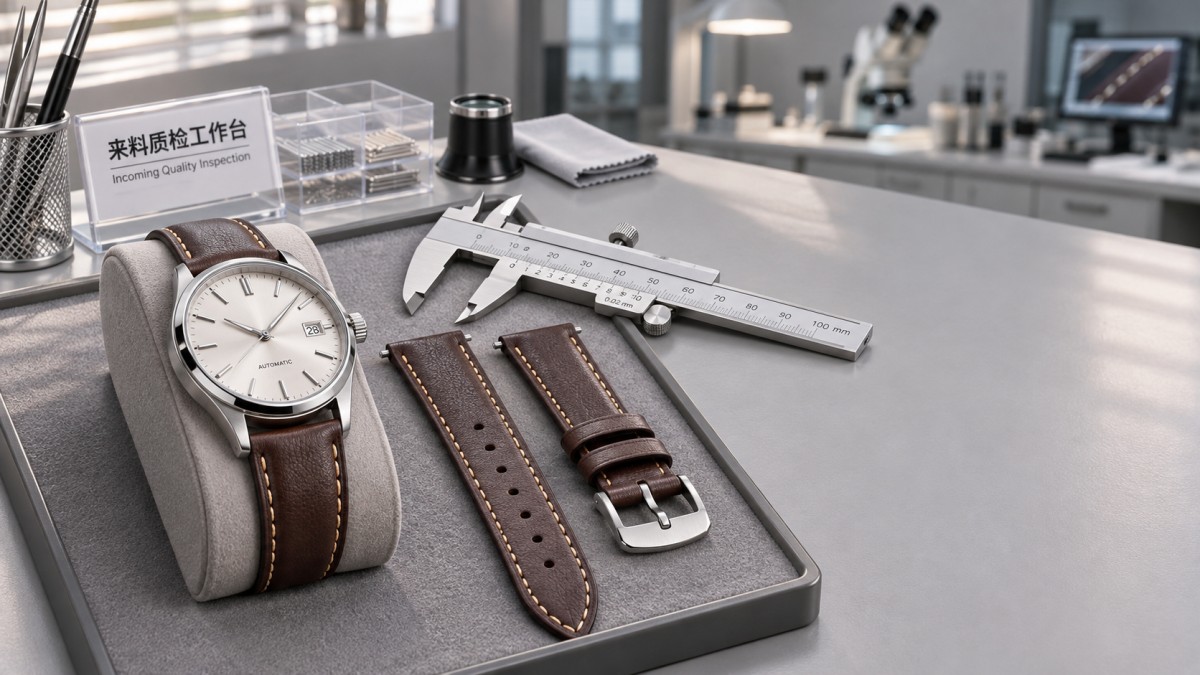
Look closely at areas that take repeated stress
Examine the points where materials join and loads are transferred: strap ends, buckle holes, stitching around keepers, bracelet links, pins, and clasp hinges. Check for uneven assembly, protruding pin ends, loose components, cracks, and sharp edges. Flex a strap in the way it is intended to bend and observe whether layers separate or the surface shows immediate damage. Avoid treating a destructive bend test as a pass-or-fail requirement unless the method has been agreed in advance.
Check adjustability as well. If the strap has punched holes, are they clean and correctly spaced? If a bracelet uses removable links, can they be adjusted with the specified tool without damaging the finish? A product may function in the sample room yet create returns if customers or retailers cannot size it reliably.
Assess materials and finish against the specification
Visual inspection can reveal defects, but it cannot establish every material claim. Ask the supplier to identify the material of each customer-relevant component, including the base metal beneath any coating, the strap’s outer surface and lining, and the composition of parts that contact skin. For leather, clarify which layers are leather and whether a backing or coating is used. For silicone, rubber, or coated fabric, ask for the agreed material description rather than relying on appearance or feel.
Inspect the sample under consistent lighting and compare it with an approved color or finish reference. Look across the product, including edges and less visible surfaces, for scratches, pits, stains, uneven coating, exposed adhesive, color variation, or inconsistent grain. On stitched products, inspect both sides: a neat top line can conceal skipped stitches or poorly secured thread ends underneath.
Define cosmetic limits according to where the accessory will be seen and sold. A small mark on a concealed surface may be acceptable for one order and unacceptable for another. Record the location and size of representative defects, then agree on what is acceptable. Photographs help with communication, but retain physical references where texture, color, or reflectivity would be difficult to judge on screen.
If the specification includes coating durability, material composition, skin-contact restrictions, or other regulated properties, request relevant documentation and arrange testing where appropriate for the product and destination market. Check that any report identifies the material or component being purchased, the test method, and the sample tested. A report for a different finish or a certificate concerning the supplier’s management system does not by itself prove that the ordered accessory meets a product requirement.
Use handling and durability checks that reflect actual use
Simple checks can expose obvious weaknesses before a buyer pays for formal testing. Operate clasps, quick-release mechanisms, zippers, or hinges repeatedly using a consistent method. Flex straps at their normal working points, check whether keepers stay in position, and look for loosening after adjustment. Record what was done and what changed; an unexplained statement that a sample “passed testing” is difficult to compare with later results.
For higher-volume orders or products with demanding claims, agree on a documented test plan before production. It should state the test method, sample quantity, conditions, acceptance limits, and who will conduct the test. Depending on the accessory, the plan might address attachment strength, clasp retention, abrasion, corrosion resistance, or color transfer. Choose requirements that reflect intended use and the materials involved; a test suitable for a metal bracelet may damage a leather strap without producing a useful comparison.
Do not infer long-term durability from a few minutes of handling. A short inspection is useful for screening visible and functional problems; it cannot establish service life. If a sample fails, identify whether the supplier will change the design, material, or process, then inspect and test a revised sample against the same agreed criteria.
Compare more than one sample and inspect the packaging
A single well-finished piece shows what the supplier can make once. Request multiple samples when the order value, product complexity, or quality risk justifies it. Compare dimensions, color, fit, stitching, hardware operation, and finish across the pieces. Variation between samples may indicate that the specification needs tighter controls or that a process requires attention before production.
If the order includes several sizes, colors, or hardware options, decide which variants need separate review. A black leather strap does not establish the color consistency of a tan version, and a sample with one clasp design cannot validate a different closure. Prioritize variants where material, tooling, construction, or finishing changes could affect performance.
Check the packaging supplied with the sample against the intended shipment and sales format. Confirm that the accessory is protected from rubbing, that metal parts cannot easily scratch adjacent surfaces, and that labels, quantities, and barcodes match the order requirements. If watches or straps will be packed in sets, inspect a complete set. A protective sleeve that works for one item may be inadequate when several pieces move together in a carton.
Turn the approved sample into a production control
Document the inspection in a shared record. Include the supplier and product reference, sample date, measured dimensions, photographs, functional observations, test results, packaging details, and the status of each issue. Separate defects that must be corrected before approval from observations that are acceptable within agreed limits.
When both parties agree on the final version, identify it clearly as the approved reference sample and retain a corresponding reference with each party where practical. Link it to the purchase specification and confirm which features the physical sample controls, such as color and finish, and which are governed by written measurements or test requirements. State how proposed substitutions or process changes will be submitted for approval.
Approval should also specify how production will be checked. Depending on the order, that may include a pre-production sample, checks during manufacturing, and a final inspection using an agreed sampling plan and defect criteria. The supplier should know what will happen if production goods differ from the reference: whether they will be sorted, reworked, replaced, or otherwise resolved under the purchase agreement.
A sample that looks right but cannot be tied to a clear specification leaves too much open to interpretation. Approve it when the product fits its intended use, the evidence supports the claims that matter, and both buyer and supplier can identify the standard the production order must meet.
 South Korea's Car Imports From China and Trade Deficit Hit RecordsSouth Korea’s car imports from China and automotive trade deficit hit records. Explore how Shanghai-made Tesla EVs are reshaping bilateral trade.
 How to check if supplier verification reports are authenticVerify supplier verification reports with confidence. Learn how to confirm the issuer, match supplier details, spot red flags, and reduce purchasing risk.
 Mexico’s President Seeks US Trade Deal at December Miami G20 SummitMexico–US trade deal talks could reach a turning point at the December Miami G20 summit. Explore what a potential agreement may mean for cross-border business.
 How to assess data quality in export market analysis servicesCompare export market analysis services with confidence. Learn how to evaluate data sources, coverage and forecasts before committing to a new market.
 Li Qiang Calls for Digital and Green Cooperation at China-Thailand Business MeetingLi Qiang calls for China-Thailand cooperation in digital and green sectors, highlighting opportunities in AI, new energy and agriculture.
 How are life sciences different from healthcare?Life sciences and healthcare overlap, but how do they differ? Explore their roles, real-world examples, and what the distinction means for sourcing.
 How is resale changing the UK apparel and fashion market?Explore how resale is reshaping apparel and fashion in UK markets, from shifting customer demand to pricing, sourcing and opportunities for brands.
 China's Trade Reaches 44.81 Trillion Yuan in First 10 Months, Up 20%China's trade reportedly reached 44.81 trillion yuan in the first 10 months, up 20%. Explore the implications for sourcing, technology exports and ASEAN markets.
 China Extends Pause on 24% US Tariff as US Extends Product ExclusionsChina-US tariffs: China extends its 24% tariff pause while the US extends 178 product exclusions. Discover what the measures mean for trade costs and planning.
 How to verify a mass production supplier’s capacityVerify a mass production supplier’s true capacity with practical checks for production records, available resources, quality controls and delivery readiness.
 He Lifeng Holds Trade Video Call with US Treasury Secretary and Trade RepresentativeHe Lifeng discusses China-US trade restrictions with US officials. Explore what the call could mean for exporters, buyers and supply chains.
 U.S. Trade Deficit Narrows to $105 Billion in September 2026U.S. trade deficit narrowed to $105 billion in September 2026 as exports rose 1.9%. Explore what the latest figures reveal about trade flows.
 How to verify international trade intelligence updatesVerify international trade intelligence updates with practical checks for sources, regulations, trade data, and disruptions. Turn complex claims into reliable insights.
 How investors can assess cyclicality in the manufacturing industryManufacturing industry analysis for investors: learn to assess cyclical demand, cash flow and downside risks to make more informed investment decisions.
 US ISM Manufacturing PMI Rises to 55.5% in October, Beating ForecastsUS ISM Manufacturing PMI rose to 55.5% in October 2026, beating forecasts. Explore what stronger orders and production could mean for manufacturers.
 China Manufacturing PMI Falls to 49.3 in OctoberChina manufacturing PMI fell to 49.3 in October, signaling renewed contraction. Explore the role of weak export orders and domestic demand.
 Can you trust flexible packaging market intelligence forecasts?Can you trust flexible packaging market intelligence forecasts? Learn how to verify sources, challenge assumptions, and assess demand before making costly investment or sourcing decisions.
 When is supply chain disruption management consulting worth the cost?When is supply chain disruption management consulting worth the cost? Learn how to compare fees, avoidable losses, and recovery options to make a confident investment decision.
 How to use macroeconomic analysis to forecast industrial demandApply an industrial macro analysis methodology to forecast demand, interpret economic signals, and plan inventory and capacity. Discover practical steps for smarter business decisions.
 How to assess Singapore suppliers with global supply chain intelligenceExplore international supply chain intelligence Singapore buyers can use to verify suppliers, assess capabilities and delivery risks, and make confident sourcing decisions.
 Which macroeconomic indicators help forecast U.S. industrial demand?Explore industrial macro analysis USA decision-makers can use to forecast demand. Track new orders, inventories, and credit signals to sharpen procurement and capacity decisions.




















Global Trade Insights & Industry
Our mission is to empower global exporters and importers with data-driven insights that foster strategic growth.
Search News
Popular Tags
Industry Overview
The global commercial kitchen equipment market is projected to reach $112 billion by 2027. Driven by urbanization, the rise of e-commerce food delivery, and strict hygiene regulations.