

What Evidence Supports a Claim for Car Batteries Damaged in Transit?
A credible claim for car batteries damaged in transit needs evidence of more than damaged goods. It must identify the affected shipment, establish the batteries’ condition at delivery, connect the damage to the period of transport, and substantiate the amount claimed. Photographs and a delivery receipt are important, but they become much stronger when supported by dispatch records, shipment identifiers, a documented inspection, and an itemized loss calculation.
The most important distinction is between proving damage and proving responsibility. A cracked battery case may clearly demonstrate physical damage without establishing when it occurred. A failed electrical test may show that a battery is unusable without proving transport caused the failure. The strongest evidence closes these gaps rather than simply adding more photographs.
What each piece of evidence actually proves
Different records answer different questions. No single document reliably establishes the shipment’s identity, the cause of damage, the responsible party, and the recoverable loss.
A practical evidence file therefore needs a consistent link between the consignment, the affected pallet or carton, the individual batteries where identifiable, and the claimed costs. An invoice for one shipment and photographs of unidentified batteries leave a gap even if both documents are genuine.
Visible damage and concealed damage need different support
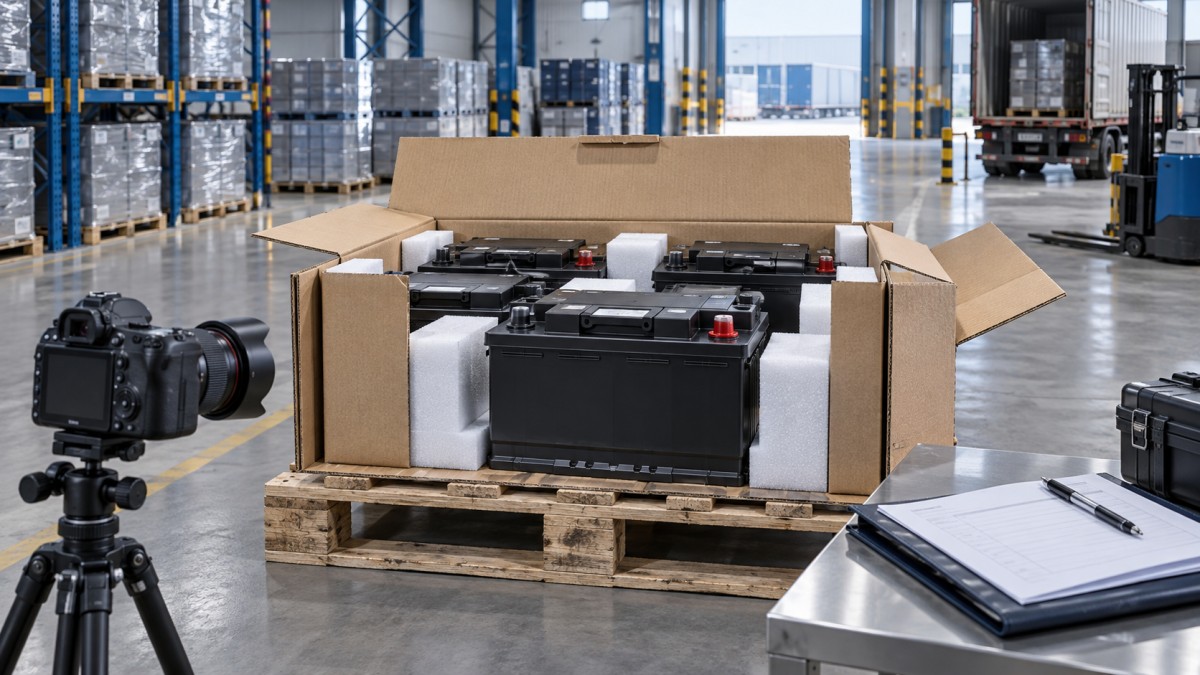
Visible damage gives the receiving team an opportunity to create evidence while the goods remain at the handover point. Before unpacking changes the scene, record the container or vehicle identifier, seal condition, pallet arrangement, broken restraints, crushed cartons, wet packaging, and any visible leakage. Photograph the overall load before moving closer to individual defects.
The delivery receipt should describe observations rather than conclusions about liability. “Two pallets leaning, cartons crushed on lower tier, liquid visible beneath pallet B” is more useful than “damaged shipment.” Identify affected handling units and quantities where this can be done safely. If the driver or receiving system will not accept an exception, document that fact and send written notice through the relevant claims channel promptly.
Concealed damage requires a stronger chronology. When the outside packaging appears intact but damage emerges during unpacking, preserve the opening sequence: receipt time, storage location, unpacking time, people present, and when the defect was discovered. Photographs showing undisturbed packaging, internal cushioning, and the battery’s position help address whether damage could have occurred after delivery.
A clean delivery receipt is not necessarily conclusive evidence that the batteries were undamaged internally. However, it can make the condition-at-delivery argument harder. Conversely, noting visible damage does not replace a formal claim or prove that every unit on the shipment is a total loss.
Physical defects are easier to observe than electrical failures
Cracked cases, broken terminals, displaced batteries, and damaged restraints can create a coherent physical damage pattern. The evidence is particularly persuasive when the defects align with packaging damage—for example, crushed corner packaging alongside case damage on batteries in that same position. This supports a causal explanation, although it does not by itself exclude inadequate packaging or pre-existing defects.
Electrical deterioration is more difficult to attribute. A low open-circuit voltage alone is not proof of transit damage. State of charge, storage duration, temperature, prior condition, and measurement procedure can affect the result. For starter batteries, a voltage reading also does not establish available starting performance.
Where functional failure is central to the claim, a qualified report should identify the battery model and chemistry, serial or batch numbers, test equipment, test conditions, applicable manufacturer criteria, and measured results. It should distinguish observed facts from proposed causes. A statement such as “failed the specified performance test” is narrower—and more defensible—than an unsupported statement that vibration during shipment caused internal failure.
Dispatch test records provide a useful comparison only when they are traceable to the shipped units and sufficiently comparable to receiving tests. Different procedures or states of charge can produce results that cannot be interpreted as a simple before-and-after deterioration.
Battery chemistry changes how evidence can be collected
Evidence preservation must not create a safety incident. Flooded lead-acid batteries can present corrosive electrolyte and electrical hazards. AGM and other valve-regulated lead-acid designs still require assessment for case damage, leakage, and terminal faults. Lithium-ion automotive batteries or modules introduce additional concerns, including delayed thermal events after mechanical damage.
Do not charge, load-test, open, or move a visibly compromised battery merely to strengthen a claim. Follow manufacturer instructions, site emergency procedures, and applicable dangerous-goods requirements. Abnormal heat, swelling, smoke, leakage, or damaged high-voltage components require an appropriate safety response, not routine receiving inspection.
Where isolation is necessary, record what was moved, by whom, when, and why. Preserve packaging and damaged components only where safe and lawful. Ask the carrier or insurer for inspection and disposal instructions, but do not delay urgent protective measures while waiting for approval. If immediate disposal is required, retain the available photographs, professional assessment, disposal documentation, and explanation of the safety necessity.
Returning damaged batteries can involve different transport requirements from shipping undamaged stock. A return authorization is not, by itself, confirmation that the proposed packaging, carrier, or route is suitable.
Carrier, insurance, and supplier claims overlap—but are not interchangeable
The same damage file may support several routes to recovery, but each route asks a different contractual question. Notifying one party should not be assumed to preserve rights against another.
Incoterms can help establish where risk transfers between seller and buyer when properly incorporated into the sale contract. They do not independently decide carrier liability, insurance coverage, or whether a battery had a manufacturing defect. Review the named place, the agreed rule and version, and any additional contractual provisions.
A freight forwarder’s role also matters: it may act as an agent or as a contracting carrier. The company that arranged transport is not automatically responsible on the same basis as the company that physically moved the goods. Keep booking confirmations, forwarding terms, bills of lading, air waybills, consignment notes, and relevant subcontracting information together.
Insurance recovery and carrier recovery can differ because policy valuation, deductibles, exclusions, and carriage liability limits operate differently. Preserve potential recovery rights and consult the insurer before signing a release or agreeing to a settlement that could affect its position.
Showing when and how the damage occurred
A useful chronology compares the last reliable evidence of sound condition with the first reliable evidence of damage. Dispatch photographs, loading records, pallet identifiers, seal numbers, warehouse receipts, and transfer inspections can narrow that interval. Each record should be associated with a date, location, and identifiable shipment.
Pre-shipment photographs are strongest when they show both the goods and their transport preparation. Images of batteries before packing say little about whether the completed pallet had adequate restraints, terminal protection, or load support. Likewise, an intact container seal can support the absence of unauthorized opening without proving that the cargo avoided shocks, compression, or poor securing.
Impact indicators, tilt indicators, and data loggers may add support if their placement, activation, timestamps, and shipment association are documented. They do not automatically prove causation. A triggered indicator records a defined event or threshold response; explaining the battery damage still requires assessment of the load and defect pattern.
Retain original image and video files rather than only annotated screenshots. Keep correspondence, inspection notes, and revised reports with their dates. If samples go to a laboratory, document their identifiers, collection, storage, and transfers so that test results remain connected to the claimed goods.
Substantiating the financial loss
The loss schedule should distinguish physically damaged units, units rejected on documented technical or safety grounds, and unaffected stock. A damaged pallet does not automatically justify claiming every battery on it. Equally, intact-looking batteries should not be declared saleable solely because their cases appear sound.
List each affected model or batch, quantity, supported unit value, and proposed disposition. Attach the commercial invoice and supporting records for inspection, segregation, permitted reconditioning, disposal, or replacement costs. Identify freight, duties, taxes, and other charges separately; their recoverability depends on the policy, contract, and applicable law.
Where repair or reconditioning is proposed, explain why it is technically acceptable and how its cost compares with replacement. Where replacement is necessary, support that conclusion with manufacturer guidance or a qualified assessment. A quotation demonstrates an expected cost, while an invoice and payment record demonstrate expenditure; label them accordingly.
Account for legitimate salvage value and avoid claiming the same loss twice. Lost sales, reputational harm, and downstream penalties require a separate contractual and evidential basis and should not simply be added to the damaged-goods invoice.
Notice deadlines and inspection rights can determine the outcome
Notification requirements depend on the transport mode, route, governing terms, applicable legal regime, and insurance policy. Visible and concealed damage may have different requirements. There is no universal deadline that safely applies to every cross-border battery shipment.
Send preliminary written notice promptly, even if testing and valuation are incomplete. Identify the shipment, delivery date, observed damage, estimated affected quantity, and location of the goods. State that investigation is continuing, request inspection instructions, and retain evidence of transmission and receipt. A preliminary notice may preserve an opportunity to claim, but it is not necessarily a compliant formal claim.
Check separately the deadlines for damage notice, the documented monetary claim, and any legal proceedings. These are not interchangeable. Arrange access for inspection where required, without leaving unsafe batteries in place or allowing avoidable deterioration.
The decisive question is whether another party can reconstruct the loss from the file: which batteries were affected, what condition they were in, when the damage appeared, why transport is implicated, and how the amount was calculated. Specific delivery observations, traceable records, qualified technical findings, and supported costs make that reconstruction possible. A large collection of disconnected photographs does not.
 China Manufacturing PMI Falls to 49.3 in OctoberChina manufacturing PMI fell to 49.3 in October, signaling renewed contraction. Explore the role of weak export orders and domestic demand.
 Can you trust flexible packaging market intelligence forecasts?Can you trust flexible packaging market intelligence forecasts? Learn how to verify sources, challenge assumptions, and assess demand before making costly investment or sourcing decisions.
 When is supply chain disruption management consulting worth the cost?When is supply chain disruption management consulting worth the cost? Learn how to compare fees, avoidable losses, and recovery options to make a confident investment decision.
 How to use macroeconomic analysis to forecast industrial demandApply an industrial macro analysis methodology to forecast demand, interpret economic signals, and plan inventory and capacity. Discover practical steps for smarter business decisions.
 How to assess Singapore suppliers with global supply chain intelligenceExplore international supply chain intelligence Singapore buyers can use to verify suppliers, assess capabilities and delivery risks, and make confident sourcing decisions.
 Which macroeconomic indicators help forecast U.S. industrial demand?Explore industrial macro analysis USA decision-makers can use to forecast demand. Track new orders, inventories, and credit signals to sharpen procurement and capacity decisions.
 Can a food processing manufacturer meet your small-batch needs?Can a food processing manufacturer meet your small-batch needs? Discover how to assess minimum orders, costs, packaging, and safety to choose the right partner for your launch.
 How to verify sourcing intelligence data before selecting suppliersVerify sourcing intelligence data before choosing suppliers. Learn how to check company records, certifications, and capacity to reduce procurement risk and build a reliable shortlist.
 How to use supplier risk analysis to spot financial warning signsUse supplier risk analysis to spot cash flow pressure, debt risks, and delivery warning signs. Learn practical steps to reduce exposure and protect supply continuity.
 When dual sourcing makes sense in a sourcing strategy for manufacturersSourcing strategy for manufacturers: learn when dual sourcing strengthens supply continuity, reduces disruption risk, and protects production without adding unnecessary complexity.
 How bulk commodities pricing affects long-term supply contractsBulk commodities pricing shapes long-term supply contracts through index rules, freight, quality, volume, and currency risk. Explore strategies for resilient costs and supply security.
 Which global manufacturing trends by sector matter most for sourcing plans?Global manufacturing trends by sector: identify sourcing risks, supplier resilience, compliance demands, and cost drivers to build smarter, more reliable procurement plans.
 What industrial trade intelligence pricing should include before you subscribeIndustrial trade intelligence pricing explained: compare coverage, data quality, access rights, and workflow value before choosing a subscription that supports smarter trade decisions.
 How an industrial trade intelligence dashboard can identify new supplier marketsDiscover how an industrial trade intelligence dashboard helps identify new supplier markets by comparing capacity, landed cost, logistics resilience, and compliance risk.
 Which global market entry barriers should exporters assess first?Global market entry barriers exporters should assess first: tariffs, compliance, buyer qualification, logistics, and payment risk. Build a practical strategy for confident market entry.
 How trade data aggregation analytics can reveal emerging supplier marketsTrade data aggregation analytics reveals emerging supplier markets by connecting trade flows, capacity signals, logistics, and compliance insights for smarter sourcing decisions.
 When an export market analysis platform can validate demand in a new marketExport market analysis platform insights help validate new-market demand through buyer fit, regulations, logistics, competition, and profitable entry conditions.
 What is driving the beauty and personal care market in the USA?Beauty and personal care in USA is driven by targeted solutions, selective premiumization, digital discovery, clean-label trust, diverse needs, and compliance. Explore key growth opportunities.
 How trade flow monitoring reports reveal changing regional demandTrade flow monitoring reports reveal changing regional demand through import volumes, sourcing shifts, product mix, logistics signals, and regulatory trends. Explore actionable market insights.
 How international market intelligence for investors reduces market-entry riskInternational market intelligence for investors reduces market-entry risk by validating demand, regulations, logistics, and competition before capital is committed.
 How international sourcing intelligence helps identify supplier risk earlyInternational sourcing intelligence helps businesses spot supplier risks early, protect supply continuity, and make smarter global procurement decisions.


Global Trade Insights & Industry
Our mission is to empower global exporters and importers with data-driven insights that foster strategic growth.
Search News
Popular Tags
Industry Overview
The global commercial kitchen equipment market is projected to reach $112 billion by 2027. Driven by urbanization, the rise of e-commerce food delivery, and strict hygiene regulations.