

Healthcare Management Consulting or In-House Change Team?
When healthcare organizations face complex transformation, the choice between healthcare management consulting and an in-house change team can shape speed, cost, and long-term outcomes. For business evaluators, the best option is rarely ideological. It depends on urgency, internal capability, regulatory complexity, and the level of measurable value the organization expects from change.
In most cases, consulting firms create faster momentum, broader cross-market insight, and stronger execution discipline for high-stakes initiatives. In-house teams usually offer better institutional continuity, lower long-run cost, and stronger internal adoption. The right decision comes from matching the change model to the organization’s risk profile, strategic timeline, and operating realities.
What business evaluators are really trying to decide
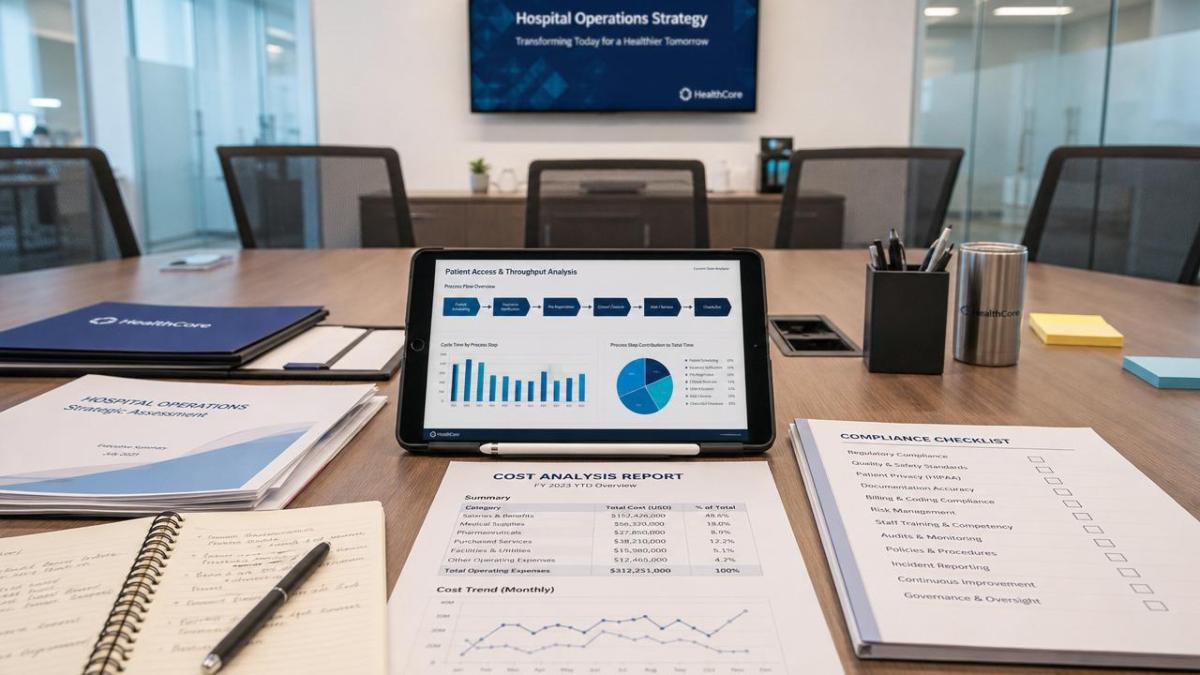
People searching for healthcare management consulting versus an in-house change team are usually not looking for a theoretical comparison. They want a practical way to judge which model will deliver safer transformation, better economics, and clearer accountability.
For business evaluators, the real question is not simply who can manage change. It is who can reduce disruption while improving results in areas such as cost control, care operations, digital adoption, patient flow, compliance readiness, and leadership alignment.
This is why a useful evaluation must focus on decision quality. Who brings the right expertise at the right time? Which model creates measurable business value? Which one carries hidden costs? Which one leaves the organization stronger after the initiative ends?
When healthcare management consulting creates the strongest advantage
Healthcare management consulting is often most valuable when the organization faces a transformation that is urgent, complex, politically sensitive, or outside its current experience. Consultants are typically brought in when speed and specialized knowledge matter more than preserving internal comfort.
Examples include post-merger integration, revenue cycle redesign, enterprise digital transformation, clinical operations turnaround, cost reduction programs, value-based care preparation, and market expansion. In these situations, external advisors can offer structured methodologies that internal teams may not have used before.
Consultants also bring benchmarking power. Because they work across clients, markets, and functional models, they can compare current performance against stronger operators. That perspective helps leadership identify whether a problem is truly unique or simply a known industry pattern with proven solutions.
Another major benefit is executive focus. External teams are not pulled into routine meetings, daily interruptions, or internal politics in the same way employees are. This can help large programs maintain pace, governance, and milestone discipline when internal attention is fragmented.
Healthcare management consulting can also be useful when credibility matters. Sometimes a board, investor group, or senior executive team needs an independent assessment before committing capital. A respected external advisor can provide a neutral business case and increase confidence in difficult decisions.
Where an in-house change team has a clear edge
An in-house change team often performs better when transformation depends on deep organizational trust, detailed process familiarity, and ongoing cultural reinforcement. Healthcare systems are complex social environments, and internal teams usually understand unwritten rules that outsiders need time to learn.
They know which leaders influence adoption, where previous initiatives failed, how frontline teams respond to change, and which legacy constraints are negotiable. This local knowledge can materially improve implementation quality, especially in organizations with strong internal talent and stable leadership.
Internal teams also support continuity. Once consultants leave, execution still needs owners. An in-house team remains accountable for reinforcement, KPI monitoring, workflow adjustment, and cross-functional coordination. That makes this model attractive for multi-year change programs rather than rapid diagnostic interventions.
Cost can be another advantage, especially if change capability already exists. While building an internal team requires investment in skills, tools, and governance, the long-term economics may be favorable when transformation is recurring rather than one-time. For systems expecting constant improvement, institutional capability matters.
Finally, internal teams often generate stronger employee buy-in. Staff can perceive external consultants as temporary evaluators or cost-cutting agents. Internal change leaders may face less resistance if they are seen as partners in operational improvement rather than outsiders imposing an external model.
The cost question: headline fees versus total business economics
Many decisions start with visible expense. Healthcare management consulting often appears more costly because fees are immediate, concentrated, and easy to compare against salary budgets. In-house teams appear cheaper because costs are distributed across payroll, management attention, and internal infrastructure.
That comparison is incomplete. Business evaluators should examine total economics, not just invoice amounts. A cheaper model that delays benefits, misses targets, or causes execution drift may be more expensive in real terms than a consulting engagement with higher upfront fees.
Important cost dimensions include speed to value, opportunity cost, risk of failure, leadership distraction, retraining expense, technology adoption lag, and the cost of weak accountability. In healthcare, delayed improvement in throughput, payer performance, staffing efficiency, or patient access can quickly outweigh consulting fees.
Internal teams also carry hidden costs. Key employees may be reassigned from operational roles, creating backfill needs or performance gaps elsewhere. If staff lack transformation experience, the organization may spend months learning while critical improvement opportunities remain unrealized.
The most useful financial test is this: which model produces the best risk-adjusted return on change? That means estimating not only implementation expense but also the probability, timing, and durability of outcomes. For business evaluators, this framing is more accurate than simple cost comparison.
Speed, expertise, and execution discipline: where the real differences appear
In high-pressure healthcare environments, the biggest gap between external and internal teams often appears in speed and execution rigor. Consulting teams usually arrive with frameworks, templates, PMO structures, and predefined workstreams that allow a program to start quickly.
They can compress diagnosis, stakeholder interviews, data review, governance design, and implementation planning into a shorter timeline. For organizations facing margin pressure, regulatory deadlines, or strategic windows, this acceleration can be decisive.
In-house teams tend to move more slowly at the beginning, particularly if they must align multiple leaders while also carrying operational responsibilities. However, once mobilized, they may execute with stronger cultural awareness and fewer assumptions about how the organization actually works.
Expertise is also different in nature. Consultants usually offer broad pattern recognition and external best practice. Internal teams offer contextual intelligence and stronger knowledge of operational realities. One is not universally better. The value depends on whether the challenge is unfamiliar complexity or internal adaptation.
Execution discipline matters as much as expertise. Many transformations fail not because the strategy was wrong, but because governance weakened, milestones slipped, and ownership became diffuse. Strong healthcare management consulting firms often reduce this risk through formal program management and executive escalation processes.
Risk, compliance, and stakeholder management in healthcare settings
Healthcare change is not like change in many other sectors. The operating environment includes regulatory oversight, privacy concerns, patient safety implications, clinical autonomy, labor sensitivity, and complex reimbursement structures. Any change model must be evaluated through this lens.
External consultants can help by bringing structured risk management practices and experience from comparable healthcare settings. They may have stronger capabilities in compliance mapping, transformation governance, and issue escalation, which is especially valuable in enterprise-wide redesign efforts.
At the same time, external teams can underestimate organizational sensitivities if they rely too heavily on generic playbooks. In clinical environments, trust and credibility are earned slowly. A recommendation that looks efficient on paper may fail if physicians, nurse leaders, or department heads see it as misaligned with care realities.
In-house teams are often better at stakeholder mapping because they understand the institution’s political landscape. They know where hidden objections may emerge and which voices must be engaged early. That can reduce resistance and improve the likelihood of sustainable adoption.
For business evaluators, the key question is whether the organization’s change challenge is primarily technical, political, or both. Technical complexity tends to favor specialized consulting support. Political and cultural complexity often increases the value of strong internal change leadership.
How to choose: a practical evaluation framework
A strong decision begins with four filters: urgency, capability, strategic importance, and sustainability. If urgency is high and internal capacity is weak, healthcare management consulting is usually the safer route. If urgency is moderate and internal capability is proven, an in-house model may be more efficient.
Next, assess the nature of the problem. Is the initiative a one-time transformation, such as an integration or turnaround, or part of a recurring improvement agenda? One-time, high-impact events often justify external support. Repeatable operational improvement often favors internal capability building.
Then test the organization’s readiness. Does it have experienced change leaders, data access, project governance, and executive sponsorship? If those foundations are weak, an internal team may struggle regardless of commitment. In that case, external support can provide needed structure and momentum.
Business evaluators should also define success in measurable terms before selecting a model. Metrics may include EBITDA improvement, cost-to-serve reduction, patient access gains, revenue cycle performance, clinician adoption rates, implementation speed, compliance outcomes, and retention of new practices after twelve months.
Finally, evaluate knowledge transfer. If consultants are engaged, the contract should not only buy analysis and delivery. It should also build internal capability. If an in-house team is selected, leadership should ensure that members have the authority, training, and protected time needed to execute effectively.
Why the hybrid model is often the smartest answer
For many healthcare organizations, the most effective model is not a strict choice between consulting and internal teams. It is a hybrid structure where consultants provide specialized expertise, acceleration, and external challenge while internal leaders own adoption, continuity, and cultural integration.
This model works especially well when the transformation is large but not purely emergency-driven. Consultants can lead early diagnosis, design the roadmap, and establish governance. Internal teams then co-own implementation and gradually assume more responsibility as the program matures.
The hybrid approach also reduces common failure points. It avoids overdependence on consultants while preventing internal teams from being overwhelmed by unfamiliar complexity. It improves knowledge transfer, strengthens long-term capability, and often creates better buy-in across leadership and frontline functions.
For business evaluators, the hybrid model can also create more attractive economics. External spend is concentrated on high-value phases rather than long-duration substitution. Internal investment is directed toward capability areas that the organization truly needs to retain after the formal transformation ends.
Final assessment: choose the model that best fits the business case
There is no universal winner between healthcare management consulting and an in-house change team. The better option depends on the scale of change, the cost of delay, the maturity of internal capabilities, and the organization’s need for speed, objectivity, and specialized expertise.
If the challenge is urgent, complex, high-risk, or strategically transformative, healthcare management consulting often provides superior value despite higher visible cost. If the organization has strong internal talent, time to build alignment, and a long-term improvement agenda, an in-house team may generate stronger sustainability.
For most business evaluators, the best decision is made by looking beyond labels and testing business fit. Compare not just cost, but speed, execution confidence, stakeholder acceptance, knowledge transfer, and the durability of results. That is where the true return on change is determined.
In healthcare transformation, success rarely comes from choosing the cheaper or more familiar option. It comes from choosing the model that can deliver measurable outcomes with the least strategic risk. That is the standard by which both consulting and internal change teams should be judged.
 Which global manufacturing trends by sector matter most for sourcing plans?Global manufacturing trends by sector: identify sourcing risks, supplier resilience, compliance demands, and cost drivers to build smarter, more reliable procurement plans.
 What industrial trade intelligence pricing should include before you subscribeIndustrial trade intelligence pricing explained: compare coverage, data quality, access rights, and workflow value before choosing a subscription that supports smarter trade decisions.
 How an industrial trade intelligence dashboard can identify new supplier marketsDiscover how an industrial trade intelligence dashboard helps identify new supplier markets by comparing capacity, landed cost, logistics resilience, and compliance risk.
 Which global market entry barriers should exporters assess first?Global market entry barriers exporters should assess first: tariffs, compliance, buyer qualification, logistics, and payment risk. Build a practical strategy for confident market entry.
 How trade data aggregation analytics can reveal emerging supplier marketsTrade data aggregation analytics reveals emerging supplier markets by connecting trade flows, capacity signals, logistics, and compliance insights for smarter sourcing decisions.
 When an export market analysis platform can validate demand in a new marketExport market analysis platform insights help validate new-market demand through buyer fit, regulations, logistics, competition, and profitable entry conditions.
 What is driving the beauty and personal care market in the USA?Beauty and personal care in USA is driven by targeted solutions, selective premiumization, digital discovery, clean-label trust, diverse needs, and compliance. Explore key growth opportunities.
 How trade flow monitoring reports reveal changing regional demandTrade flow monitoring reports reveal changing regional demand through import volumes, sourcing shifts, product mix, logistics signals, and regulatory trends. Explore actionable market insights.
 How international market intelligence for investors reduces market-entry riskInternational market intelligence for investors reduces market-entry risk by validating demand, regulations, logistics, and competition before capital is committed.
 How international sourcing intelligence helps identify supplier risk earlyInternational sourcing intelligence helps businesses spot supplier risks early, protect supply continuity, and make smarter global procurement decisions.
 How trade data aggregation analytics reveals emerging supplier marketsTrade data aggregation analytics reveals emerging supplier markets through export trends, input flows, logistics, and regulatory signals. Discover smarter sourcing insights.
 What industrial cluster monitoring in Vietnam reveals about site riskIndustrial cluster monitoring Vietnam reveals hidden site risks across labor, utilities, logistics, compliance, and supplier dependencies. Make smarter sourcing and expansion decisions.
 Food Technology Trends Reshaping Shelf Life, Safety, and Product InnovationFood technology is reshaping shelf life, safety, and innovation. Discover the trends helping food businesses cut risk, improve compliance, and unlock stronger global market growth.
 How electronics manufacturing services are changing with low-volume demandElectronics manufacturing services are evolving fast with low-volume demand. Learn how agile EMS partners improve flexibility, compliance, sourcing resilience, and speed to market.
 How Can Buyers Reduce Procurement Risks for Electronic Components?How to reduce procurement risks for electronic components: learn how buyers assess traceability, lead times, compliance, and supplier types to avoid costly sourcing mistakes.
 What Sourcing Intelligence India Reveals About Supplier Risk and Cost ShiftsSourcing intelligence India reveals hidden supplier risk, compliance gaps, logistics pressure, and real cost shifts—helping buyers compare vendors smarter and source with more confidence.
 Fashion Trends 2026: Which Materials, Colors, and Silhouettes Are Gaining Ground?Fashion trends 2026 spotlight tactile fabrics, mineral colors, and controlled volume. Explore the materials, shades, and silhouettes shaping smarter, more wearable style.
 Smart Device Market Outlook: Key Growth Drivers, Segments, and Business OpportunitiesSmart device market trends are shifting toward system value, industrial demand, and resilient supply chains. Explore key growth drivers, high-potential segments, and business opportunities.
 How Global Trade Intelligence Services Help B2B Firms Evaluate Markets and SuppliersGlobal trade intelligence services help B2B firms compare suppliers, assess market potential, and uncover compliance, logistics, and pricing risks before costly decisions are made.
 Manufacturing Sector Updates for Investors: What Signals Matter Most in 2025?Manufacturing sector updates for investors in 2025: track orders, margins, supply chains, regulation, and exports to spot resilient manufacturers and smarter investment signals.
 How Energy Market Intelligence Helps Businesses Track Price Risks and Demand ShiftsEnergy market intelligence helps businesses spot price risks, demand shifts, and supply pressure early—improving procurement, resilience, and faster strategic decisions.





















Global Trade Insights & Industry
Our mission is to empower global exporters and importers with data-driven insights that foster strategic growth.
Search News
Popular Tags
Industry Overview
The global commercial kitchen equipment market is projected to reach $112 billion by 2027. Driven by urbanization, the rise of e-commerce food delivery, and strict hygiene regulations.