

Choosing an industrial transformer supplier in 2026 requires more than comparing quoted prices and rated capacity. Buyers need evidence of suitability, quality, and delivery reliability.
Start by rejecting technically unsuitable offers, then compare documented performance, total ownership costs, and execution risks. A weighted score should support this process after qualification.
A practical industrial transformer supplier comparison 2026 framework helps procurement teams distinguish documented capabilities from sales claims and identify risks before committing to an order.
This guide gives sourcing managers, electrical engineers, and purchasing leaders a structured basis for evaluating manufacturing quality, efficiency guarantees, supply chain resilience, and contract terms.
Are Suppliers Quoting the Same Transformer Requirements?
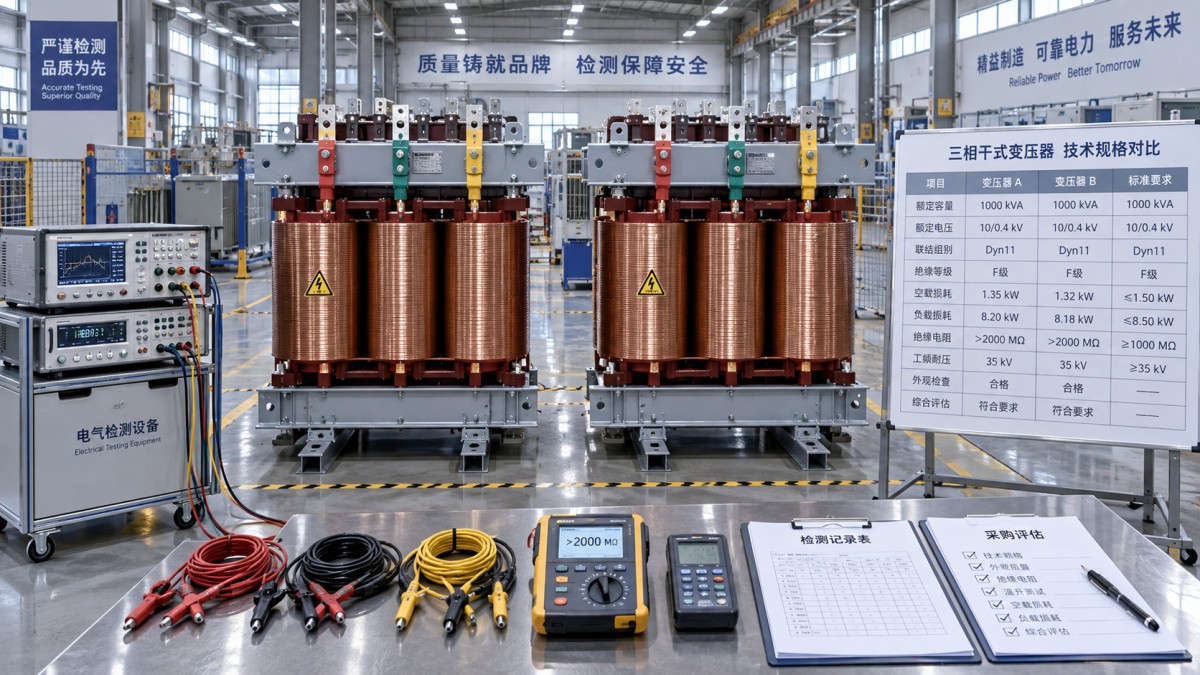
The first comparison problem is often inconsistent specifications. Suppliers may quote different cooling arrangements, insulation systems, accessories, or testing scopes while appearing to offer equivalent equipment.
Create one technical requirement sheet before requesting prices. Include rated power, primary and secondary voltages, frequency, phase configuration, vector group, impedance, and required tapping arrangements.
Describe the installation environment: ambient temperature, altitude, humidity, contamination, ventilation, enclosure requirements, and indoor or outdoor location. These conditions can change design requirements and usable capacity.
Explain the actual load profile, including operating hours, expected expansion, motor starting, variable frequency drives, and other nonlinear loads. Nameplate capacity alone cannot establish suitability.
For harmonic-rich applications, request an assessment of additional heating and any required derating. Avoid accepting a generic claim that a transformer is suitable for industrial use.
Compare liquid-filled and dry-type options against fire requirements, maintenance access, environmental constraints, and site conditions. The appropriate choice depends on the installation and operating priorities.
Require a written deviation schedule with every quotation. Each exception should identify its technical effect, commercial consequence, and proposed resolution before the offer enters final evaluation.
Which Compliance Documents Actually Apply to Your Project?
Ask suppliers to identify the standards, editions, and local requirements governing the offered equipment. A broad statement such as “IEC compliant” leaves important questions unanswered.
Depending on product type and destination, relevant references may include the IEC 60076 series, IEEE C57 standards, and applicable national safety or energy efficiency requirements.
These frameworks are not interchangeable. Confirm which requirements govern design, testing, installation approval, and market access, using the destination jurisdiction and project specification as references.
ISO 9001 certification describes a quality management system; it does not establish that a particular transformer meets your electrical performance requirements or destination market rules.
Likewise, a CE marking should not be treated as independent product approval. Where applicable, review the declaration, relevant legislation, and supporting conformity documentation carefully.
For 2026 orders, verify requirements against manufacturing, import, and commissioning dates. Published future rules may affect planning without yet applying to equipment delivered this year.
Request certificate numbers, issuing bodies, validity periods, and covered manufacturing locations. Check whether the evidence covers the offered product family, factory, and proposed configuration specifically.
What Evidence Proves Manufacturing Quality and Performance?
Prioritize reports linked to the proposed design and explainable test procedures. A polished certificate package offers limited value if its scope excludes the equipment being purchased.
Ask how routine tests will verify winding resistance, voltage ratio, phase displacement, impedance, losses, and dielectric performance, according to the agreed standard and equipment type.
Review relevant type-test evidence, including temperature-rise testing where required. Establish whether an existing report represents the proposed design or whether additional testing is necessary.
Short-circuit withstand deserves particular attention for critical installations. Agree on acceptable evidence, which may involve applicable test reports, design validation, or calculations under governing requirements.
Factory capability should be visible through material traceability, calibrated instruments, inspection records, and controlled production processes. Request evidence for the actual manufacturing site being proposed.
Ask suppliers to document conductor materials, insulation systems, core materials, and approved substitution procedures. Material substitutions can affect losses, temperature rise, dimensions, and delivery schedules.
For higher-risk purchases, arrange a factory acceptance test with agreed witness points and acceptance criteria. Specify reporting, failure resolution, retesting costs, and shipment release conditions.
How Can Buyers Compare Lifecycle Cost Fairly?
Evaluate purchase price alongside electrical losses, installation costs, maintenance, spare parts, and potential downtime. A cheaper transformer can become more expensive over its operating life.
Request guaranteed no-load and load losses, with reference conditions and contractual tolerances clearly stated. Catalog efficiency percentages alone are insufficient for comparing different duty profiles.
A simplified annual loss estimate uses no-load loss multiplied by energized hours, plus rated load loss multiplied by squared loading fraction and corresponding operating hours.
For illustration, assume 2 kW no-load loss, 12 kW rated load loss, continuous energization, and constant 60% loading. Estimated annual losses equal approximately 55,363 kWh.
At an assumed electricity price of $0.12 per kWh, those losses cost approximately $6,644 annually. These illustrative inputs are not market benchmarks or supplier performance claims.
Real facilities have changing loads. Use time intervals or a load-duration profile, and account for applicable temperature corrections, auxiliary consumption, and tariff structure where relevant.
Compare alternatives over the same evaluation period using discounted costs. Test sensitivity to electricity prices and utilization, then specify remedies if verified losses exceed guarantees.
Is the Delivery Promise Supported by a Credible Production Plan?
A quoted lead time becomes useful when its starting point and assumptions are clear. Separate engineering approval, material procurement, manufacturing, testing, dispatch, and transport milestones.
Ask whether the production slot is reserved and which components constrain the schedule. Core steel, conductors, bushings, tap changers, or specialist accessories may require scrutiny.
Request current evidence of material availability and recent delivery performance on comparable orders. Avoid treating an attractive standard lead time as a confirmed project commitment.
Review alternative sourcing arrangements and substitution controls together. Backup components improve resilience only when their use preserves agreed technical performance and receives the required approval.
For imported equipment, define the named place and Incoterms version precisely. Allocate export handling, insurance, customs clearance, inland transport, unloading, and site access responsibilities explicitly.
Verify customs classification, origin documentation, duties, and any applicable trade measures before award. Delivered cost depends on product characteristics, origin, destination, and current customs treatment.
Check dimensions, transport mass, lifting points, packaging, and storage requirements early. Route restrictions or unsuitable unloading equipment can delay installation after the transformer reaches port.
Will Warranty and After-Sales Support Protect Operations?
Warranty length matters less than practical coverage and response capability. Compare the trigger date, exclusions, claim procedure, and responsibility for repair or replacement costs carefully.
Clarify whether coverage includes travel, diagnostics, labor, freight, removal, and reinstallation. A replacement component alone may cover only a fraction of an actual failure expense.
Ask who will commission the equipment and provide local support. Identify service locations, technician availability, escalation contacts, and response commitments appropriate to the site's criticality.
Request a recommended spare-parts list with prices and availability. Proprietary monitoring devices or accessories can create long-term dependence if replacements require extended international shipping times.
For critical processes, assess contingency options such as repair capability, compatible replacement equipment, or a site spare. Match the investment to realistic business interruption exposure.
Supplier references should concern similar voltage classes, applications, operating environments, and destination markets. Ask about installation issues, delivery accuracy, and how service claims were resolved.
Verify installation instructions, commissioning records, maintenance guidance, and as-built documentation as contractual deliverables. Complete records help operators maintain equipment and support future troubleshooting or modifications.
How Should Buyers Score Qualified Suppliers?
Use mandatory qualification gates before weighted scoring. An offer that fails essential electrical requirements, legal obligations, or required safety evidence should not win through price.
After qualification, apply a scorecard reflecting the project. The following example suits an industrial facility where equipment performance and operational continuity carry substantial business value.
Score each category from one to five using defined evidence thresholds. For example, an unsupported delivery promise should receive less credit than a substantiated schedule.
Keep missing evidence visible rather than assuming satisfactory performance. Record open questions, responsible reviewers, and deadlines so the shortlist reflects both capability and remaining uncertainty.
Adjust weights for the application. A remote continuous-process plant may prioritize service access, while a heavily utilized installation may place greater weight on guaranteed losses.
Have engineering, procurement, operations, and finance review the result together. This helps expose assumptions that a single department might overlook during an otherwise orderly comparison.
What Must Be Settled Before Issuing the Purchase Order?
Convert the winning proposal into enforceable obligations. Attach the final specification, approved deviations, drawing requirements, testing plan, delivery milestones, and document list to the contract.
Define acceptance criteria and the process for resolving nonconformities. Agree who authorizes corrective work, how retesting occurs, and which issues prevent shipment or final acceptance.
Structure payments around verifiable milestones appropriate to the transaction. Consider supplier financial stability and available protections when substantial advances are required for a first order.
Address engineering changes and material substitutions explicitly. Require written approval when changes affect specifications, performance, interfaces, price, or schedule, and define how revisions are documented.
Confirm responsibility for unloading, installation checks, commissioning, and operator training. These handoffs frequently determine whether equipment arriving on time becomes equipment operating on time successfully.
Pause the award if essential questions remain unresolved. Pressure to secure a production slot should not override missing compliance evidence, unclear guarantees, or unexplained exclusions.
Choose the Supplier Whose Commitments You Can Verify
The strongest supplier combines technical suitability, credible evidence, competitive lifecycle cost, and dependable execution. The lowest quotation becomes meaningful only after these conditions are established.
For a defensible 2026 decision, use one specification, qualify offers consistently, compare documented costs and risks, and translate the selected supplier's promises into contract terms.
GTIIN's trade intelligence perspective supports this broader evaluation: connect equipment requirements with regional regulation, sourcing conditions, logistics, and service capability before committing procurement funds responsibly.