

What Hotel and Restaurant Supplies Matter Most When Opening a New Property?
When opening a new hospitality property, the hotel and restaurant supplies that matter most are the categories that affect operational readiness, guest experience, compliance, and replacement cost from day one. For procurement teams, the real search intent behind this topic is not a generic list of products. It is a decision framework: which supplies must be prioritized first, which specifications influence long-term performance, where sourcing mistakes usually happen, and how to balance opening speed with quality and budget control.
That means the most important supplies are rarely the most visible ones alone. Kitchen equipment, tabletop items, housekeeping products, room operating essentials, storage solutions, food safety tools, and service support items all shape whether a new property opens smoothly or begins operations with avoidable disruptions. Procurement teams need to identify which categories directly influence service continuity, hygiene standards, labor efficiency, and lifecycle cost.
What matters most when prioritizing hotel and restaurant supplies?
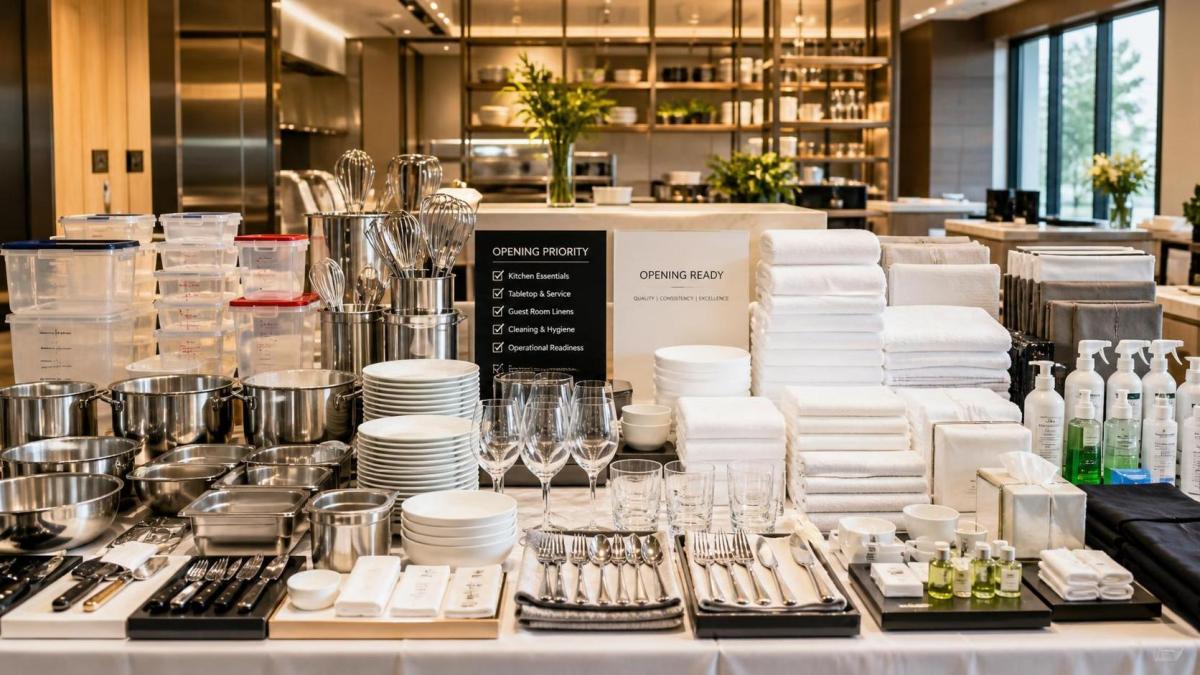
The best way to prioritize hotel and restaurant supplies is to start with operational dependency rather than aesthetics. If an item is essential for serving guests, maintaining hygiene, protecting food safety, or keeping rooms ready for turnover, it belongs in the highest-priority procurement group.
In practical terms, the most important categories usually include back-of-house kitchen essentials, food preparation and storage tools, restaurant serviceware, housekeeping and cleaning supplies, guest room operating items, and receiving or storage equipment. These are the categories that affect opening readiness immediately.
Procurement teams should also separate critical supplies into three levels: must-have for opening day, needed within the first operating cycle, and scalable after occupancy or dining volume becomes clearer. This structure helps reduce rushed purchases and lowers the risk of overbuying nonessential items.
Why kitchen and food-service supplies usually carry the highest opening risk
For properties with restaurants, kitchens, breakfast service, banqueting, or room service, food-service supplies usually require the closest attention. Delays or specification errors in this category can stop service completely, create hygiene issues, or increase labor pressure during the first weeks of operation.
The highest-priority kitchen supplies include cookware, food preparation utensils, knives, chopping boards, food pans, gastronorm containers, storage bins, shelving, temperature-monitoring tools, waste handling products, trays, and cleaning accessories. These are not glamorous purchases, but they determine whether staff can execute service consistently.
Procurement teams should evaluate each item through four questions: Is it food-safe? Is it durable under daily commercial use? Is it compatible with local workflow and equipment sizing? Can it be replenished quickly if damaged or lost? A low-cost product that fails on any of these points may become expensive very quickly.
Another common mistake is focusing heavily on major equipment while underestimating smallwares. Ovens, refrigerators, and dishwashers are visible capex items, but service breakdown often comes from missing preparation tools, insufficient storage containers, poorly selected utensils, or fragile kitchen accessories that cannot withstand volume.
Which restaurant and tabletop supplies most directly affect guest perception?
For front-of-house operations, tabletop and service supplies matter because they shape the guest’s immediate impression of quality, cleanliness, and brand positioning. Plates, bowls, cutlery, glassware, serving pieces, trays, buffet accessories, menu holders, and condiment systems all influence perceived standards.
Procurement should not select these items on appearance alone. The right question is whether the product supports the service model. A business hotel breakfast area, a casual dining outlet, and a premium restaurant will require different levels of durability, presentation, replacement flexibility, and storage efficiency.
Durability is especially important. Glassware breakage, chipped plates, and easily scratched flatware create recurring replacement cost and operational inconsistency. Buyers should compare unit cost with expected usage cycles, stackability, handling resistance, and supplier ability to provide matching replenishment batches later.
Standardization also matters. If tabletop items vary too much across early purchase batches, the property may struggle to maintain a coherent visual identity. Procurement teams should secure sample approvals, define exact finish and dimension tolerances, and confirm whether future reorder consistency can be maintained across production lots.
What room and housekeeping supplies should never be treated as secondary?
In new hotel openings, guest room supplies and housekeeping essentials are often underestimated because they seem easier to source than kitchen or restaurant items. In reality, these categories directly affect room turnaround speed, hygiene perception, and the consistency of the guest stay.
High-priority hotel supplies typically include linens, towels, pillows, mattress protectors, hangers, laundry bags, in-room bins, amenity trays, irons, kettles, hair dryers, housekeeping carts, cleaning cloths, chemical dispensers, waste bags, and storage systems for floor operations.
Procurement teams should pay close attention to material performance and replacement logic. Towels and linens are not simple textile purchases. Absorbency, wash durability, shrinkage control, color stability, and supplier consistency influence both guest satisfaction and operating cost over time.
Housekeeping tools also deserve stronger evaluation. Poor cart design, weak caster quality, unstable storage trays, or incompatible refill systems reduce staff efficiency every day. For labor-intensive operations, these small choices compound into meaningful cost and service differences across the year.
How should procurement teams balance opening budget with long-term operating cost?
The most effective procurement decisions for hotel and restaurant supplies are rarely based on the lowest purchase price. A better approach is to compare total operating value, including durability, replenishment frequency, cleaning efficiency, breakage rate, and compatibility with actual workflow.
For example, a cheaper plate with a higher chip rate may create more replacement cost than a moderately higher-priced product with better edge strength. A low-cost towel with poor wash life may require faster reordering and produce inconsistent guest experience. The same logic applies across kitchen tools, bins, shelving, and service accessories.
Procurement teams should classify supplies by lifecycle sensitivity. High-use, high-loss, and high-visibility products deserve deeper evaluation. Decorative or low-frequency items can usually tolerate more budget compression. This helps allocate spending where the business impact is greatest.
It is also useful to distinguish between standardized items and identity-defining items. Standardized operating supplies can often be sourced through broader supplier pools. Brand-defining serviceware, presentation items, or guest-facing accessories may justify tighter supplier selection because inconsistency carries a larger perception risk.
What supplier capabilities matter beyond product price and catalog range?
For B2B buyers, supplier evaluation should go beyond unit quotations. In hospitality procurement, the supplier’s ability to deliver complete, compliant, and repeatable supply matters as much as the product itself. Opening schedules are tight, and incomplete fulfillment can create expensive last-minute substitutions.
Reliable suppliers should be assessed for production stability, quality control, packaging discipline, lead time reliability, replenishment capability, and responsiveness during pre-opening changes. For international sourcing, buyers should also review export experience, labeling accuracy, documentation support, and logistics coordination strength.
Sample consistency is another critical issue. A good sample does not guarantee scalable production quality. Procurement teams should confirm whether approved samples represent mass production, whether raw material inputs are stable, and whether color, finish, or dimensions can remain consistent across larger orders.
For cross-border buyers, regulatory and material transparency can also become decisive. Depending on product type and destination market, teams may need declarations on food-contact safety, textile composition, restricted substances, packaging compliance, or testing standards. This is particularly relevant for hotel and restaurant supplies that interact with food, heat, water, or repeated industrial washing.
Where do sourcing mistakes happen most often in new property openings?
One common mistake is purchasing by department in isolation. When restaurant, kitchen, housekeeping, and rooms teams specify products independently, overlaps and incompatibilities often appear. Procurement should coordinate requirements centrally to align storage, cleaning systems, dimensions, and replenishment planning.
Another mistake is failing to forecast consumption realistically. Opening teams may buy for launch optics rather than for real operating rhythm. This can result in too few backup items, weak par stock planning, or overspending on slow-moving items that occupy storage space without supporting service continuity.
Late-stage substitutions are also risky. When procurement decisions are delayed, teams may accept products without proper testing for wash performance, handling comfort, stacking efficiency, or space fit. These shortcuts often lead to hidden operational friction after opening.
Finally, some buyers overlook post-opening replenishment. A property may open successfully with one shipment, but struggle later because the original supplier cannot support smaller repeat orders, matching finishes, or stable lead times. Opening procurement should always include a replenishment strategy, not just a launch shipment plan.
How can procurement teams build a practical opening checklist for hotel and restaurant supplies?
A strong opening checklist should be built around operating zones rather than broad product names. Divide sourcing by kitchen preparation, cooking, service, stewarding, guest rooms, housekeeping, receiving, storage, and public-area support. This reduces omissions and makes cross-team verification easier.
Within each zone, assign products by opening-critical, operational reserve, and later-phase upgrade. Then define required specifications, target quantities, expected usage intensity, hygiene requirements, and reorder assumptions. This turns a basic buying list into a usable procurement control tool.
Buyers should also create a review layer for compatibility risks. Check whether items fit existing equipment, storage shelves, dishwashing racks, carts, room layouts, and local service routines. A supply item that performs well in isolation may still fail if it does not match site conditions.
Finally, connect the checklist with supplier risk scoring. Critical categories should have backup options, approved alternates, and delivery milestones tied to the opening schedule. This gives procurement teams a clearer way to reduce uncertainty before the property begins operations.
Conclusion
When opening a new property, the hotel and restaurant supplies that matter most are the ones that keep service moving, protect hygiene standards, support staff efficiency, and maintain guest-facing consistency. For procurement teams, the real priority is not buying everything at once, but identifying which categories carry the highest operational and financial impact.
Kitchen smallwares, food storage tools, tabletop items, housekeeping essentials, linens, room operating supplies, and replenishment-ready service products usually deserve the closest attention. The best procurement decisions come from evaluating lifecycle cost, supplier reliability, compliance readiness, and fit with real operating workflows.
For business buyers, this makes hotel and restaurant supplies more than a purchasing category. They are a direct input into opening readiness, service quality, and long-term cost control. A disciplined sourcing plan reduces risk at launch and creates a stronger foundation for stable hospitality operations after opening day.
 Which global manufacturing trends by sector matter most for sourcing plans?Global manufacturing trends by sector: identify sourcing risks, supplier resilience, compliance demands, and cost drivers to build smarter, more reliable procurement plans.
 What industrial trade intelligence pricing should include before you subscribeIndustrial trade intelligence pricing explained: compare coverage, data quality, access rights, and workflow value before choosing a subscription that supports smarter trade decisions.
 How an industrial trade intelligence dashboard can identify new supplier marketsDiscover how an industrial trade intelligence dashboard helps identify new supplier markets by comparing capacity, landed cost, logistics resilience, and compliance risk.
 Which global market entry barriers should exporters assess first?Global market entry barriers exporters should assess first: tariffs, compliance, buyer qualification, logistics, and payment risk. Build a practical strategy for confident market entry.
 How trade data aggregation analytics can reveal emerging supplier marketsTrade data aggregation analytics reveals emerging supplier markets by connecting trade flows, capacity signals, logistics, and compliance insights for smarter sourcing decisions.
 When an export market analysis platform can validate demand in a new marketExport market analysis platform insights help validate new-market demand through buyer fit, regulations, logistics, competition, and profitable entry conditions.
 What is driving the beauty and personal care market in the USA?Beauty and personal care in USA is driven by targeted solutions, selective premiumization, digital discovery, clean-label trust, diverse needs, and compliance. Explore key growth opportunities.
 How trade flow monitoring reports reveal changing regional demandTrade flow monitoring reports reveal changing regional demand through import volumes, sourcing shifts, product mix, logistics signals, and regulatory trends. Explore actionable market insights.
 How international market intelligence for investors reduces market-entry riskInternational market intelligence for investors reduces market-entry risk by validating demand, regulations, logistics, and competition before capital is committed.
 How international sourcing intelligence helps identify supplier risk earlyInternational sourcing intelligence helps businesses spot supplier risks early, protect supply continuity, and make smarter global procurement decisions.
 How trade data aggregation analytics reveals emerging supplier marketsTrade data aggregation analytics reveals emerging supplier markets through export trends, input flows, logistics, and regulatory signals. Discover smarter sourcing insights.
 What industrial cluster monitoring in Vietnam reveals about site riskIndustrial cluster monitoring Vietnam reveals hidden site risks across labor, utilities, logistics, compliance, and supplier dependencies. Make smarter sourcing and expansion decisions.
 Food Technology Trends Reshaping Shelf Life, Safety, and Product InnovationFood technology is reshaping shelf life, safety, and innovation. Discover the trends helping food businesses cut risk, improve compliance, and unlock stronger global market growth.
 How electronics manufacturing services are changing with low-volume demandElectronics manufacturing services are evolving fast with low-volume demand. Learn how agile EMS partners improve flexibility, compliance, sourcing resilience, and speed to market.
 How Can Buyers Reduce Procurement Risks for Electronic Components?How to reduce procurement risks for electronic components: learn how buyers assess traceability, lead times, compliance, and supplier types to avoid costly sourcing mistakes.
 What Sourcing Intelligence India Reveals About Supplier Risk and Cost ShiftsSourcing intelligence India reveals hidden supplier risk, compliance gaps, logistics pressure, and real cost shifts—helping buyers compare vendors smarter and source with more confidence.
 Fashion Trends 2026: Which Materials, Colors, and Silhouettes Are Gaining Ground?Fashion trends 2026 spotlight tactile fabrics, mineral colors, and controlled volume. Explore the materials, shades, and silhouettes shaping smarter, more wearable style.
 Smart Device Market Outlook: Key Growth Drivers, Segments, and Business OpportunitiesSmart device market trends are shifting toward system value, industrial demand, and resilient supply chains. Explore key growth drivers, high-potential segments, and business opportunities.
 How Global Trade Intelligence Services Help B2B Firms Evaluate Markets and SuppliersGlobal trade intelligence services help B2B firms compare suppliers, assess market potential, and uncover compliance, logistics, and pricing risks before costly decisions are made.
 Manufacturing Sector Updates for Investors: What Signals Matter Most in 2025?Manufacturing sector updates for investors in 2025: track orders, margins, supply chains, regulation, and exports to spot resilient manufacturers and smarter investment signals.
 How Energy Market Intelligence Helps Businesses Track Price Risks and Demand ShiftsEnergy market intelligence helps businesses spot price risks, demand shifts, and supply pressure early—improving procurement, resilience, and faster strategic decisions.





















Global Trade Insights & Industry
Our mission is to empower global exporters and importers with data-driven insights that foster strategic growth.
Search News
Popular Tags
Industry Overview
The global commercial kitchen equipment market is projected to reach $112 billion by 2027. Driven by urbanization, the rise of e-commerce food delivery, and strict hygiene regulations.