

How to verify compliance claims in electronics manufacturing services
A supplier may present an ISO certificate and a statement that its assemblies are RoHS compliant, yet neither document alone establishes that the ordered product meets its destination-market requirements. The certificate might cover a different factory; the declaration might refer to an obsolete bill of materials. Either gap can delay approval or leave nonconforming products undiscovered.
To verify electronics manufacturing services compliance, connect each claim to the applicable requirement, manufacturing location, product configuration and supporting evidence. Confirm certificates with their issuers, assess whether test reports and material declarations cover the parts supplied, and record unresolved gaps before releasing an order or shipment.
Start with the product and the claim, not the logo
Build a requirement register for the specific assembly before requesting documents. Record the product name and revision, intended function, destination markets, customer specifications, manufacturing sites and relevant bill of materials (BOM). Include supplied components, subcontracted operations and any planned substitutions. An assembly sold as a finished device may face different obligations from a bare printed circuit board supplied as a component.
Separate legal requirements from contractual and voluntary requirements. For example, EU RoHS substance restrictions may apply depending on the equipment and any relevant exclusions or exemptions. Electrical safety and electromagnetic compatibility requirements depend on the product, its configuration and the market. A customer may also require a particular quality-management certification or workmanship standard even where it is not a general legal condition of sale.
Assign an owner to determine applicability. The contract should identify who is responsible for conformity assessment, technical documentation, declarations and market access: the EMS provider, the product manufacturer, the importer or another party. A supplier can provide essential manufacturing evidence without being responsible for every obligation associated with the finished product.
Check the certificate against the actual operation
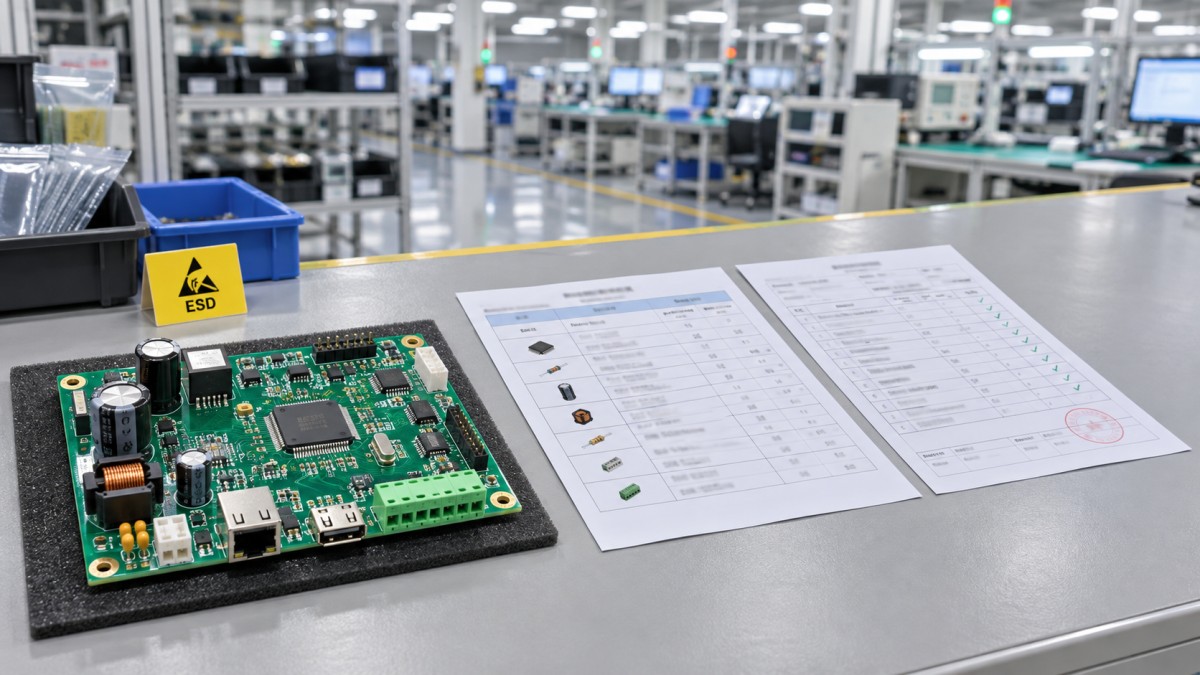
For a management-system certificate, obtain the complete document rather than a logo, cropped image or marketing slide. ISO 9001 can provide evidence of a certified quality management system; sector-specific certifications may be relevant where the contract requires them. Neither is a blanket approval of every product made at the facility.
- Match the legal entity and site. Compare the certificate holder and addresses with the entity accepting the order and each location performing relevant work. Ask how remote sites, warehouses or subcontractors are covered.
- Read the scope. Check whether it includes the activities being purchased, such as assembly, testing or design where applicable. A certificate for distribution does not establish coverage of a separate manufacturing process.
- Verify status independently. Use the certification body’s public register or contact it directly with the certificate number. Check validity dates and whether the certificate has been suspended, withdrawn or replaced.
- Examine accreditation where required. Identify the accreditation body and verify that the certification body is accredited for the relevant certification activity when the customer or contract requires accredited certification.
Names can differ legitimately after a reorganization, but the connection must be documented. Request an explanation and supporting records rather than assuming that a similar name or shared logo means the certificate applies. If an issuer cannot confirm the status or scope, treat the claim as unverified until the discrepancy is resolved.
Review product evidence separately from factory certification
A product certificate, test report and declaration of conformity serve different purposes. A certificate may document a defined approval; a laboratory report records tests on identified samples; a declaration is a responsible party’s formal statement of conformity where the relevant regime calls for one. None should be accepted without checking precisely what it covers.
Is the tested configuration representative?
Compare the report’s sample description with the released design: PCB revision, critical components, enclosure, power supply, operating modes and accessories, as relevant to the tests. A report for a similar model may support an engineering assessment, but similarity alone does not prove coverage. Obtain a documented comparison explaining the differences, their potential effect and whether additional testing or assessment is needed.
Check the test standard and edition against the requirements applicable to the intended market and the assessment date. A report using an older edition is not automatically invalid, but its acceptability needs evaluation against current rules and any transition provisions. Review failures, deviations, limitations and amendments; a cover page marked “pass” may not capture conditions that affect the intended use.
Where accredited testing is required, confirm both the laboratory’s accreditation status and whether the specific test methods were within its accredited scope when performed. Accreditation does not itself certify that an untested production lot conforms to the requirements.
Read the declaration as a controlled document
A useful declaration identifies the product, responsible entity, applicable requirements and supporting standards or other conformity route, as appropriate to the regime. Check that the signer has authority and that the version corresponds to the supplied configuration. CE marking, where applicable, is not proof that an authority has approved the product; examine the underlying declaration and technical evidence rather than relying on the mark alone.
Request evidence through the agreed channels while respecting confidentiality. A supplier may reasonably restrict access to detailed design files, but it should be able to explain how a claim was substantiated and provide sufficient evidence for the contractual and regulatory responsibilities assigned to each party.
Trace substance claims through the BOM
Material compliance is especially vulnerable to gaps between purchasing records and generic supplier statements. Begin with the approved BOM revision and map each relevant component and material to its manufacturer part number, source and supporting declaration. Include items that can be overlooked, such as solder, coatings, adhesives, connectors and packaging where they fall within the requirement being assessed.
For a RoHS claim, check that the declaration addresses the applicable substance restrictions and identifies any claimed exemption. Confirm that the exemption applies to the material, application and market, and check its current validity. A declaration referring broadly to “lead-free” does not establish compliance with all restricted substances. Likewise, a component-level statement is not automatically a declaration for the complete assembly.
Supplier declarations can be supplemented with test data, particularly where evidence is missing or risk is higher. Screening techniques can help identify materials for further investigation, but their detection limits and material coverage matter. Determine whether the chosen method can assess the relevant substance at the required level and whether confirmatory laboratory testing is needed. Testing a small sample also cannot establish the composition of every part in every lot.
Pay particular attention to authorized alternates and broker-sourced parts. Ask whether each alternate has its own evidence and whether substitution requires prior approval. A compliant original component does not transfer its status automatically to a replacement, even when the replacement is electrically compatible.
Test whether production controls preserve the claim
Documents describe a defined state. The operational question is whether the EMS provider can reproduce that state after materials, equipment, personnel or subcontractors change. Review the controls that link incoming parts to production records and finished units.
- Incoming control: How are manufacturer part numbers, approved sources and required declarations checked before material is released?
- Traceability: Can the supplier link finished units or lots to relevant component lots, manufacturing dates, test results and the BOM revision used?
- Change control: Who approves component, process, site, firmware or subcontractor changes, and when must the customer be notified?
- Nonconformance: How are suspect materials segregated, affected products identified and corrective actions verified?
- Subcontracted work: Which controls apply to external assembly, coating or testing, and what records can be retrieved?
Use a targeted audit or remote evidence review to test a sample transaction from receipt through shipment. Select records tied to the product being evaluated rather than relying only on a general procedure. The objective is to see whether the documented process was followed and whether missing links can be reconstructed. Agree on access, sampling and confidentiality before the review.
Make a disposition when evidence is incomplete
Log each finding against the requirement it affects. Distinguish a confirmed nonconformance from missing evidence and from a claim that is not applicable. Record the affected product revision, part or site; the source reviewed; the risk; the responsible owner; and the deadline for closure. Preserve the document version and verification date so that a later reviewer can reproduce the decision.
For a mismatched certificate, request verification or evidence for the actual site. For an incomplete material declaration, obtain a part-specific declaration or agree on an appropriate assessment. For a changed safety-critical component, hold the affected configuration pending engineering review and any required reassessment. A commercial deadline does not turn an unsupported claim into verified compliance.
Set a decision for each open item: accepted with a documented rationale, conditionally accepted where the applicable rules and contract permit, or held pending evidence or correction. Define who may authorize a conditional release and what happens if the supplier misses the closure date. Legal obligations cannot be waived simply by recording a risk acceptance.
Revisit the evidence when certificates expire, requirements change or the supplier reports a significant design, material, process or site change. The record should identify which claims need revalidation and who will receive updated documents; otherwise, an approval for one configuration can quietly be applied to another.
 South Korea's Car Imports From China and Trade Deficit Hit RecordsSouth Korea’s car imports from China and automotive trade deficit hit records. Explore how Shanghai-made Tesla EVs are reshaping bilateral trade.
 How to check if supplier verification reports are authenticVerify supplier verification reports with confidence. Learn how to confirm the issuer, match supplier details, spot red flags, and reduce purchasing risk.
 Mexico’s President Seeks US Trade Deal at December Miami G20 SummitMexico–US trade deal talks could reach a turning point at the December Miami G20 summit. Explore what a potential agreement may mean for cross-border business.
 How to assess data quality in export market analysis servicesCompare export market analysis services with confidence. Learn how to evaluate data sources, coverage and forecasts before committing to a new market.
 Li Qiang Calls for Digital and Green Cooperation at China-Thailand Business MeetingLi Qiang calls for China-Thailand cooperation in digital and green sectors, highlighting opportunities in AI, new energy and agriculture.
 How are life sciences different from healthcare?Life sciences and healthcare overlap, but how do they differ? Explore their roles, real-world examples, and what the distinction means for sourcing.
 How is resale changing the UK apparel and fashion market?Explore how resale is reshaping apparel and fashion in UK markets, from shifting customer demand to pricing, sourcing and opportunities for brands.
 China's Trade Reaches 44.81 Trillion Yuan in First 10 Months, Up 20%China's trade reportedly reached 44.81 trillion yuan in the first 10 months, up 20%. Explore the implications for sourcing, technology exports and ASEAN markets.
 China Extends Pause on 24% US Tariff as US Extends Product ExclusionsChina-US tariffs: China extends its 24% tariff pause while the US extends 178 product exclusions. Discover what the measures mean for trade costs and planning.
 How to verify a mass production supplier’s capacityVerify a mass production supplier’s true capacity with practical checks for production records, available resources, quality controls and delivery readiness.
 He Lifeng Holds Trade Video Call with US Treasury Secretary and Trade RepresentativeHe Lifeng discusses China-US trade restrictions with US officials. Explore what the call could mean for exporters, buyers and supply chains.
 U.S. Trade Deficit Narrows to $105 Billion in September 2026U.S. trade deficit narrowed to $105 billion in September 2026 as exports rose 1.9%. Explore what the latest figures reveal about trade flows.
 How to verify international trade intelligence updatesVerify international trade intelligence updates with practical checks for sources, regulations, trade data, and disruptions. Turn complex claims into reliable insights.
 How investors can assess cyclicality in the manufacturing industryManufacturing industry analysis for investors: learn to assess cyclical demand, cash flow and downside risks to make more informed investment decisions.
 US ISM Manufacturing PMI Rises to 55.5% in October, Beating ForecastsUS ISM Manufacturing PMI rose to 55.5% in October 2026, beating forecasts. Explore what stronger orders and production could mean for manufacturers.
 China Manufacturing PMI Falls to 49.3 in OctoberChina manufacturing PMI fell to 49.3 in October, signaling renewed contraction. Explore the role of weak export orders and domestic demand.
 Can you trust flexible packaging market intelligence forecasts?Can you trust flexible packaging market intelligence forecasts? Learn how to verify sources, challenge assumptions, and assess demand before making costly investment or sourcing decisions.
 When is supply chain disruption management consulting worth the cost?When is supply chain disruption management consulting worth the cost? Learn how to compare fees, avoidable losses, and recovery options to make a confident investment decision.
 How to use macroeconomic analysis to forecast industrial demandApply an industrial macro analysis methodology to forecast demand, interpret economic signals, and plan inventory and capacity. Discover practical steps for smarter business decisions.
 How to assess Singapore suppliers with global supply chain intelligenceExplore international supply chain intelligence Singapore buyers can use to verify suppliers, assess capabilities and delivery risks, and make confident sourcing decisions.
 Which macroeconomic indicators help forecast U.S. industrial demand?Explore industrial macro analysis USA decision-makers can use to forecast demand. Track new orders, inventories, and credit signals to sharpen procurement and capacity decisions.



















Global Trade Insights & Industry
Our mission is to empower global exporters and importers with data-driven insights that foster strategic growth.
Search News
Popular Tags
Industry Overview
The global commercial kitchen equipment market is projected to reach $112 billion by 2027. Driven by urbanization, the rise of e-commerce food delivery, and strict hygiene regulations.