

How Much Does a BMS for an EV Battery Pack Cost in 2026?
An EV battery management system (BMS) does not have a single meaningful price in 2026. A quotation for one controller board is not comparable with a quotation covering the complete pack-level system, licensed software, integration support, and validation. The useful cost is the price of a production-ready BMS for a defined battery architecture—not the lowest advertised board price.
For a concrete budgeting example, assume a complete BMS hardware set costs $400 per pack and application-specific engineering costs $120,000. Across 2,000 packs, that produces an allocated BMS cost of $460 per pack before freight, taxes, vehicle-level validation, and other exclusions. These are illustrative assumptions, not verified 2026 market prices. Their value is showing why order volume and quotation scope can matter as much as hardware price.
What should count as the cost of an EV BMS?
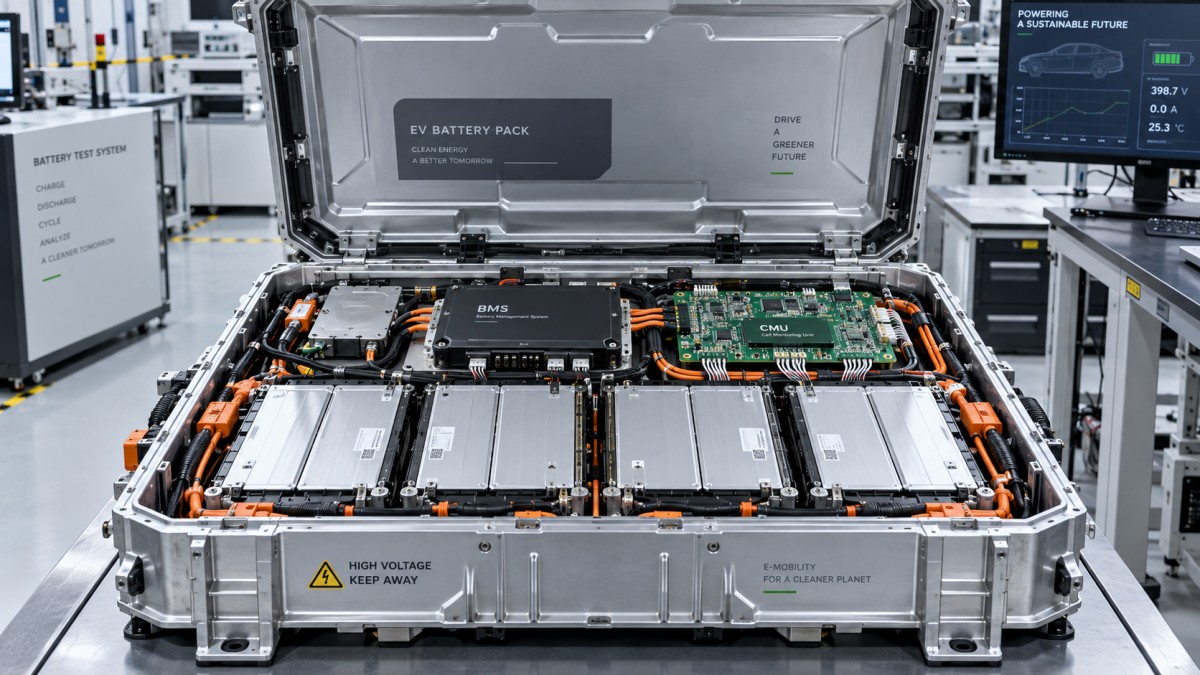
A BMS measures battery conditions, estimates operating limits, and coordinates protective actions. Depending on the architecture, those functions may sit on one board or be distributed across a master controller and several cell-monitoring units.
A complete cost comparison should distinguish the following items:
- Recurring hardware: master controller, cell-monitoring boards, communication interfaces, and any included sensing components.
- Pack-specific accessories: harnesses, connectors, enclosures, mounting parts, and interfaces to current measurement or insulation monitoring.
- Software and calibration: firmware, communication configuration, battery models, operating limits, and diagnostic settings.
- Non-recurring engineering: customization, integration, test development, documentation, and agreed validation work.
- Lifecycle obligations: software maintenance, change management, replacement support, and any recurring license charges.
Not every supplier provides every item. A current sensor may be supplied separately, for example, while contactors and precharge components may belong to the battery disconnect assembly rather than the BMS purchase. Their exclusion is not necessarily a problem; an unclear responsibility boundary is.
Can a low-cost BMS board be used in a road-going EV?
A low advertised price does not establish suitability for a traction battery. A board designed for a low-voltage utility application may provide voltage monitoring and basic protection without meeting the electrical, environmental, diagnostic, or integration requirements of a road vehicle.
For a high-voltage pack, the relevant questions include measurement accuracy, isolation design, fault response, communication reliability, temperature coverage, and operation during electrical disturbances. The BMS must also coordinate with the vehicle controller, charger, and battery switching hardware.
A board that measures every cell is not automatically a complete vehicle-ready system. Missing diagnostics, undocumented failure behavior, or inaccessible firmware can create engineering work that exceeds the apparent hardware saving. Conversely, an expensive controller is not automatically appropriate: its capabilities and supporting evidence still need to match the application.
Which battery specifications have the greatest effect on price?
Series-cell count and monitoring architecture
The number of series-connected cell groups determines how many voltage measurement channels are needed. Parallel cells connected as one group are generally monitored as a shared voltage node; total physical cell count alone therefore does not describe BMS complexity.
A distributed design can require several monitoring boards, an isolated communication chain, and a master controller. A centralized design places more measurement connections at one location. Neither architecture is universally cheaper once wiring, assembly, service access, and pack layout are included.
Pack voltage and electrical isolation
Higher pack voltage affects insulation coordination, component selection, board layout, connectors, and test requirements. It does not simply multiply the price in proportion to voltage.
Similarly, an 800 V pack does not necessarily require twice the BMS expenditure of a 400 V pack. Series-channel count, module arrangement, safety architecture, and supplier platform reuse determine the actual difference.
Accuracy, sensing, and balancing
Voltage and current measurement quality influence state-of-charge estimation and operating-limit calculations. Temperature sensor quantity and placement affect the ability to identify local overheating. These requirements should be specified rather than reduced to a generic claim of “high accuracy.”
Balancing also changes the design. Passive balancing dissipates energy through resistors; active balancing transfers energy between cells or groups. Active balancing adds circuit and control complexity, but its economic value depends on the imbalance problem it solves. It should not be purchased solely because it sounds more advanced.
Cell chemistry affects calibration as well. For lithium iron phosphate cells, the relatively flat voltage curve across part of the operating range makes voltage-only state-of-charge estimation inadequate. Current measurement, capacity characterization, and estimation logic remain important even when the monitoring hardware can support multiple chemistries.
How much should be reserved for engineering and integration?
Engineering expenditure depends on how closely the supplier’s existing platform matches the battery and vehicle. Configuring an established system is a different task from developing new electronics, safety functions, communication software, and battery estimation algorithms.
A useful quotation separates configuration from development. Configuration may cover channel allocation, temperature thresholds, CAN messages, and operating parameters. Development may involve a new board layout, custom diagnostics, additional vehicle interfaces, or changes to the protection architecture.
Calibration also needs a defined scope. A firmware package with adjustable parameters is not the same as a validated state-of-charge model for a particular cell, temperature range, and aging profile. Cell characterization data, test facilities, and responsibility for approving the calibration should be agreed before treating software as “included.”
Engineering fees should identify deliverables and acceptance criteria. Otherwise, an apparently fixed price can become a sequence of change orders when charging behavior, fault handling, or vehicle communication requirements are clarified.
How does production volume change the per-pack cost?
Volume affects both manufacturing economics and the allocation of development expenditure. The simplest comparison is:
Allocated BMS cost per pack = recurring supply cost + recurring license cost + non-recurring program cost ÷ committed production quantity.
The following example isolates that allocation effect. It deliberately holds hardware price constant rather than assuming an unverified volume discount.
These figures are hypothetical, not supplier quotations. They show why a small production program may justify a higher-priced configurable platform if it avoids substantial custom development.
Use a credible production commitment in the denominator. Allocating engineering expenditure across an optimistic lifetime forecast can conceal the cost of a delayed launch or a smaller production run. Pilot, initial production, and later-volume pricing should be shown separately.
Are safety certification and regulatory compliance included?
They should never be assumed to be included. A supplier may provide component test reports, a functional safety development package, or support for pack-level testing. Those are different deliverables.
ISO 26262 addresses functional safety for road vehicles. A claim of development to a particular Automotive Safety Integrity Level needs a defined scope and supporting evidence; it is not a blanket guarantee that the finished battery or vehicle meets every requirement.
UN Regulation No. 100 addresses electric powertrain safety and rechargeable electrical energy storage system requirements in applicable vehicle approval contexts. UN 38.3 concerns transport testing of lithium cells and batteries. Neither should be described as a universal standalone BMS certificate.
The commercial question is who supplies the evidence, who performs the integration tests, and who pays for retesting after changes. BMS documentation can support approval, but it does not replace pack- or vehicle-level assessment. Applicable requirements depend on vehicle category and destination market.
Why can two apparently similar supplier quotes differ so much?
One quote may cover bare electronics, while another includes a housing, harness, calibrated firmware, production testing, and technical support. Both may be described as a “complete BMS” despite materially different boundaries.
Software rights can also create a price difference. Access to configuration tools, diagnostic protocols, firmware updates, and calibration data affects whether the system can be maintained independently. A low initial price can leave the battery dependent on paid supplier intervention for later changes.
Manufacturing quality requirements add another distinction. Traceability, end-of-line test records, controlled component substitutions, and formal change notification have costs. Their value is the ability to identify affected units and assess whether a production change alters safety or performance.
Cross-border quotations require a further adjustment for delivery terms, freight, duties, taxes, currency exposure, and warranty logistics. Compare prices on the same Incoterm and destination basis. An ex-works quotation and a delivered quotation are not equivalent purchasing costs.
What information is needed for a usable price request?
A request stating only battery capacity and nominal voltage leaves too much undefined. Capacity in kilowatt-hours does not reveal the number of monitoring channels, module arrangement, or communication requirements.
A price request should provide:
- Cell chemistry, series/parallel configuration, and module layout.
- Minimum, nominal, and maximum pack voltage.
- Continuous and peak current, including relevant charging conditions.
- Temperature range, sensor requirements, and installation environment.
- Vehicle and charger interfaces, including required communication messages.
- Protection functions, diagnostic expectations, and applicable safety requirements.
- Prototype quantity, production quantities, and delivery schedule.
- Required software access, documentation, validation support, and service arrangements.
Ask the supplier to return an itemized scope, exclusions, assumptions, and engineering deliverables. Require separate prices for prototypes, production units, tooling, licenses, and customization. This makes omissions visible before commercial negotiation begins.
Is replacing an existing BMS cheaper than buying a new system?
Not necessarily. Replacement cost includes compatibility, not just a new controller. The original battery may use proprietary communication, specific sensor interfaces, undocumented calibration, or vehicle-side authentication.
A mechanically compatible replacement can still fail to communicate with the vehicle or apply unsuitable operating limits. Reusing an aged pack also requires appropriate treatment of capacity loss and cell imbalance; original new-cell parameters should not be assumed to remain valid.
For an existing vehicle, establish whether the quoted replacement is an approved service part, a configurable substitute, or a redesign requiring engineering validation. Those categories carry very different cost and responsibility boundaries.
What is the most defensible way to set a 2026 budget?
Set the budget around a defined system boundary and obtain comparable, dated supplier quotations. Separate recurring hardware from engineering, testing, software rights, and landed costs. Keep unresolved scope items visible rather than hiding them inside a single per-pack estimate.
The purchasing decision should then turn on the cost of delivering the required battery behavior. A higher unit price can be economical when it removes development work or provides usable validation evidence. A lower price can be equally rational when the existing platform already fits and its documentation is sufficient.
The critical figure is not the cheapest BMS board available in 2026. It is the fully scoped cost of a system that can be integrated, validated, manufactured, and supported for the intended EV battery pack.
 Can a food processing manufacturer meet your small-batch needs?Can a food processing manufacturer meet your small-batch needs? Discover how to assess minimum orders, costs, packaging, and safety to choose the right partner for your launch.
 How to verify sourcing intelligence data before selecting suppliersVerify sourcing intelligence data before choosing suppliers. Learn how to check company records, certifications, and capacity to reduce procurement risk and build a reliable shortlist.
 How to use supplier risk analysis to spot financial warning signsUse supplier risk analysis to spot cash flow pressure, debt risks, and delivery warning signs. Learn practical steps to reduce exposure and protect supply continuity.
 When dual sourcing makes sense in a sourcing strategy for manufacturersSourcing strategy for manufacturers: learn when dual sourcing strengthens supply continuity, reduces disruption risk, and protects production without adding unnecessary complexity.
 How bulk commodities pricing affects long-term supply contractsBulk commodities pricing shapes long-term supply contracts through index rules, freight, quality, volume, and currency risk. Explore strategies for resilient costs and supply security.
 Which global manufacturing trends by sector matter most for sourcing plans?Global manufacturing trends by sector: identify sourcing risks, supplier resilience, compliance demands, and cost drivers to build smarter, more reliable procurement plans.
 What industrial trade intelligence pricing should include before you subscribeIndustrial trade intelligence pricing explained: compare coverage, data quality, access rights, and workflow value before choosing a subscription that supports smarter trade decisions.
 How an industrial trade intelligence dashboard can identify new supplier marketsDiscover how an industrial trade intelligence dashboard helps identify new supplier markets by comparing capacity, landed cost, logistics resilience, and compliance risk.
 Which global market entry barriers should exporters assess first?Global market entry barriers exporters should assess first: tariffs, compliance, buyer qualification, logistics, and payment risk. Build a practical strategy for confident market entry.
 How trade data aggregation analytics can reveal emerging supplier marketsTrade data aggregation analytics reveals emerging supplier markets by connecting trade flows, capacity signals, logistics, and compliance insights for smarter sourcing decisions.
 When an export market analysis platform can validate demand in a new marketExport market analysis platform insights help validate new-market demand through buyer fit, regulations, logistics, competition, and profitable entry conditions.
 What is driving the beauty and personal care market in the USA?Beauty and personal care in USA is driven by targeted solutions, selective premiumization, digital discovery, clean-label trust, diverse needs, and compliance. Explore key growth opportunities.
 How trade flow monitoring reports reveal changing regional demandTrade flow monitoring reports reveal changing regional demand through import volumes, sourcing shifts, product mix, logistics signals, and regulatory trends. Explore actionable market insights.
 How international market intelligence for investors reduces market-entry riskInternational market intelligence for investors reduces market-entry risk by validating demand, regulations, logistics, and competition before capital is committed.
 How international sourcing intelligence helps identify supplier risk earlyInternational sourcing intelligence helps businesses spot supplier risks early, protect supply continuity, and make smarter global procurement decisions.
 How trade data aggregation analytics reveals emerging supplier marketsTrade data aggregation analytics reveals emerging supplier markets through export trends, input flows, logistics, and regulatory signals. Discover smarter sourcing insights.
 What industrial cluster monitoring in Vietnam reveals about site riskIndustrial cluster monitoring Vietnam reveals hidden site risks across labor, utilities, logistics, compliance, and supplier dependencies. Make smarter sourcing and expansion decisions.
 Food Technology Trends Reshaping Shelf Life, Safety, and Product InnovationFood technology is reshaping shelf life, safety, and innovation. Discover the trends helping food businesses cut risk, improve compliance, and unlock stronger global market growth.
 How electronics manufacturing services are changing with low-volume demandElectronics manufacturing services are evolving fast with low-volume demand. Learn how agile EMS partners improve flexibility, compliance, sourcing resilience, and speed to market.
 How Can Buyers Reduce Procurement Risks for Electronic Components?How to reduce procurement risks for electronic components: learn how buyers assess traceability, lead times, compliance, and supplier types to avoid costly sourcing mistakes.
 What Sourcing Intelligence India Reveals About Supplier Risk and Cost ShiftsSourcing intelligence India reveals hidden supplier risk, compliance gaps, logistics pressure, and real cost shifts—helping buyers compare vendors smarter and source with more confidence.



















Global Trade Insights & Industry
Our mission is to empower global exporters and importers with data-driven insights that foster strategic growth.
Search News
Popular Tags
Industry Overview
The global commercial kitchen equipment market is projected to reach $112 billion by 2027. Driven by urbanization, the rise of e-commerce food delivery, and strict hygiene regulations.