

Why some battery management systems fail to report state of charge accurately
If a battery pack shows 60% charge, then suddenly drops to 20%, or stays at 100% for too long, the problem is often not the cells alone. In many field cases, the real issue sits inside the logic of battery management systems, the quality of sensing hardware, or the way the pack has been used and calibrated over time. For maintenance work, that distinction matters. It changes whether you replace a module, update firmware, rebalance cells, or simply correct bad operating conditions before the next failure call.
A short answer is this: state-of-charge reporting becomes inaccurate when the BMS is forced to estimate with weak inputs. That can happen because of current sensor drift, voltage readings taken under load, temperature effects, cell aging, poor calibration, firmware limitations, or pack configurations that no longer behave like the original model assumed.
Many people expect state of charge, or SOC, to be something the system can measure directly. It cannot. A BMS estimates SOC from indirect signals such as voltage, current flow, temperature, historical usage, and cell behavior. When those signals are noisy, incomplete, or no longer match real battery conditions, the estimate starts to drift. Sometimes the drift is small. Sometimes it is large enough to trigger shutdowns, false low-battery alarms, customer complaints, and avoidable warranty arguments.
Why battery management systems struggle with SOC in real operating conditions
On a bench, SOC estimation can look stable. In actual use, the pack rarely sees calm, repeatable conditions. Loads change fast. Temperature moves up and down. Charging habits vary. Cells age at different speeds. The BMS is trying to interpret a moving target.
One common source of error is overreliance on voltage. Open-circuit voltage can help estimate charge level, but only after the battery has rested. In the field, packs are often measured while charging, discharging, or recovering from a heavy load. That means terminal voltage is being distorted by internal resistance and polarization effects. A pack may look fuller or emptier than it really is. Maintenance teams see this often in systems that show normal voltage but still shut down early under load.
Another issue is coulomb counting drift. Many battery management systems calculate SOC by counting current in and out of the pack over time. In principle, this works well. In practice, even a small current measurement error accumulates. If the shunt, Hall sensor, or ADC path has offset or gain drift, the SOC estimate walks away from reality. After enough cycles, the pack may look healthy on the display while its usable capacity tells a different story.
Temperature makes the situation worse. Battery chemistry does not behave the same way at 5 degrees C and 35 degrees C. Internal resistance, available capacity, and charging acceptance all change. If the BMS model is too simple, poorly tuned, or based on limited test data, SOC can become misleading at the exact moment the user needs accuracy most.
Then there is cell aging. A new pack and an aged pack do not follow the same voltage curve, capacity profile, or balancing behavior. Some systems continue to estimate SOC using assumptions that were reasonable only when the battery was fresh. That is why older packs often show “normal” percentages but deliver much shorter runtime.
The fault is not always in the BMS board
This is where troubleshooting gets more practical. After-sales teams sometimes replace the controller too quickly. But inaccurate SOC can come from several layers at once.
If one or two cells in a series string have aged faster than the rest, the pack voltage may still look acceptable while the weakest cells hit their lower threshold early. The customer sees a sudden drop from 30% to shutdown and assumes the display is wrong. In reality, the BMS may be reporting an average condition while the pack fails at the weakest point.
Balance problems create a similar symptom. A pack that rarely reaches a full balancing phase may drift cell-to-cell over time. SOC calculation becomes less trustworthy because the pack no longer behaves like a matched set. This is especially common when equipment is opportunity-charged, interrupted mid-charge, or stored for long periods without proper maintenance.
Connector resistance, loose sense wires, or degraded harnesses can also distort readings. These are easy to miss because they do not always leave obvious visual damage. A few millivolts of error per cell, repeated across channels, is enough to confuse the model. If a service team jumps straight to firmware without checking the wiring path, the root cause stays in the field.
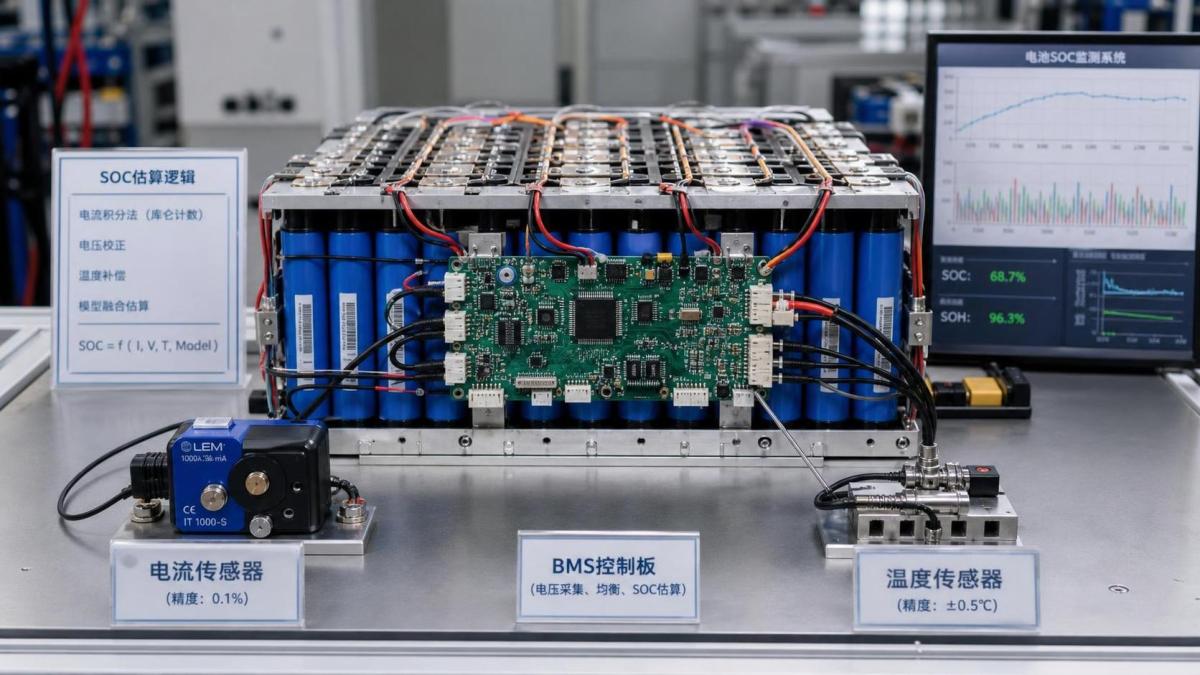
There is also a basic but costly misunderstanding: SOC accuracy is not the same as state-of-health accuracy. A battery may still report charge percentage in a smooth way while total usable capacity has already fallen sharply. Customers describe this as “the gauge looks normal but runtime is bad.” In that case, the BMS may not be failing to count charge. It may be failing to update capacity assumptions as the pack ages.
What usually goes wrong during service diagnosis
In field support, three mistakes show up again and again.
First, teams compare SOC numbers across different temperatures and load conditions as if they were measured on equal ground. They are not. A 40% reading during a cold, high-current discharge is not directly comparable to a 40% reading after the pack has rested indoors.
Second, technicians trust pack voltage too much. Voltage is useful, but without context it is a poor standalone indicator, especially for lithium chemistries with relatively flat discharge curves through much of the usable range.
Third, people assume a firmware reset equals recalibration. Sometimes it helps, sometimes it only clears symptoms temporarily. If the underlying issue is sensor drift, aging cells, or imbalance, the same complaint usually returns.
A better approach is to ask four questions in sequence: Has the pack changed physically? Has the sensing path changed electrically? Has the usage pattern changed? Has the BMS model been updated for the current battery condition? That sequence saves time because it separates hardware degradation from estimation logic problems.
What to check before replacing parts
When SOC readings look unreliable, start with the basics that most directly affect estimation quality:
- Verify cell voltage consistency at rest and under moderate load.
- Check current sensor offset and gain against a trusted reference.
- Review temperature sensor placement, not just sensor output.
- Inspect balancing behavior across full charge cycles.
- Look for loose sense leads, oxidized connectors, or harness damage.
- Confirm the battery chemistry and pack parameters match the loaded firmware.
- Compare reported full-charge capacity with actual delivered runtime or discharge test results.
If one of these checks fails, replacing the BMS alone may not solve anything. If all of them pass, then firmware logic, SOC algorithm tuning, or memory corruption becomes more likely.
One practical reminder: not every pack should be recalibrated in the same way. Some systems need a controlled full charge and rest period. Others need a full charge-discharge-charge cycle under defined current and temperature limits. Pushing an aged or safety-sensitive pack through an aggressive recalibration routine can create more risk than value. Service teams should follow the battery maker’s official method where available.
Why the same complaint appears more often in older fleets and mixed supply chains
As battery-powered equipment spreads across more markets, after-sales teams are supporting packs built from different cell sources, BMS suppliers, firmware revisions, and regional compliance requirements. That creates variation that is not always visible on the nameplate.
Two units may look identical but behave differently because one batch uses cells with a different aging profile, or because the firmware threshold set was adjusted for another export market. In cross-border supply chains, this is not unusual. It also explains why maintenance records matter more than many teams expect. If a distributor, importer, or repair center cannot trace which pack revision is in the field, SOC complaints become harder to classify and resolve.
This is one area where broader industrial information can help. Platforms such as GTIIN are useful less for fixing a single pack on the bench and more for understanding upstream shifts: battery sourcing changes, regulatory adjustments affecting pack design, supplier quality signals, and market-level differences in component consistency. That context helps service organizations explain recurring issues that are not caused by local misuse alone.
When inaccurate SOC points to a deeper quality problem
Sometimes the reading issue is only the first visible symptom. If SOC inaccuracy appears together with heat complaints, unusual balancing time, swelling, repeated low-voltage cutoffs, or large cell spread, the safer assumption is that the pack has a hardware reliability problem, not just a display problem.
This matters for warranty and safety decisions. A pack that is merely out of calibration may be recoverable. A pack with unstable cell behavior should be isolated, tested under controlled conditions, and judged against the manufacturer’s replacement criteria. Treating both cases as the same “BMS error” leads to bad service decisions.
It also helps to watch for pattern failures. If the same model returns from multiple customers with SOC drift after similar cycle counts, the issue may be linked to design margin, balancing strategy, sensing component tolerance, or firmware robustness. In that case, the maintenance team should feed the evidence upstream rather than resolving each case as a one-off repair.
How experienced teams reduce repeat complaints
The strongest service teams do not rely on percentage display alone. They build a simple decision process around measured behavior. They compare reported SOC with cell spread, delivered runtime, charge acceptance, event logs, and temperature history. They document whether the pack spends most of its life in shallow cycling, deep discharge, cold storage, or fast-charge use. Those details explain far more than a single snapshot reading.
They also manage customer expectations better. Some users assume SOC should behave like a fuel gauge in a new vehicle: steady, exact, and identical in every condition. Real batteries do not work like that, especially older ones in demanding environments. Good support means explaining what level of variation is normal and what level points to a fault.
If you are seeing repeated field complaints, the right next step is usually not “replace everything electronic.” Start by confirming whether the pack is mismeasured, mismodeled, imbalanced, or simply worn out. That distinction is where reliable battery management systems support begins, and it is also where a lot of avoidable service cost can be removed.
FAQ
Can a BMS read state of charge directly?
No. It estimates SOC from voltage, current, temperature, and battery behavior over time. Accuracy depends on both sensor quality and the quality of the estimation model.
Why does SOC drop suddenly near the end of discharge?
Often because weak cells hit cutoff early, cell imbalance has increased, or voltage under load is collapsing faster than the BMS model expected.
Will firmware updates always fix inaccurate SOC?
No. Firmware can improve estimation logic, but it cannot repair aged cells, bad current sensing, poor wiring, or physical imbalance.
Is recalibration enough after battery replacement?
Usually it is necessary, but not always sufficient. The BMS must also have the correct pack parameters and stable sensor inputs.
When should a pack be treated as a safety concern rather than a gauge problem?
If inaccurate SOC appears together with overheating, swelling, abnormal cell spread, or repeated unexpected shutdowns, the pack should be evaluated as a reliability and safety case.
Image Placeholder List
Placement suggestion: After the section discussing hidden causes beyond the BMS board.
Image content: A service diagnostic flow showing cells, current sensor, temperature sensor, wiring harness, and BMS logic paths that affect SOC accuracy.
Alt text: Battery SOC diagnostic path showing sensors, cell imbalance, wiring faults, and BMS estimation errors.
Internal Link Anchor Text Suggestions
- battery pack balancing problems: guide page about cell imbalance and maintenance checks
- how to diagnose lithium battery voltage drop under load: troubleshooting article
- BMS firmware selection and compatibility: technical reference page
- battery state of health vs state of charge: educational explainer
- energy storage supply chain quality risks: industry insight page
External Authority Source Suggestions
- battery manufacturer official technical manuals and service bulletins
- government or recognized safety certification body pages covering battery testing and transport requirements
- academic or industry research materials on SOC estimation methods and lithium battery aging behavior
 Which global manufacturing trends by sector matter most for sourcing plans?Global manufacturing trends by sector: identify sourcing risks, supplier resilience, compliance demands, and cost drivers to build smarter, more reliable procurement plans.
 What industrial trade intelligence pricing should include before you subscribeIndustrial trade intelligence pricing explained: compare coverage, data quality, access rights, and workflow value before choosing a subscription that supports smarter trade decisions.
 How an industrial trade intelligence dashboard can identify new supplier marketsDiscover how an industrial trade intelligence dashboard helps identify new supplier markets by comparing capacity, landed cost, logistics resilience, and compliance risk.
 Which global market entry barriers should exporters assess first?Global market entry barriers exporters should assess first: tariffs, compliance, buyer qualification, logistics, and payment risk. Build a practical strategy for confident market entry.
 How trade data aggregation analytics can reveal emerging supplier marketsTrade data aggregation analytics reveals emerging supplier markets by connecting trade flows, capacity signals, logistics, and compliance insights for smarter sourcing decisions.
 When an export market analysis platform can validate demand in a new marketExport market analysis platform insights help validate new-market demand through buyer fit, regulations, logistics, competition, and profitable entry conditions.
 What is driving the beauty and personal care market in the USA?Beauty and personal care in USA is driven by targeted solutions, selective premiumization, digital discovery, clean-label trust, diverse needs, and compliance. Explore key growth opportunities.
 How trade flow monitoring reports reveal changing regional demandTrade flow monitoring reports reveal changing regional demand through import volumes, sourcing shifts, product mix, logistics signals, and regulatory trends. Explore actionable market insights.
 How international market intelligence for investors reduces market-entry riskInternational market intelligence for investors reduces market-entry risk by validating demand, regulations, logistics, and competition before capital is committed.
 How international sourcing intelligence helps identify supplier risk earlyInternational sourcing intelligence helps businesses spot supplier risks early, protect supply continuity, and make smarter global procurement decisions.
 How trade data aggregation analytics reveals emerging supplier marketsTrade data aggregation analytics reveals emerging supplier markets through export trends, input flows, logistics, and regulatory signals. Discover smarter sourcing insights.
 What industrial cluster monitoring in Vietnam reveals about site riskIndustrial cluster monitoring Vietnam reveals hidden site risks across labor, utilities, logistics, compliance, and supplier dependencies. Make smarter sourcing and expansion decisions.
 Food Technology Trends Reshaping Shelf Life, Safety, and Product InnovationFood technology is reshaping shelf life, safety, and innovation. Discover the trends helping food businesses cut risk, improve compliance, and unlock stronger global market growth.
 How electronics manufacturing services are changing with low-volume demandElectronics manufacturing services are evolving fast with low-volume demand. Learn how agile EMS partners improve flexibility, compliance, sourcing resilience, and speed to market.
 How Can Buyers Reduce Procurement Risks for Electronic Components?How to reduce procurement risks for electronic components: learn how buyers assess traceability, lead times, compliance, and supplier types to avoid costly sourcing mistakes.
 What Sourcing Intelligence India Reveals About Supplier Risk and Cost ShiftsSourcing intelligence India reveals hidden supplier risk, compliance gaps, logistics pressure, and real cost shifts—helping buyers compare vendors smarter and source with more confidence.
 Fashion Trends 2026: Which Materials, Colors, and Silhouettes Are Gaining Ground?Fashion trends 2026 spotlight tactile fabrics, mineral colors, and controlled volume. Explore the materials, shades, and silhouettes shaping smarter, more wearable style.
 Smart Device Market Outlook: Key Growth Drivers, Segments, and Business OpportunitiesSmart device market trends are shifting toward system value, industrial demand, and resilient supply chains. Explore key growth drivers, high-potential segments, and business opportunities.
 How Global Trade Intelligence Services Help B2B Firms Evaluate Markets and SuppliersGlobal trade intelligence services help B2B firms compare suppliers, assess market potential, and uncover compliance, logistics, and pricing risks before costly decisions are made.
 Manufacturing Sector Updates for Investors: What Signals Matter Most in 2025?Manufacturing sector updates for investors in 2025: track orders, margins, supply chains, regulation, and exports to spot resilient manufacturers and smarter investment signals.
 How Energy Market Intelligence Helps Businesses Track Price Risks and Demand ShiftsEnergy market intelligence helps businesses spot price risks, demand shifts, and supply pressure early—improving procurement, resilience, and faster strategic decisions.





















Global Trade Insights & Industry
Our mission is to empower global exporters and importers with data-driven insights that foster strategic growth.
Search News
Popular Tags
Industry Overview
The global commercial kitchen equipment market is projected to reach $112 billion by 2027. Driven by urbanization, the rise of e-commerce food delivery, and strict hygiene regulations.