

STEM Toys by Age Group: What Skills Do They Really Help Children Build?
STEM toys are easy to overpraise. Packaging often promises coding, engineering, creativity, and future-ready thinking all at once. For parents, that creates a practical question: what do these toys really help children build at different ages, and which claims are mostly marketing?
The useful way to look at STEM toys is not by the label alone, but by the kind of thinking and physical interaction they encourage. A toy does not need electronics to support engineering thinking. A robot kit does not automatically teach coding. A microscope does not guarantee scientific curiosity. The real value comes from the match between the toy, the child’s developmental stage, and the way the child is allowed to explore it.
Across age groups, good STEM toys tend to support a combination of six areas: fine motor control, spatial reasoning, cause-and-effect understanding, problem-solving, persistence, and creative experimentation. The balance changes with age. What a three-year-old needs from STEM play is very different from what is useful for an eight-year-old or a teenager.
That is where many buying decisions go wrong. Adults often choose toys that look advanced rather than toys that fit how children actually learn.
What counts as a STEM toy in practice?
In the broadest sense, STEM toys are play products that expose children to ideas linked to science, technology, engineering, or mathematics. In practice, that category includes a wide range of products: stacking and sorting sets, magnetic tiles, simple machines, building kits, circuit toys, beginner coding games, microscopes, telescopes, robotics sets, chemistry kits, and logic puzzles.
Not all of them develop “hard STEM skills” in a direct way. Many work at an earlier level by building the foundations that later support STEM learning in school. A child who spends time with shape-matching toys or open-ended construction sets is not studying engineering, but may be building the visual-spatial and problem-solving habits that make later engineering concepts easier to grasp.
That distinction matters. The most valuable STEM toys for young children are often the least flashy.
Ages 1 to 3: sensory exploration, hand control, and early cause-and-effect
At this stage, children are not ready for formal concepts. They are learning through touch, movement, repetition, and immediate feedback. The best STEM-oriented toys for toddlers usually involve stacking, sorting, fitting, pouring, pressing, rolling, or simple motion.
What skills do these toys actually build?
Fine motor development is one of the biggest. Large peg boards, chunky blocks, shape sorters, and twist-and-fit toys help children control grip, finger strength, and hand-eye coordination. Those are not small achievements. Later writing, tool use, model building, and many classroom tasks depend on these early physical skills.
Children in this age group also begin forming an understanding of cause and effect. Press a button and a light turns on. Drop a ball and it rolls down a track. Stack too high and the tower falls. These simple experiences create the mental basis for prediction and experimentation.
Pattern recognition starts here too, though in a very early form. Matching colors, grouping shapes, and noticing that some parts fit while others do not are the beginnings of classification and logic.
The mistake adults make at this age is buying for future potential instead of current ability. Toys with too many functions, app connections, or complex instructions often reduce real learning because the child cannot independently explore them.
Ages 3 to 5: problem-solving, sequencing, and early spatial thinking
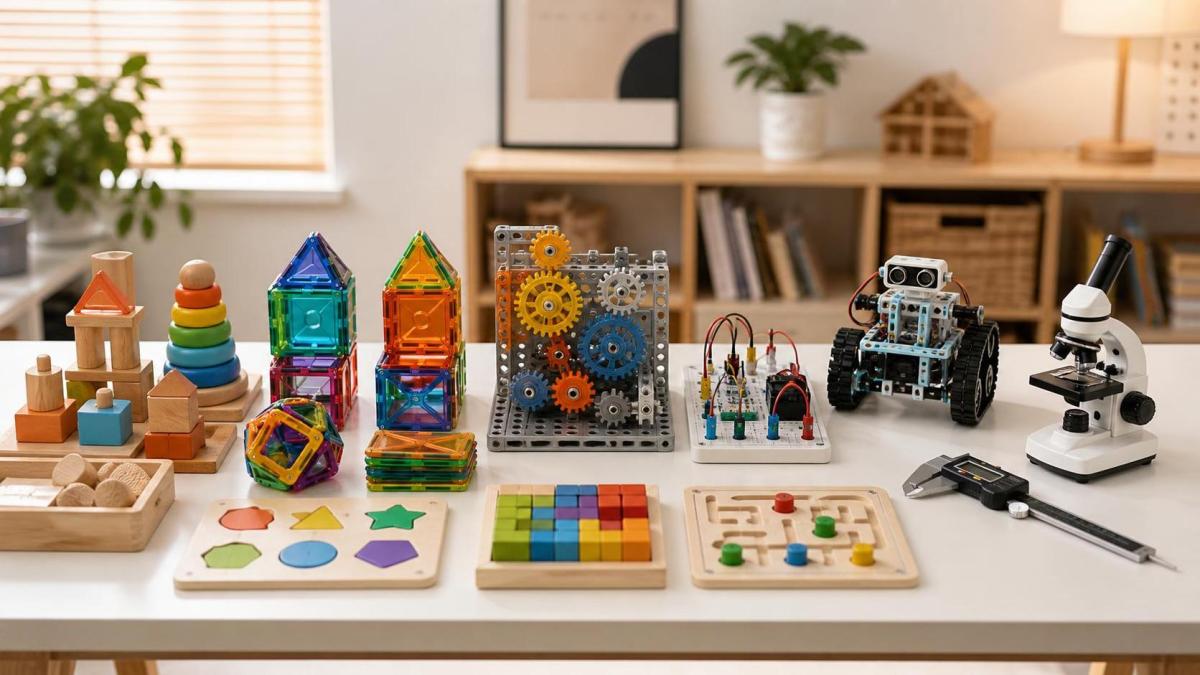
Preschool children can handle more structured challenges, but still learn best through concrete play rather than explanation. This is a strong age for construction toys, ramps, marble runs, beginner coding boards without screens, counting toys, balancing games, and simple science activity sets.
The development shift here is important. Children move from basic cause-and-effect toward intentional problem-solving. Instead of only observing that a tower falls, they begin asking why it fell and how to make it stronger. Instead of only connecting pieces randomly, they may start building with a goal in mind.
Spatial reasoning becomes much more visible in this stage. Magnetic tiles, interlocking builders, and 3D puzzles help children understand symmetry, balance, enclosure, and orientation. These are foundational skills for geometry, design, and mechanical reasoning later on.
Sequencing also begins to matter. Simple coding toys that involve arrows, direction cards, or step-by-step actions can help children understand that actions happen in order and that changing one step changes the result. That is an early computational idea, even without a screen.
Children also start practicing persistence. A preschooler who rebuilds a bridge after it collapses is learning more than construction. They are learning frustration tolerance, adjustment, and trial-and-error thinking.
Ages 5 to 7: logic, rules, and the transition from play to challenge
Early primary years are often where STEM toys begin to show clearer educational value. Children can now follow rules, compare outcomes, and work through multi-step tasks with less adult support. Good options in this stage include beginner circuit kits, gear sets, more advanced building systems, measuring tools, logic puzzles, and simple science experiment kits.
One key skill at this age is logical thinking. Children become better at understanding systems: if this piece connects here, that gear turns; if the battery is reversed, the light does not work; if the ramp is steeper, the car moves faster. Their play becomes less random and more test-based.
Numeracy and measurement can also become more concrete. Toys involving weights, volume, distance, time, and comparison help children connect math to real-world experience. This matters because many children struggle with mathematics when it feels abstract too early.
Another area that develops strongly is rule-based experimentation. Science kits for this age are not about mastering chemistry or physics. They help children observe, compare, and record simple outcomes: what dissolves, what floats, what grows, what changes color, what moves faster.
Parents should still be cautious about overstated claims. A basic crystal-growing kit may support observation and excitement, but it does not by itself create scientific reasoning. The better indicator is whether the toy invites the child to predict, test, and discuss results.
Ages 7 to 10: engineering thinking, independent building, and deeper curiosity
This is often the most commercially active segment in the STEM toys market, because children are old enough to engage with more sophisticated kits but still young enough to enjoy toy-based learning. Robotics kits, modular electronics, mechanical building sets, coding games, beginner microscopes, and model-based engineering toys are common here.
The real developmental gain at this stage is the move from isolated tasks to systems thinking. Children can begin to see how multiple parts work together. A robot is not just a moving object; it becomes a combination of structure, power, input, and output. A bridge is not just something to assemble; it has strength, load, and design choices.
Independent problem-solving also improves. Children may now read instructions, troubleshoot mistakes, and compare alternative solutions. This is where STEM toys can genuinely support early engineering habits: testing, revising, and optimizing.
Curiosity also becomes more selective. Some children start gravitating toward mechanics, others toward coding, nature observation, chemistry-style experiments, or mathematical puzzles. At this point, matching toys to interest becomes more important than simply buying “the best STEM toy.” A child deeply interested in insects may get more long-term value from observation tools and field journals than from a generic robot kit.
Another overlooked skill in this age range is communication. Many good STEM toys encourage children to explain what they built, why it failed, or how they fixed it. That ability to describe process is part of real scientific and technical learning.
Ages 10 to 12: applied reasoning, project thinking, and confidence through mastery
Preteens are more capable of handling kits that require planning, patience, and abstraction. Electronics sets, structured robotics kits, coding platforms, advanced model engineering sets, and more serious lab-style activity kits often become suitable here.
The skill shift is not just “more difficult content.” It is a shift toward applied reasoning. Children in this stage can often connect what they are doing with broader concepts: circuits, sensors, energy transfer, structural stability, variables, and data.
Project thinking becomes more visible as well. Instead of finishing one short task, they may work toward a larger outcome over time. That means learning to interpret instructions, organize parts, correct errors, and stay engaged through delayed results.
This age is also where confidence matters. A well-matched STEM toy can help a child see themselves as capable of figuring things out. A badly matched one can do the opposite, especially if the product is too difficult, poorly designed, or overly dependent on adult setup.
For parents, this is an important buying filter: challenge should create momentum, not repeated failure.
Teen years: specialization, real tools, and interest-led learning
For teenagers, the phrase “STEM toy” becomes less accurate. Products in this age group often look more like beginner technical tools, project kits, maker platforms, coding devices, lab sets, or hobby engineering systems.
The value here depends heavily on genuine interest. Teens are less likely to engage with a product just because it is educational. They respond better when it supports a self-directed goal: building a game, designing a robot, using a telescope, soldering a circuit, printing a 3D model, or collecting environmental data.
What skills are being built at this stage? Technical persistence is one. Projects become longer and more complex. Analytical reasoning is another, especially where troubleshooting is involved. Teens also begin learning about process discipline: reading documentation, testing systematically, and managing failure without quitting immediately.
For some teenagers, STEM products can also support career identity. Not in a narrow “this toy will make them an engineer” sense, but by showing whether they enjoy designing, coding, observing, measuring, or building.
What STEM toys do not automatically teach
There are a few common misunderstandings worth clearing up.
First, STEM toys do not guarantee academic advantage. They can support useful habits and familiarity, but school outcomes depend on many other factors, including teaching quality, confidence, and sustained interest.
Second, more technology does not always mean more learning. Screen-based toys can be effective, but many children gain just as much or more from hands-on construction, mechanical interaction, and open-ended experimentation.
Third, the toy itself is only part of the equation. A strong product can lose value if it is too scripted, too fragile, or too frustrating to use. A simpler product can become highly educational if it invites repeated experimentation.
Finally, STEM play is not only for children who already seem “good at science.” Many children develop interest after positive play experiences, not before.
How to judge whether a STEM toy is developmentally useful
A practical buying decision usually comes down to a few questions.
Does the toy match the child’s current ability, not just their age on the box? Age ranges are broad and often influenced by marketing.
Does it encourage active thinking rather than passive button-pressing? Toys that require building, predicting, adjusting, or comparing tend to offer more developmental value.
Can the child use it more than once in different ways? Open-ended toys generally support longer-term skill building than single-outcome kits.
Is there a clear feedback loop? Children learn best when their actions lead to understandable results.
Does it support independence with just enough challenge? The best STEM toys usually sit between boredom and overload.
The broader takeaway
STEM toys by age group are most useful when adults stop treating them as prestige purchases and start viewing them as tools for stage-based development. For toddlers, that may mean hand control and cause-and-effect. For preschoolers, spatial reasoning and sequencing. For school-age children, logic, experimentation, and early engineering habits. For older children and teens, the value shifts toward project thinking, specialization, and self-directed problem-solving.
That is the real promise of STEM play when it works well. Not early technical mastery, and not a shortcut to academic success, but a steady way of helping children become more curious, more capable, and more comfortable figuring things out for themselves.
 When dual sourcing makes sense in a sourcing strategy for manufacturersSourcing strategy for manufacturers: learn when dual sourcing strengthens supply continuity, reduces disruption risk, and protects production without adding unnecessary complexity.
 How bulk commodities pricing affects long-term supply contractsBulk commodities pricing shapes long-term supply contracts through index rules, freight, quality, volume, and currency risk. Explore strategies for resilient costs and supply security.
 Which global manufacturing trends by sector matter most for sourcing plans?Global manufacturing trends by sector: identify sourcing risks, supplier resilience, compliance demands, and cost drivers to build smarter, more reliable procurement plans.
 What industrial trade intelligence pricing should include before you subscribeIndustrial trade intelligence pricing explained: compare coverage, data quality, access rights, and workflow value before choosing a subscription that supports smarter trade decisions.
 How an industrial trade intelligence dashboard can identify new supplier marketsDiscover how an industrial trade intelligence dashboard helps identify new supplier markets by comparing capacity, landed cost, logistics resilience, and compliance risk.
 Which global market entry barriers should exporters assess first?Global market entry barriers exporters should assess first: tariffs, compliance, buyer qualification, logistics, and payment risk. Build a practical strategy for confident market entry.
 How trade data aggregation analytics can reveal emerging supplier marketsTrade data aggregation analytics reveals emerging supplier markets by connecting trade flows, capacity signals, logistics, and compliance insights for smarter sourcing decisions.
 When an export market analysis platform can validate demand in a new marketExport market analysis platform insights help validate new-market demand through buyer fit, regulations, logistics, competition, and profitable entry conditions.
 What is driving the beauty and personal care market in the USA?Beauty and personal care in USA is driven by targeted solutions, selective premiumization, digital discovery, clean-label trust, diverse needs, and compliance. Explore key growth opportunities.
 How trade flow monitoring reports reveal changing regional demandTrade flow monitoring reports reveal changing regional demand through import volumes, sourcing shifts, product mix, logistics signals, and regulatory trends. Explore actionable market insights.
 How international market intelligence for investors reduces market-entry riskInternational market intelligence for investors reduces market-entry risk by validating demand, regulations, logistics, and competition before capital is committed.
 How international sourcing intelligence helps identify supplier risk earlyInternational sourcing intelligence helps businesses spot supplier risks early, protect supply continuity, and make smarter global procurement decisions.
 How trade data aggregation analytics reveals emerging supplier marketsTrade data aggregation analytics reveals emerging supplier markets through export trends, input flows, logistics, and regulatory signals. Discover smarter sourcing insights.
 What industrial cluster monitoring in Vietnam reveals about site riskIndustrial cluster monitoring Vietnam reveals hidden site risks across labor, utilities, logistics, compliance, and supplier dependencies. Make smarter sourcing and expansion decisions.
 Food Technology Trends Reshaping Shelf Life, Safety, and Product InnovationFood technology is reshaping shelf life, safety, and innovation. Discover the trends helping food businesses cut risk, improve compliance, and unlock stronger global market growth.
 How electronics manufacturing services are changing with low-volume demandElectronics manufacturing services are evolving fast with low-volume demand. Learn how agile EMS partners improve flexibility, compliance, sourcing resilience, and speed to market.
 How Can Buyers Reduce Procurement Risks for Electronic Components?How to reduce procurement risks for electronic components: learn how buyers assess traceability, lead times, compliance, and supplier types to avoid costly sourcing mistakes.
 What Sourcing Intelligence India Reveals About Supplier Risk and Cost ShiftsSourcing intelligence India reveals hidden supplier risk, compliance gaps, logistics pressure, and real cost shifts—helping buyers compare vendors smarter and source with more confidence.
 Fashion Trends 2026: Which Materials, Colors, and Silhouettes Are Gaining Ground?Fashion trends 2026 spotlight tactile fabrics, mineral colors, and controlled volume. Explore the materials, shades, and silhouettes shaping smarter, more wearable style.
 Smart Device Market Outlook: Key Growth Drivers, Segments, and Business OpportunitiesSmart device market trends are shifting toward system value, industrial demand, and resilient supply chains. Explore key growth drivers, high-potential segments, and business opportunities.
 How Global Trade Intelligence Services Help B2B Firms Evaluate Markets and SuppliersGlobal trade intelligence services help B2B firms compare suppliers, assess market potential, and uncover compliance, logistics, and pricing risks before costly decisions are made.




















Global Trade Insights & Industry
Our mission is to empower global exporters and importers with data-driven insights that foster strategic growth.
Search News
Popular Tags
Industry Overview
The global commercial kitchen equipment market is projected to reach $112 billion by 2027. Driven by urbanization, the rise of e-commerce food delivery, and strict hygiene regulations.