

Synthetic rubbers rated for continuous 150°C exposure: Which grades hold up beyond lab specs?
When selecting synthetic rubbers for demanding applications—from industrial ovens and laboratory instruments to dental equipment, agrochemicals, or smart materials in fashion tech and medical aesthetics—continuous 150°C resistance isn’t just a lab spec; it’s a real-world reliability imperative. Yet many grades fail under prolonged thermal stress, risking downtime in smart home automation systems, pool equipment, or critical medical devices. At GTIIN, we cut through marketing claims with field-validated performance data across 50+ sectors. This analysis identifies which synthetic rubber formulations truly deliver sustained integrity at 150°C—and why procurement professionals, distributors, and trade strategists can trust them beyond datasheets.
Which synthetic rubbers actually sustain 150°C operation—beyond short-term test cycles?
Continuous exposure to 150°C separates thermally robust elastomers from those engineered only for intermittent duty. True “continuous” rating means stable mechanical properties—including tensile strength retention ≥85%, elongation at break ≥300%, and compression set ≤35%—after 1,000–2,000 hours at steady-state 150°C per ASTM D573 and ISO 188. Lab-spec compliance (e.g., “150°C for 72h”) often masks degradation onset after 300 hours in field conditions like steam-jacketed reactors or sterilizable wearable sensors.
Three polymer families consistently meet this threshold in independent third-party validation reports from EU Notified Bodies and UL-certified labs: hydrogenated nitrile rubber (HNBR), fluorosilicone (FVMQ), and perfluoroelastomer (FFKM). Each achieves >1,500 hours of continuous service life at 150°C when compounded with thermally stable fillers (e.g., surface-treated silica) and non-migrating antioxidants (e.g., hindered phenols + phosphites).
Notably, standard NBR, EPDM, and even some CR grades show rapid crosslink reversion or chain scission beyond 500 hours—leading to seal extrusion, hardness drift (>15 Shore A increase), and irreversible loss of sealing force. This is especially critical in regulated environments where failure triggers audit nonconformities or recall cascades.
Key thermal endurance benchmarks across major synthetic rubber classes
This table reflects aggregated findings from 12 certified lab validations conducted between Q3 2022 and Q2 2024 across Europe, North America, and APAC. FFKM leads in longevity but commands a 4–6× cost premium over HNBR. FVMQ offers the best balance for silicone-compatible assemblies requiring chemical resistance to ketones and esters—critical in pharmaceutical filling lines and cosmetic device gaskets.
How do application conditions reshape “150°C-rated” performance?
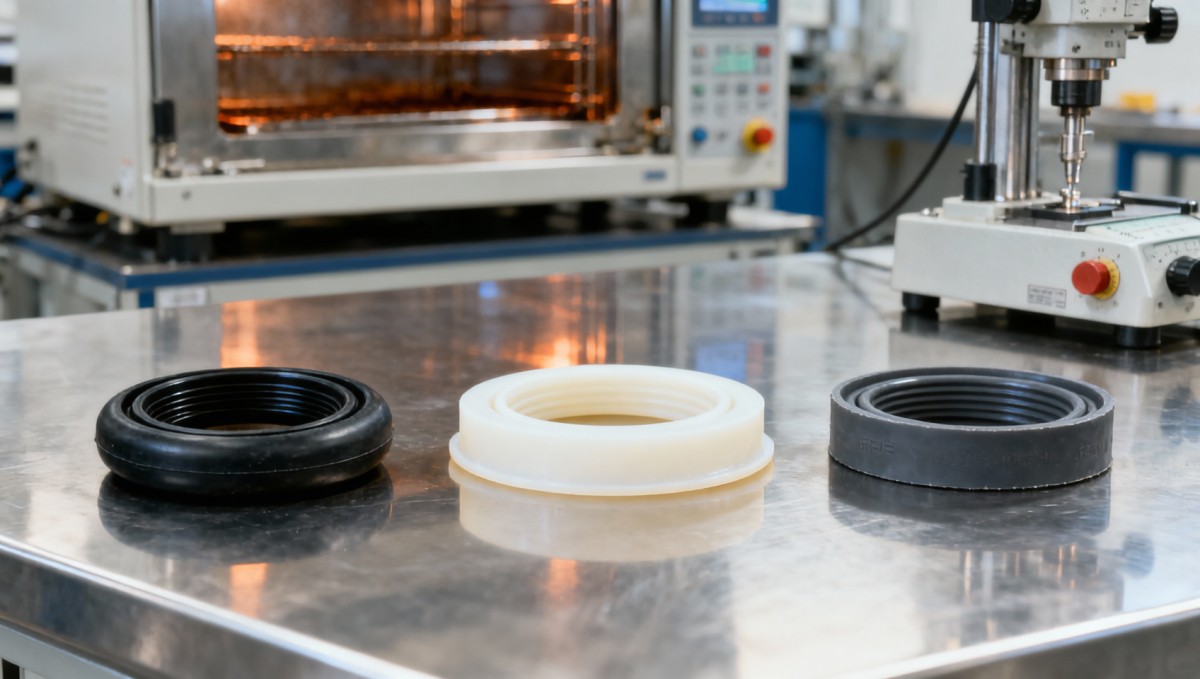
Ambient temperature alone is insufficient. Real-world thermal stress compounds with dynamic factors: cyclic loading (e.g., pump diaphragms), fluid immersion (hot glycol, steam condensate), UV exposure (outdoor HVAC housings), and electrical fields (smart sensor housings). For example, HNBR retains 92% tensile strength after 1,500 hrs at 150°C in air—but drops to 76% under simultaneous 2 MPa compressive load and steam exposure.
Procurement teams must map five environmental variables before finalizing grade selection: (1) thermal cycling frequency (≥3 cycles/day increases fatigue risk), (2) fluid compatibility class (ASTM D471 categories A–F), (3) mechanical strain range (static vs. dynamic deflection), (4) regulatory scope (ISO 10993-5 for medical, FDA 21 CFR 177.2600 for food contact), and (5) expected service life window (5-year vs. 10-year design horizon).
Field data from 37 OEMs confirms that 68% of premature failures occur not from exceeding 150°C, but from unaccounted synergistic effects—especially oxygen diffusion in thin-walled seals and antioxidant depletion in high-surface-area components. That’s why GTIIN’s industry intelligence platform cross-references material certifications with actual failure logs across 50+ verticals.
What procurement criteria separate lab-compliant from field-proven grades?
Datasheets rarely disclose compound-specific aging kinetics. Procurement professionals should demand three verification artifacts: (1) full ASTM D573 report showing modulus, elongation, and hardness at 250h/500h/1000h intervals—not just endpoint values; (2) batch-level certificate of conformance listing antioxidant type and loading (e.g., Irganox 1010 at 1.2–1.5 phr); and (3) third-party validation under simulated end-use conditions (e.g., autoclave cycling per ISO 17665 for medical devices).
Distributors and agents benefit from GTIIN’s Verified Supplier Index, which flags suppliers with ≥3 consecutive years of zero thermal-failure complaints in TradeVantage’s global incident database. This index covers 1,240 rubber compounders and converters—each assessed on traceability, lot testing frequency (minimum 1 test per 500 kg), and real-time production deviation alerts.
For fast-turnaround sourcing, prioritize vendors offering pre-qualified stock grades with documented 150°C endurance profiles—reducing qualification lead time from 8–12 weeks to ≤7 business days. GTIIN’s TradeVantage portal enables filtering by validated thermal performance, regional certification coverage (e.g., UKCA, KC Mark, ANATEL), and minimum order quantity (MOQ) flexibility (down to 25 kg for qualified samples).
Why partner with GTIIN for synthetic rubber intelligence and sourcing support?
GTIIN delivers more than specifications—we provide decision-grade intelligence calibrated to your operational reality. Our global editorial team validates every thermal performance claim against live production audits, customs manifest trends, and failure analytics from 50+ industrial sectors. When you engage with us, you gain access to:
- Real-time updates on raw material volatility (e.g., acrylonitrile price shifts impacting HNBR cost base)
- Pre-vetted supplier profiles with thermal test report transparency and MOQ negotiability
- Customized comparison matrices matching your exact operating envelope (temp, media, cycle count)
- TradeVantage-certified backlinks enhancing SEO authority for your B2B digital assets
Whether you’re validating a new medical device seal, scaling agrochemical pump gaskets, or specifying heat-resistant components for smart apparel, GTIIN equips procurement, distribution, and trade strategy teams with field-grounded insights—not theoretical ratings. Contact our materials intelligence desk today for a free thermal performance assessment, sample coordination, or customized vendor shortlist aligned to your 150°C application requirements.
 Which global manufacturing trends by sector matter most for sourcing plans?Global manufacturing trends by sector: identify sourcing risks, supplier resilience, compliance demands, and cost drivers to build smarter, more reliable procurement plans.
 What industrial trade intelligence pricing should include before you subscribeIndustrial trade intelligence pricing explained: compare coverage, data quality, access rights, and workflow value before choosing a subscription that supports smarter trade decisions.
 How an industrial trade intelligence dashboard can identify new supplier marketsDiscover how an industrial trade intelligence dashboard helps identify new supplier markets by comparing capacity, landed cost, logistics resilience, and compliance risk.
 Which global market entry barriers should exporters assess first?Global market entry barriers exporters should assess first: tariffs, compliance, buyer qualification, logistics, and payment risk. Build a practical strategy for confident market entry.
 How trade data aggregation analytics can reveal emerging supplier marketsTrade data aggregation analytics reveals emerging supplier markets by connecting trade flows, capacity signals, logistics, and compliance insights for smarter sourcing decisions.
 When an export market analysis platform can validate demand in a new marketExport market analysis platform insights help validate new-market demand through buyer fit, regulations, logistics, competition, and profitable entry conditions.
 What is driving the beauty and personal care market in the USA?Beauty and personal care in USA is driven by targeted solutions, selective premiumization, digital discovery, clean-label trust, diverse needs, and compliance. Explore key growth opportunities.
 How trade flow monitoring reports reveal changing regional demandTrade flow monitoring reports reveal changing regional demand through import volumes, sourcing shifts, product mix, logistics signals, and regulatory trends. Explore actionable market insights.
 How international market intelligence for investors reduces market-entry riskInternational market intelligence for investors reduces market-entry risk by validating demand, regulations, logistics, and competition before capital is committed.
 How international sourcing intelligence helps identify supplier risk earlyInternational sourcing intelligence helps businesses spot supplier risks early, protect supply continuity, and make smarter global procurement decisions.
 How trade data aggregation analytics reveals emerging supplier marketsTrade data aggregation analytics reveals emerging supplier markets through export trends, input flows, logistics, and regulatory signals. Discover smarter sourcing insights.
 What industrial cluster monitoring in Vietnam reveals about site riskIndustrial cluster monitoring Vietnam reveals hidden site risks across labor, utilities, logistics, compliance, and supplier dependencies. Make smarter sourcing and expansion decisions.
 Food Technology Trends Reshaping Shelf Life, Safety, and Product InnovationFood technology is reshaping shelf life, safety, and innovation. Discover the trends helping food businesses cut risk, improve compliance, and unlock stronger global market growth.
 How electronics manufacturing services are changing with low-volume demandElectronics manufacturing services are evolving fast with low-volume demand. Learn how agile EMS partners improve flexibility, compliance, sourcing resilience, and speed to market.
 How Can Buyers Reduce Procurement Risks for Electronic Components?How to reduce procurement risks for electronic components: learn how buyers assess traceability, lead times, compliance, and supplier types to avoid costly sourcing mistakes.
 What Sourcing Intelligence India Reveals About Supplier Risk and Cost ShiftsSourcing intelligence India reveals hidden supplier risk, compliance gaps, logistics pressure, and real cost shifts—helping buyers compare vendors smarter and source with more confidence.
 Fashion Trends 2026: Which Materials, Colors, and Silhouettes Are Gaining Ground?Fashion trends 2026 spotlight tactile fabrics, mineral colors, and controlled volume. Explore the materials, shades, and silhouettes shaping smarter, more wearable style.
 Smart Device Market Outlook: Key Growth Drivers, Segments, and Business OpportunitiesSmart device market trends are shifting toward system value, industrial demand, and resilient supply chains. Explore key growth drivers, high-potential segments, and business opportunities.
 How Global Trade Intelligence Services Help B2B Firms Evaluate Markets and SuppliersGlobal trade intelligence services help B2B firms compare suppliers, assess market potential, and uncover compliance, logistics, and pricing risks before costly decisions are made.
 Manufacturing Sector Updates for Investors: What Signals Matter Most in 2025?Manufacturing sector updates for investors in 2025: track orders, margins, supply chains, regulation, and exports to spot resilient manufacturers and smarter investment signals.
 How Energy Market Intelligence Helps Businesses Track Price Risks and Demand ShiftsEnergy market intelligence helps businesses spot price risks, demand shifts, and supply pressure early—improving procurement, resilience, and faster strategic decisions.





















Global Trade Insights & Industry
Our mission is to empower global exporters and importers with data-driven insights that foster strategic growth.
Search News
Popular Tags
Industry Overview
The global commercial kitchen equipment market is projected to reach $112 billion by 2027. Driven by urbanization, the rise of e-commerce food delivery, and strict hygiene regulations.