

Common bottlenecks that slow robotic assembly lines
Robotic assembly lines promise speed and precision, but daily output often drops for practical reasons rather than dramatic failures.
A feeder hesitation, a drifting sensor, or a slow program handoff can reduce cycle stability across the whole cell.
When these issues repeat, robotic assembly lines create hidden losses through micro-stops, rework, overtime, and delayed delivery windows.
Understanding bottlenecks by production scenario makes improvement faster, because different line types fail for different reasons.
That scenario-based view also helps industrial teams compare upgrades, prioritize maintenance, and protect long-term line efficiency.
Why robotic assembly lines slow down in different production scenarios
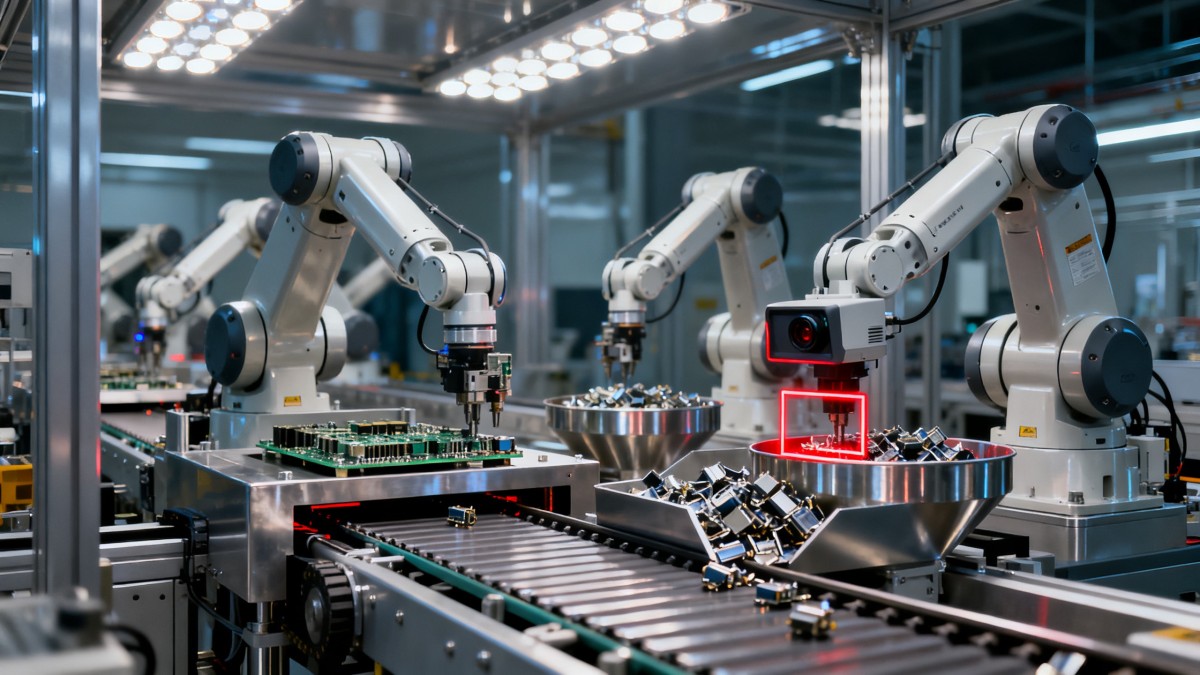
Not all robotic assembly lines face the same constraints.
A high-volume electronics line struggles with vision speed, while a mixed-model automotive station often loses time during changeovers.
A packaging assembly cell may run smoothly for hours, then stall because lightweight parts shift in unstable feeding channels.
In heavy industrial robot applications, payload, reach, and fixture rigidity become more important than software response alone.
This is why the best diagnostic path starts with operating context, not just a maintenance checklist.
TradeVantage tracks industrial shifts across global supply chains, where robotic assembly lines increasingly support shorter product cycles and stricter quality targets.
That broader market view matters because production bottlenecks are often linked to sourcing variability, engineering changes, and rising throughput expectations.
Scenario 1: High-volume lines where part feeding becomes the hidden bottleneck
In fast robotic assembly lines, part feeding failures usually appear before robot motion becomes the limit.
Bowls, trays, conveyors, and escapements must present every part in the expected orientation and timing window.
If components overlap, rotate, or bounce, the robot waits, retries, or places defective parts.
These short delays are easy to ignore, but they slowly damage OEE and increase takt-time variance.
Core judgment points for feeding-related slowdowns
- Frequent robot idle time despite normal servo health
- Random pick failures at the same transfer point
- Higher stoppage rates after material lot changes
- Manual clearing needed around feeder exits
For these robotic assembly lines, improving feeder repeatability often delivers better gains than increasing robot speed settings.
Scenario 2: Mixed-model robotic assembly lines slowed by changeover complexity
Mixed-model production creates a different problem.
Robotic assembly lines must switch programs, grippers, inspection rules, and sometimes fixtures within tight windows.
When digital recipes are incomplete or mechanical references drift, every model transition adds uncertainty.
The line may still run, but cycle consistency degrades and first-pass yield drops.
Common causes in flexible assembly environments
- Program versions not synchronized across robot and PLC
- Tooling offsets not validated after maintenance
- Part presence logic too sensitive for variant differences
- Insufficient operator guidance during recipe selection
For flexible robotic assembly lines, bottlenecks often come from coordination, not hardware limitations.
Scenario 3: Precision assembly cells where sensing and calibration limit output
Some robotic assembly lines handle small tolerances, miniature parts, or exact insertion tasks.
Here, sensor quality and calibration routines strongly influence speed.
If vision contrast changes or force thresholds drift, the robot slows itself to avoid collision or rejects usable parts.
This creates a false impression that the robot lacks capacity, when the true limit is measurement confidence.
Signals that sensing is the real bottleneck
- Cycle time increases under changing ambient light
- Frequent reteach requests despite no mechanical crash
- Insertion success improves only when speed is reduced
- Inspection rejects cluster around one camera angle
In these robotic assembly lines, stable sensing infrastructure is a throughput tool, not only a quality tool.
Scenario 4: Connected lines where software downtime interrupts robotic assembly lines
Modern robotic assembly lines depend on communication between robots, PLCs, MES platforms, and quality databases.
If handshakes lag or data mapping fails, the physical robot may be ready while the process waits for permission.
These delays are difficult to spot because they look like random line pauses.
Software bottlenecks are especially costly in globally distributed plants using shared production standards.
They also matter for exporters and importers evaluating supplier reliability, because unstable digital execution can affect delivery confidence.
How bottleneck priorities change across robotic assembly lines
Practical adaptation advice for robotic assembly lines under different needs
Improvement plans work better when matched to line behavior.
- For unstable feeding, measure empty-gripper time before changing robot motion profiles.
- For frequent model changes, lock approved recipes and require digital confirmation before restart.
- For precision work, schedule calibration by drift trend, not only by calendar interval.
- For connected robotic assembly lines, align robot, PLC, and MES logs to one clock source.
- For all scenarios, separate chronic micro-stops from major downtime during root-cause analysis.
This approach keeps investments targeted and avoids expensive upgrades that do not remove the real bottleneck.
Common misjudgments that keep robotic assembly lines underperforming
One common mistake is assuming the robot is always the slowest asset.
In many robotic assembly lines, the robot only exposes weaknesses upstream or downstream.
Another mistake is treating downtime as isolated events instead of recurring patterns linked to certain SKUs, shifts, or suppliers.
Lines also suffer when quality teams, controls engineers, and maintenance teams review separate datasets.
Without a shared timeline, a vision issue may be blamed on mechanics, or a feed problem may be blamed on code.
A final oversight is ignoring trade-side variability.
Changes in component finish, packaging, or tolerances from different sources can alter robotic assembly lines without any local engineering change.
Next steps to improve robotic assembly lines with confidence
Start with a one-week bottleneck map.
Track waiting time, retry counts, feeder stops, sensor alarms, and communication delays by product scenario.
Then rank issues by lost minutes, not by how visible they appear on the floor.
For robotic assembly lines serving export supply chains, pair production data with material-lot and supplier-change records.
That connection often reveals why the same line behaves differently over time.
TradeVantage supports this decision process by helping global businesses follow industrial trends, sourcing shifts, and operational signals across sectors.
With the right scenario diagnosis, robotic assembly lines can recover stability, protect output, and create measurable gains in quality and delivery performance.
 Which global manufacturing trends by sector matter most for sourcing plans?Global manufacturing trends by sector: identify sourcing risks, supplier resilience, compliance demands, and cost drivers to build smarter, more reliable procurement plans.
 What industrial trade intelligence pricing should include before you subscribeIndustrial trade intelligence pricing explained: compare coverage, data quality, access rights, and workflow value before choosing a subscription that supports smarter trade decisions.
 How an industrial trade intelligence dashboard can identify new supplier marketsDiscover how an industrial trade intelligence dashboard helps identify new supplier markets by comparing capacity, landed cost, logistics resilience, and compliance risk.
 Which global market entry barriers should exporters assess first?Global market entry barriers exporters should assess first: tariffs, compliance, buyer qualification, logistics, and payment risk. Build a practical strategy for confident market entry.
 How trade data aggregation analytics can reveal emerging supplier marketsTrade data aggregation analytics reveals emerging supplier markets by connecting trade flows, capacity signals, logistics, and compliance insights for smarter sourcing decisions.
 When an export market analysis platform can validate demand in a new marketExport market analysis platform insights help validate new-market demand through buyer fit, regulations, logistics, competition, and profitable entry conditions.
 What is driving the beauty and personal care market in the USA?Beauty and personal care in USA is driven by targeted solutions, selective premiumization, digital discovery, clean-label trust, diverse needs, and compliance. Explore key growth opportunities.
 How trade flow monitoring reports reveal changing regional demandTrade flow monitoring reports reveal changing regional demand through import volumes, sourcing shifts, product mix, logistics signals, and regulatory trends. Explore actionable market insights.
 How international market intelligence for investors reduces market-entry riskInternational market intelligence for investors reduces market-entry risk by validating demand, regulations, logistics, and competition before capital is committed.
 How international sourcing intelligence helps identify supplier risk earlyInternational sourcing intelligence helps businesses spot supplier risks early, protect supply continuity, and make smarter global procurement decisions.
 How trade data aggregation analytics reveals emerging supplier marketsTrade data aggregation analytics reveals emerging supplier markets through export trends, input flows, logistics, and regulatory signals. Discover smarter sourcing insights.
 What industrial cluster monitoring in Vietnam reveals about site riskIndustrial cluster monitoring Vietnam reveals hidden site risks across labor, utilities, logistics, compliance, and supplier dependencies. Make smarter sourcing and expansion decisions.
 Food Technology Trends Reshaping Shelf Life, Safety, and Product InnovationFood technology is reshaping shelf life, safety, and innovation. Discover the trends helping food businesses cut risk, improve compliance, and unlock stronger global market growth.
 How electronics manufacturing services are changing with low-volume demandElectronics manufacturing services are evolving fast with low-volume demand. Learn how agile EMS partners improve flexibility, compliance, sourcing resilience, and speed to market.
 How Can Buyers Reduce Procurement Risks for Electronic Components?How to reduce procurement risks for electronic components: learn how buyers assess traceability, lead times, compliance, and supplier types to avoid costly sourcing mistakes.
 What Sourcing Intelligence India Reveals About Supplier Risk and Cost ShiftsSourcing intelligence India reveals hidden supplier risk, compliance gaps, logistics pressure, and real cost shifts—helping buyers compare vendors smarter and source with more confidence.
 Fashion Trends 2026: Which Materials, Colors, and Silhouettes Are Gaining Ground?Fashion trends 2026 spotlight tactile fabrics, mineral colors, and controlled volume. Explore the materials, shades, and silhouettes shaping smarter, more wearable style.
 Smart Device Market Outlook: Key Growth Drivers, Segments, and Business OpportunitiesSmart device market trends are shifting toward system value, industrial demand, and resilient supply chains. Explore key growth drivers, high-potential segments, and business opportunities.
 How Global Trade Intelligence Services Help B2B Firms Evaluate Markets and SuppliersGlobal trade intelligence services help B2B firms compare suppliers, assess market potential, and uncover compliance, logistics, and pricing risks before costly decisions are made.
 Manufacturing Sector Updates for Investors: What Signals Matter Most in 2025?Manufacturing sector updates for investors in 2025: track orders, margins, supply chains, regulation, and exports to spot resilient manufacturers and smarter investment signals.
 How Energy Market Intelligence Helps Businesses Track Price Risks and Demand ShiftsEnergy market intelligence helps businesses spot price risks, demand shifts, and supply pressure early—improving procurement, resilience, and faster strategic decisions.





















Global Trade Insights & Industry
Our mission is to empower global exporters and importers with data-driven insights that foster strategic growth.
Search News
Popular Tags
Industry Overview
The global commercial kitchen equipment market is projected to reach $112 billion by 2027. Driven by urbanization, the rise of e-commerce food delivery, and strict hygiene regulations.