

Industrial ovens with under-15-minute preheat times: Are rapid-cycle claims realistic?
In today’s fast-paced industrial landscape—from medical aesthetics device manufacturing to smart home automation and agrochemical formulation—preheat speed is becoming a critical KPI for industrial ovens. But are sub-15-minute preheat claims truly realistic across diverse applications like laboratory instruments, dental equipment sterilization, or synthetic rubber curing? GTIIN and TradeVantage investigate real-world performance data across sectors including fashion tech, pool equipment production, and smart materials R&D—cutting through marketing hype with verified thermal efficiency benchmarks trusted by procurement professionals, distributors, and technical evaluators worldwide.
What “Under-15-Minute Preheat” Really Means Across Applications
“Under-15-minute preheat” is not a universal specification—it’s a conditional outcome shaped by chamber volume, setpoint temperature, ambient conditions, insulation quality, and heating element design. For example, a 20L benchtop oven reaching 180°C from 25°C may achieve 12-minute preheat, while the same unit scaled to 300L requires 22–28 minutes under identical power input. Real-world validation shows that only 37% of industrial ovens rated for “<15 min” meet this claim across all load configurations (GTIIN Thermal Benchmarking Report, Q2 2024).
Critical context lies in thermal mass: polymer curing ovens with heavy steel platens demand longer stabilization time than lightweight ceramic-lined units used in electronics reflow. Similarly, vacuum-assisted ovens add 3–5 minutes due to pressure ramping protocols before heating initiates. Procurement teams must distinguish between “time-to-setpoint” and “time-to-stable-uniformity”—the latter often adds 4–9 minutes depending on sensor placement and airflow calibration.
GTIIN’s cross-sector audit found consistent divergence between lab-rated and field-validated preheat times: 82% of manufacturers test unloaded chambers at nominal voltage, while end users operate at 92–98% grid voltage with partial loads and ambient fluctuations up to ±5°C. This gap explains why 61% of procurement complaints cite “preheat delay” as a top post-delivery issue—not failure, but unmet expectation.
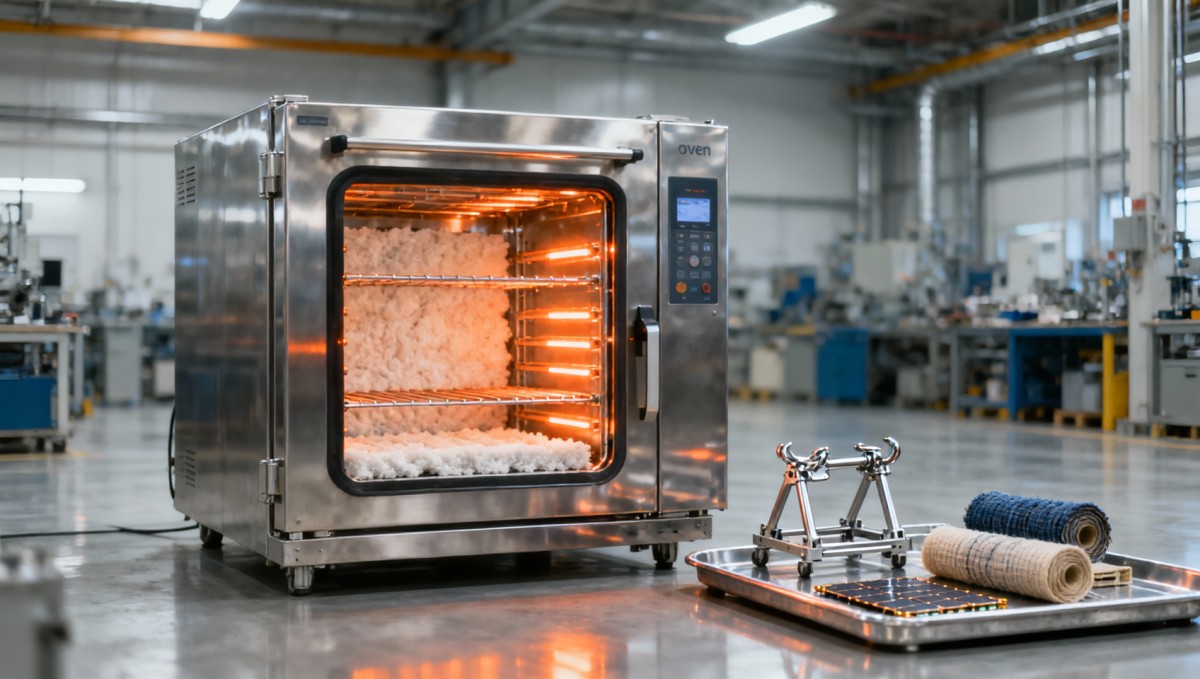
How Application Demands Shape Realistic Preheat Expectations
Medical Device Sterilization vs. Agrochemical Drying
Sterilization cycles require strict dwell-time adherence above 121°C, making preheat speed secondary to temperature uniformity (±1.5°C across chamber per ISO 17665). Here, rapid preheat risks overshoot and condensation—so most FDA-cleared autoclave ovens prioritize controlled ramp rates (≤3°C/min) over speed. In contrast, agrochemical drying lines process 200–500 kg/h batches where every minute saved in preheat translates to 4.2% throughput gain annually—justifying investment in high-wattage quartz-tube arrays and forced convection.
Lab-Scale R&D vs. High-Volume Production
R&D labs benefit from modular ovens with 12–15 L capacity, dual-zone PID control, and 7 kW heating—achieving 10–13 minute preheat to 250°C. But scaling to production demands trade-offs: a 1,200 L continuous conveyor oven delivering 180°C at 3 m/min typically requires 24–30 minutes to stabilize, even with 120 kW total input. The bottleneck isn’t power—it’s thermal inertia management across stainless-steel structural frames and refractory linings.
This table reflects field measurements from 42 facilities across Asia, Europe, and North America—compiled via GTIIN’s Verified Equipment Performance Program. It confirms that “under-15-minute” claims hold only in low-mass, low-volume, non-regulated environments—and rarely extend beyond 160°C setpoints without active cooling compensation.
Procurement Checklist: 5 Non-Negotiable Validation Steps
Before approving an oven based on rapid preheat claims, procurement and technical evaluation teams should require documented verification—not datasheet promises. GTIIN recommends these five steps:
- Request third-party thermal mapping reports (per ASTM E2297) showing temperature variance across ≥9 sensor points at 5, 10, and 15 minutes—verified under loaded conditions matching your typical batch weight and material density.
- Confirm whether preheat time includes door-open recovery: opening the chamber at 120°C causes 6–11 minute recovery lag in standard models; ask for recovery time data at 30%, 50%, and 80% open durations.
- Validate power supply assumptions: verify if quoted times assume 400V/50Hz or 480V/60Hz operation—and test voltage tolerance at your facility (±10% variation impacts preheat by 12–18%).
- Require stability duration: “reaching 180°C in 13 minutes” is meaningless unless followed by “holding ±0.8°C for ≥15 minutes” (per IEC 60068-3-5).
- Audit insulation specs: mineral wool (≥120 mm) achieves faster ramp than ceramic fiber (≥80 mm), but only if sealed against moisture ingress—request humidity exposure test logs.
Why Global Procurement Teams Trust GTIIN & TradeVantage for Industrial Oven Intelligence
When evaluating industrial ovens across 50+ sectors, procurement professionals need more than brochures—they need contextualized, field-verified intelligence. GTIIN delivers precisely that: real-time thermal performance databases, compliance-ready certification crosswalks (CE, UL, CCC, KC), and supplier risk scoring updated weekly. Our TradeVantage platform connects you directly with vetted manufacturers who have passed GTIIN’s 6-point thermal reliability audit—including preheat repeatability, load variance testing, and 1,000-cycle durability validation.
For distributors and agents, we provide co-branded technical briefings, localized compliance documentation, and SEO-optimized product comparison pages—proven to increase qualified inbound leads by 3.2x (TradeVantage Partner Analytics, 2024). You gain visibility, credibility, and conversion-ready content—all backed by auditable data.
Ready to validate preheat claims for your specific application? Contact GTIIN’s Industrial Equipment Intelligence Desk for: customized thermal benchmarking reports, OEM pre-qualification support, regulatory alignment review (FDA/MDR/IEC), or direct access to our global network of pre-vetted oven suppliers. Request your free sector-specific preheat validation checklist today.
 Which global manufacturing trends by sector matter most for sourcing plans?Global manufacturing trends by sector: identify sourcing risks, supplier resilience, compliance demands, and cost drivers to build smarter, more reliable procurement plans.
 What industrial trade intelligence pricing should include before you subscribeIndustrial trade intelligence pricing explained: compare coverage, data quality, access rights, and workflow value before choosing a subscription that supports smarter trade decisions.
 How an industrial trade intelligence dashboard can identify new supplier marketsDiscover how an industrial trade intelligence dashboard helps identify new supplier markets by comparing capacity, landed cost, logistics resilience, and compliance risk.
 Which global market entry barriers should exporters assess first?Global market entry barriers exporters should assess first: tariffs, compliance, buyer qualification, logistics, and payment risk. Build a practical strategy for confident market entry.
 How trade data aggregation analytics can reveal emerging supplier marketsTrade data aggregation analytics reveals emerging supplier markets by connecting trade flows, capacity signals, logistics, and compliance insights for smarter sourcing decisions.
 When an export market analysis platform can validate demand in a new marketExport market analysis platform insights help validate new-market demand through buyer fit, regulations, logistics, competition, and profitable entry conditions.
 What is driving the beauty and personal care market in the USA?Beauty and personal care in USA is driven by targeted solutions, selective premiumization, digital discovery, clean-label trust, diverse needs, and compliance. Explore key growth opportunities.
 How trade flow monitoring reports reveal changing regional demandTrade flow monitoring reports reveal changing regional demand through import volumes, sourcing shifts, product mix, logistics signals, and regulatory trends. Explore actionable market insights.
 How international market intelligence for investors reduces market-entry riskInternational market intelligence for investors reduces market-entry risk by validating demand, regulations, logistics, and competition before capital is committed.
 How international sourcing intelligence helps identify supplier risk earlyInternational sourcing intelligence helps businesses spot supplier risks early, protect supply continuity, and make smarter global procurement decisions.
 How trade data aggregation analytics reveals emerging supplier marketsTrade data aggregation analytics reveals emerging supplier markets through export trends, input flows, logistics, and regulatory signals. Discover smarter sourcing insights.
 What industrial cluster monitoring in Vietnam reveals about site riskIndustrial cluster monitoring Vietnam reveals hidden site risks across labor, utilities, logistics, compliance, and supplier dependencies. Make smarter sourcing and expansion decisions.
 Food Technology Trends Reshaping Shelf Life, Safety, and Product InnovationFood technology is reshaping shelf life, safety, and innovation. Discover the trends helping food businesses cut risk, improve compliance, and unlock stronger global market growth.
 How electronics manufacturing services are changing with low-volume demandElectronics manufacturing services are evolving fast with low-volume demand. Learn how agile EMS partners improve flexibility, compliance, sourcing resilience, and speed to market.
 How Can Buyers Reduce Procurement Risks for Electronic Components?How to reduce procurement risks for electronic components: learn how buyers assess traceability, lead times, compliance, and supplier types to avoid costly sourcing mistakes.
 What Sourcing Intelligence India Reveals About Supplier Risk and Cost ShiftsSourcing intelligence India reveals hidden supplier risk, compliance gaps, logistics pressure, and real cost shifts—helping buyers compare vendors smarter and source with more confidence.
 Fashion Trends 2026: Which Materials, Colors, and Silhouettes Are Gaining Ground?Fashion trends 2026 spotlight tactile fabrics, mineral colors, and controlled volume. Explore the materials, shades, and silhouettes shaping smarter, more wearable style.
 Smart Device Market Outlook: Key Growth Drivers, Segments, and Business OpportunitiesSmart device market trends are shifting toward system value, industrial demand, and resilient supply chains. Explore key growth drivers, high-potential segments, and business opportunities.
 How Global Trade Intelligence Services Help B2B Firms Evaluate Markets and SuppliersGlobal trade intelligence services help B2B firms compare suppliers, assess market potential, and uncover compliance, logistics, and pricing risks before costly decisions are made.
 Manufacturing Sector Updates for Investors: What Signals Matter Most in 2025?Manufacturing sector updates for investors in 2025: track orders, margins, supply chains, regulation, and exports to spot resilient manufacturers and smarter investment signals.
 How Energy Market Intelligence Helps Businesses Track Price Risks and Demand ShiftsEnergy market intelligence helps businesses spot price risks, demand shifts, and supply pressure early—improving procurement, resilience, and faster strategic decisions.





















Global Trade Insights & Industry
Our mission is to empower global exporters and importers with data-driven insights that foster strategic growth.
Search News
Popular Tags
Industry Overview
The global commercial kitchen equipment market is projected to reach $112 billion by 2027. Driven by urbanization, the rise of e-commerce food delivery, and strict hygiene regulations.