

How to Select Industrial Instrumentation for Harsh Process Environments
It often starts with a familiar argument in a plant meeting or during a maintenance review: the instrument on paper looks suitable, but the one installed in the field keeps drifting, clogging, corroding, or failing much sooner than expected. In harsh process environments, that gap between specification sheets and real operating conditions becomes expensive very quickly. A temperature transmitter that is technically within range may still fail because of thermal cycling. A pressure device may survive nominal pressure but not repeated pulsation. A level instrument may be chemically compatible in theory and still become unreliable because vapor, foam, buildup, or washdown conditions were not considered early enough.
Many selection problems happen not because the team ignores the basics, but because the buying decision gets narrowed too early to range, output, and price. When shutdown risk, safety exposure, calibration burden, spare part complexity, and enclosure integrity are treated as secondary details, industrial instrumentation becomes a recurring trouble source rather than a stable part of the process. If you are trying to make a better choice before placing an order, it helps to slow the evaluation down and judge the environment first, then the measurement principle, and only after that the model options.
One useful correction is to stop asking, “Which instrument matches the process value?” and start asking, “What exactly will this instrument live through every day?” That small shift usually changes the shortlist. In severe environments, the medium is only one part of the story. The instrument also faces cleaning routines, ambient heat, cold starts, vibration from rotating equipment, operator handling, cable stress, ingress from moisture, and sometimes aggressive combinations of all of them at once.
Where selection usually goes wrong
A common mistake is treating harsh service as a single issue, usually corrosion or high temperature. In practice, failure often comes from stacked stress. A sensor body may tolerate a corrosive fluid, but the seal material may not. The electronics may be protected from the process, yet still degrade in a hot enclosure with poor ventilation. The probe may read accurately in steady operation, then lose reliability during startup because the process is turbulent, condensing, or coated with solids.
Another weak point is assuming that an instrument used successfully in one unit can simply be repeated in another. Similar media does not mean similar service. A line close to a pump behaves differently from a quiet tank nozzle. Outdoor installation is not the same as sheltered indoor use. Washdown areas create different sealing demands than dry process rooms. Even if two devices measure the same variable, their survivability may be determined by installation geometry and maintenance access rather than by sensing performance alone.
That is why industrial instrumentation selection for severe duty should be treated as an application review, not a catalog exercise. The goal is not to find the broadest feature list. It is to reduce uncertainty around actual operating stress.
Start with the environment before the instrument type
Before comparing technologies, define the environment in layers. The first layer is the process itself: temperature, pressure, chemical exposure, viscosity, solids content, density variation, and whether the process is continuous, batch, or cyclic. The second layer is operating behavior: startup conditions, shutdown conditions, cleaning methods, pressure spikes, vacuum events, and whether the process value changes smoothly or violently. The third layer is surrounding exposure: ambient temperature, humidity, UV, salt, dust, vibration, hose-down cleaning, and installation height or accessibility.
This is the stage where many teams discover that the “normal operating condition” written in a request form is too narrow. Instruments fail in the extremes, transitions, and exceptions. If a line occasionally sees steam cleaning, occasional overpressure, crystallization, or slurry carryover, that information matters as much as the average process reading. It may influence diaphragm material, wetted parts, enclosure rating, impulse line design, remote sealing, or whether a contactless method is safer than an intrusive one.
When reviewing harsh environments, it also helps to separate “must survive” from “must measure accurately.” Some devices can physically withstand the service but not maintain stable performance. Others can produce accurate readings in clean conditions but become maintenance-heavy under contamination or coating. That distinction keeps the discussion realistic.
Matching the measurement principle to field reality
Once the environment is clear, the next step is choosing a measurement approach that is naturally tolerant of those conditions. This is often more important than chasing the highest specification number.
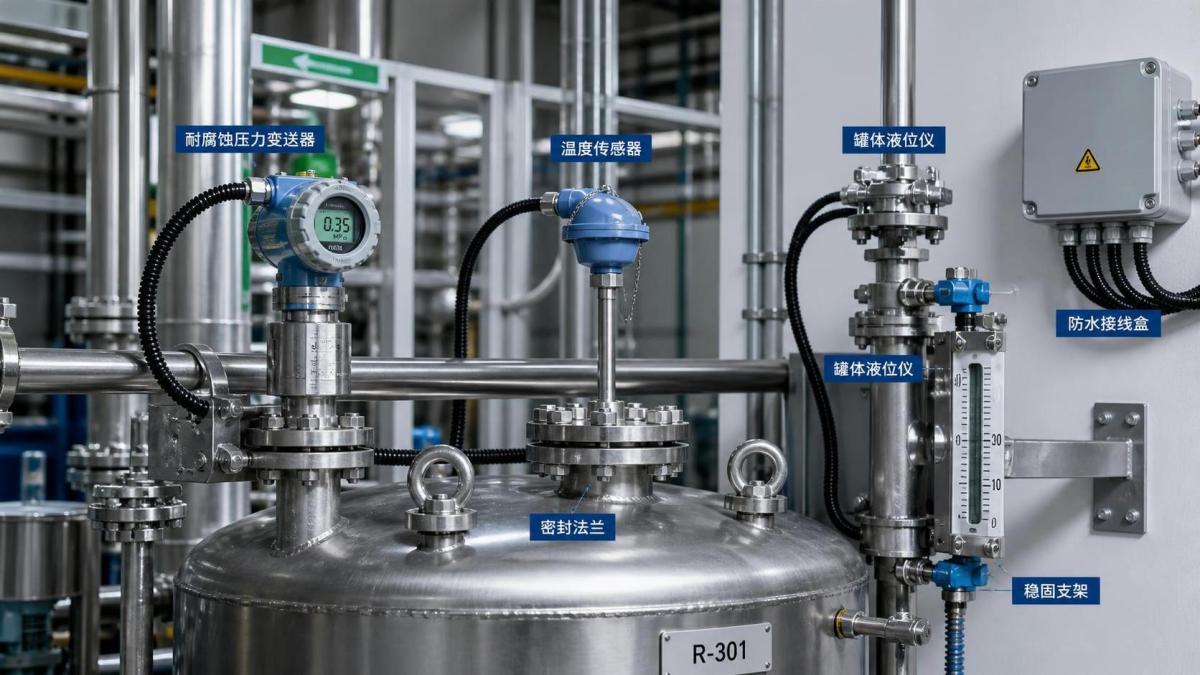
For pressure measurement, evaluators frequently focus on pressure range and output protocol first. In rough service, attention should shift to pulsation, overpressure frequency, media plugging risk, and temperature transfer into the sensing element. If the process contains solids or sticky material, direct mounting may create long-term maintenance problems. A seal arrangement, flush connection, or a different tapping location may be more important than the transmitter electronics. If vibration is strong, mechanical stress relief and mounting design matter almost as much as the sensor itself.
For temperature points, the sensor element is only part of the decision. Thermal response, sheath material, thermowell design, insertion length, and mechanical fatigue all affect reliability. In very dynamic or high-velocity service, a poor thermowell choice can become a durability issue. In corrosive or hygienic service, the assembly details often decide whether calibration remains stable over time.
Level measurement is where harsh environments expose weak assumptions quickly. Foam, vapor, condensation, coating, turbulence, narrow vessels, internal obstructions, and changing dielectric properties can make a theoretically suitable method unreliable in day-to-day operation. In some tanks, a non-contact method reduces contamination and maintenance concerns. In others, a guided method works better because surface conditions are too unstable. Selection should be based on vessel behavior, not only product type.
Flow measurement deserves the same discipline. Dirty fluids, entrained gas, conductive properties, abrasion, and required straight pipe length all affect what will work in reality. A meter that performs well in a clean utility line may become a poor choice in slurry, mixed-phase, or variable-flow service. If the installation area is cramped, that limitation must be considered early, because piping compromises can reduce performance more than the meter specification suggests.
Materials and sealing details are not small details
When equipment is selected under time pressure, teams often confirm that the main wetted metal is compatible and move on. That is not enough. In harsh process areas, the weak point may be an elastomer, gasket, cable gland, potting compound, window material, or coating. A chemically resistant body does not protect a seal that swells, hardens, or cracks under cleaning agents or temperature cycling.
It is worth reviewing all contact and near-contact materials, including process seals, fill fluids where relevant, cable jackets, terminal housing materials, and any exposed fasteners in corrosive atmospheres. In marine, chemical, mining, and high-humidity installations, atmospheric corrosion can damage external parts even when the process side is fully compatible.
Sealing integrity also needs a practical view. A device with a suitable ingress rating can still become vulnerable if conduit entries are poorly oriented, if temperature swings create breathing and condensation, or if field wiring practices leave weak points. If the application includes frequent washdown or outdoor exposure, the enclosure decision should be tied to installation method, not treated as a label on the datasheet.
Do not separate certification from application review
In demanding industrial settings, certification and compliance requirements should be checked while the application is being defined, not after the instrument type has been chosen. Hazardous location requirements, regional electrical expectations, industry-specific hygiene or material demands, and documentation needs can narrow the acceptable options early. Leaving this review to the final procurement stage often forces late substitutions that are less suitable for the environment.
This does not mean over-specifying every point. It means understanding which approvals are mandatory, which are site preferences, and which documentation packages are expected for installation, validation, or maintenance records. The right choice is usually the one that meets the real operating and compliance demands without creating unnecessary complexity in spares and support.
Think about serviceability before approval
An instrument can be technically correct and still be a poor decision if routine access is difficult or if calibration requires frequent interruption of production. In severe environments, maintenance burden is part of the selection. Ask whether the point can be isolated safely, whether cleaning will be needed, whether drift can be detected easily, and whether replacement requires special tools or shutdown windows.
Field conditions matter here. If the instrument is mounted high above grade, near hot surfaces, or in an area with limited access, reducing service frequency may be more valuable than choosing a lower initial price. If spare part standardization matters across multiple sites, that should be built into the evaluation. For many teams, lifecycle stability comes from selecting fewer instrument families that are well understood, not from buying a different optimized model for every single point.
This is also where structured information from industrial market and supply chain sources can help. Not because it tells you which exact model to buy, but because it can highlight procurement risks around lead time, regional availability, documentation consistency, and component substitution pressure. Those factors do not replace engineering judgment, yet they influence whether a technically sound selection remains practical over the life of the asset.
A more reliable way to compare options
When several candidate instruments seem acceptable, comparing them by feature count rarely leads to the best decision. A more grounded approach is to compare them by exposure tolerance and operational consequence. Which option is least sensitive to buildup? Which one handles temperature shock better? Which design reduces leak paths? Which one remains readable and serviceable in the actual installation position? Which one creates the least maintenance intervention under expected contamination?
It can also help to write down the likely failure modes for each option before deciding. For one device, the weakness may be seal aging. For another, false readings from vapor. For another, electronics heat stress. Once likely failure modes are visible, the selection becomes less abstract. You are no longer choosing between product descriptions; you are choosing between risk patterns.
In many cases, the best answer is not the most advanced instrument, but the one with the fewest ways to become unreliable in that exact environment. Simpler designs often win in dirty, remote, or difficult-to-access installations. In other cases, a higher-spec option is justified because it avoids repeated intervention or provides better stability during harsh operating cycles. The right balance depends on the cost of failure, not just purchase price.
When to reconsider the installation instead of the instrument
Sometimes the repeated question is “Which industrial instrumentation should we use here?” when the real problem is that the installation setup is poor. If impulse lines trap condensate incorrectly, if the mounting point receives excessive vibration, if the sensor is placed in a dead zone, or if the cable route exposes the device to avoidable damage, changing models may not solve much.
It is often worth reviewing whether the sensing point can be relocated, whether a stand-off or remote arrangement would protect electronics, whether shielding or damping is needed, or whether the process connection should be redesigned to avoid plugging and coating. Harsh-environment selection works best when instrument choice and installation practice are evaluated together. Separating them creates false confidence.
Questions worth settling before purchase
By the time you approve a device, you should be reasonably clear about the worst operating condition, the real chemical and mechanical exposures, the installation constraints, the maintenance approach, and the consequence of bad readings or downtime. If any of those points are still vague, the selection is not finished.
Many people look for certainty from the datasheet, but datasheets are only part of the answer. Better decisions come from combining process understanding, field observation, maintenance input, and procurement realism. That is usually the difference between an instrument that merely fits and one that continues to perform where heat, corrosion, vibration, contamination, and pressure variation are part of normal life.
In harsh service, the safest habit is to be suspicious of easy matches. If a choice seems obvious after checking only range and material, it is probably too early to decide. A slower review at the front end usually saves more time than repeated troubleshooting later.
 When dual sourcing makes sense in a sourcing strategy for manufacturersSourcing strategy for manufacturers: learn when dual sourcing strengthens supply continuity, reduces disruption risk, and protects production without adding unnecessary complexity.
 How bulk commodities pricing affects long-term supply contractsBulk commodities pricing shapes long-term supply contracts through index rules, freight, quality, volume, and currency risk. Explore strategies for resilient costs and supply security.
 Which global manufacturing trends by sector matter most for sourcing plans?Global manufacturing trends by sector: identify sourcing risks, supplier resilience, compliance demands, and cost drivers to build smarter, more reliable procurement plans.
 What industrial trade intelligence pricing should include before you subscribeIndustrial trade intelligence pricing explained: compare coverage, data quality, access rights, and workflow value before choosing a subscription that supports smarter trade decisions.
 How an industrial trade intelligence dashboard can identify new supplier marketsDiscover how an industrial trade intelligence dashboard helps identify new supplier markets by comparing capacity, landed cost, logistics resilience, and compliance risk.
 Which global market entry barriers should exporters assess first?Global market entry barriers exporters should assess first: tariffs, compliance, buyer qualification, logistics, and payment risk. Build a practical strategy for confident market entry.
 How trade data aggregation analytics can reveal emerging supplier marketsTrade data aggregation analytics reveals emerging supplier markets by connecting trade flows, capacity signals, logistics, and compliance insights for smarter sourcing decisions.
 When an export market analysis platform can validate demand in a new marketExport market analysis platform insights help validate new-market demand through buyer fit, regulations, logistics, competition, and profitable entry conditions.
 What is driving the beauty and personal care market in the USA?Beauty and personal care in USA is driven by targeted solutions, selective premiumization, digital discovery, clean-label trust, diverse needs, and compliance. Explore key growth opportunities.
 How trade flow monitoring reports reveal changing regional demandTrade flow monitoring reports reveal changing regional demand through import volumes, sourcing shifts, product mix, logistics signals, and regulatory trends. Explore actionable market insights.
 How international market intelligence for investors reduces market-entry riskInternational market intelligence for investors reduces market-entry risk by validating demand, regulations, logistics, and competition before capital is committed.
 How international sourcing intelligence helps identify supplier risk earlyInternational sourcing intelligence helps businesses spot supplier risks early, protect supply continuity, and make smarter global procurement decisions.
 How trade data aggregation analytics reveals emerging supplier marketsTrade data aggregation analytics reveals emerging supplier markets through export trends, input flows, logistics, and regulatory signals. Discover smarter sourcing insights.
 What industrial cluster monitoring in Vietnam reveals about site riskIndustrial cluster monitoring Vietnam reveals hidden site risks across labor, utilities, logistics, compliance, and supplier dependencies. Make smarter sourcing and expansion decisions.
 Food Technology Trends Reshaping Shelf Life, Safety, and Product InnovationFood technology is reshaping shelf life, safety, and innovation. Discover the trends helping food businesses cut risk, improve compliance, and unlock stronger global market growth.
 How electronics manufacturing services are changing with low-volume demandElectronics manufacturing services are evolving fast with low-volume demand. Learn how agile EMS partners improve flexibility, compliance, sourcing resilience, and speed to market.
 How Can Buyers Reduce Procurement Risks for Electronic Components?How to reduce procurement risks for electronic components: learn how buyers assess traceability, lead times, compliance, and supplier types to avoid costly sourcing mistakes.
 What Sourcing Intelligence India Reveals About Supplier Risk and Cost ShiftsSourcing intelligence India reveals hidden supplier risk, compliance gaps, logistics pressure, and real cost shifts—helping buyers compare vendors smarter and source with more confidence.
 Fashion Trends 2026: Which Materials, Colors, and Silhouettes Are Gaining Ground?Fashion trends 2026 spotlight tactile fabrics, mineral colors, and controlled volume. Explore the materials, shades, and silhouettes shaping smarter, more wearable style.
 Smart Device Market Outlook: Key Growth Drivers, Segments, and Business OpportunitiesSmart device market trends are shifting toward system value, industrial demand, and resilient supply chains. Explore key growth drivers, high-potential segments, and business opportunities.
 How Global Trade Intelligence Services Help B2B Firms Evaluate Markets and SuppliersGlobal trade intelligence services help B2B firms compare suppliers, assess market potential, and uncover compliance, logistics, and pricing risks before costly decisions are made.




















Global Trade Insights & Industry
Our mission is to empower global exporters and importers with data-driven insights that foster strategic growth.
Search News
Popular Tags
Industry Overview
The global commercial kitchen equipment market is projected to reach $112 billion by 2027. Driven by urbanization, the rise of e-commerce food delivery, and strict hygiene regulations.