

How Much Does 3D Printing Cost per Unit for Small Batches?
How Much Does 3D Printing Cost per Unit for Small Batches?
Searching for “3D printing cost per unit small batch” estimates can leave procurement teams with quotes that are difficult to compare. The real cost depends on material, printing technology, part geometry, order quantity, and finishing requirements—not just machine time. For manufacturers and sourcing managers, inspection, shipping, and import charges can also change the economics.
There is no reliable universal price per printed part. A basic polymer fixture and a metal component requiring heat treatment and machined interfaces are different purchasing decisions, even if their dimensions look similar. The useful number is the cost of an accepted, usable part delivered to the required location. This guide explains how to establish that number and decide whether additive manufacturing makes commercial sense.
Start with the cost of a usable part
A supplier’s unit price may cover only printing and routine cleanup. It may exclude engineering review, dimensional reports, threaded inserts, coating, packaging, or freight. Another quote may include those services. Comparing the headline figures without checking scope can make the more complete offer look unnecessarily expensive.
Landed cost per accepted unit = total attributable batch cost ÷ number of accepted, usable parts.
Total attributable cost can include design preparation, production, finishing, inspection, packaging, transport, customs clearance, and applicable nonrecoverable import charges. Internal receiving or qualification costs may also matter. Keep recoverable taxes separate when your accounting treatment allows; otherwise, comparisons across supplier regions can become misleading.
The denominator matters just as much. If parts fail the agreed acceptance criteria, the quoted price does not describe their practical cost. Establish whether the supplier will replace rejected parts, who pays replacement freight, and whether the delivery commitment covers production completion or arrival at your facility.
Why the printing process changes the quotation
Technology should follow the application, not simply the lowest initial quote. Different processes produce different surface characteristics, mechanical behavior, and downstream workloads. Material names alone do not establish equivalence: a photopolymer described as “ABS-like” should not automatically be treated as interchangeable with thermoplastic ABS.
For a visual prototype, surface appearance may dominate the decision. For a production fixture, stiffness, temperature exposure, and repeated loading may matter more. A metal part with sealing surfaces or bearing seats may still need machining after printing. Those operations belong in the original estimate, not in a later budget revision.
Geometry often matters more than material weight
Buying filament or powder by weight does not mean printed parts are priced by weight alone. Tall geometry can extend build time. Overhangs can require supports. Thin walls may complicate handling, while enclosed cavities can make support or powder removal difficult. Two parts using similar material quantities can therefore require very different production effort.
Orientation creates trade-offs. Rotating a component might reduce supports but change surface quality or mechanical performance in a critical direction. For material-extrusion parts, layer direction deserves particular attention where loads act across layer interfaces. Ask the supplier to explain the proposed orientation for functional components rather than accepting an automatic layout without review.
Cost reduction should begin with features that do not affect function: unnecessary solid volume, inaccessible support regions, cosmetic requirements on hidden surfaces, or overly tight tolerances on noncritical dimensions. Hollowing a part is not automatically a saving if it creates cleaning problems or weakens the assembly.
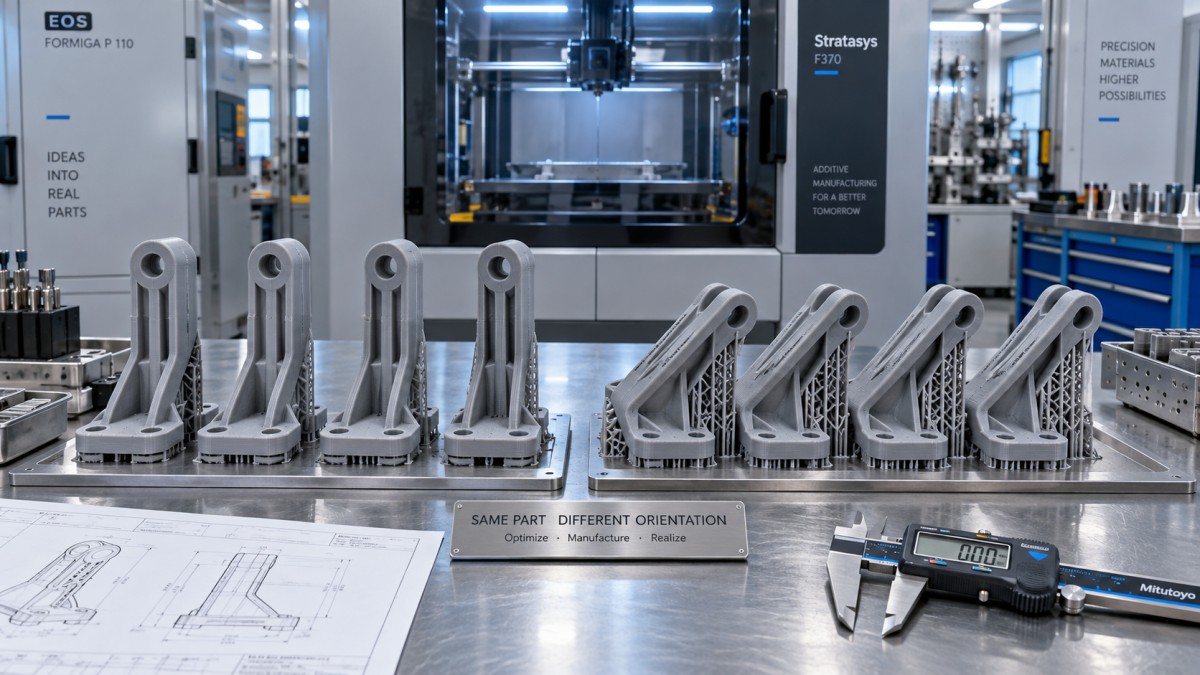
A useful design-review image shows the same component in alternative build orientations, with supports, critical faces, and removal access marked. This makes the pricing discussion concrete: the buyer can see which design decisions create machine time or manual work.
Small-batch discounts have limits
Increasing order quantity can spread file preparation, setup, and reporting costs across more units. Some processes also benefit when multiple components share a build. That does not mean doubling the quantity will halve the price. Material consumption, finishing, and individual inspection still increase with each part.
Pricing may change in steps rather than along a smooth curve. If an order exceeds available build capacity, another build may be needed. Conversely, a supplier may offer a better rate when your delivery schedule allows parts to share production capacity with other work. The saving comes from scheduling flexibility, not from volume alone.
Ask for price breaks around your actual purchasing plan: the initial qualification lot, expected replenishment order, and plausible larger release. Confirm whether the discount requires one production run or several scheduled deliveries. A lower price tied to early production can increase inventory exposure if the design changes before those parts are used.
Finishing and verification can dominate the economics
An “as-printed” component is not necessarily ready for assembly. Support removal, sanding, dyeing, coating, tapping, inserts, or secondary machining can introduce substantial manual work. Finishing requirements should identify the surfaces involved and the intended result. “Smooth finish” is too vague to support consistent quotations.
Inspection needs similar precision. Checking a few overall dimensions is different from providing traceable measurements of critical interfaces. Specify the acceptance method, sampling arrangement, and required documentation before production. Do not apply the tightest tolerance to every feature simply because one interface requires it.
Regulated or safety-related applications need an additional review. A material datasheet or supplier quality-system certificate does not, by itself, demonstrate that the finished component is approved for medical, food-contact, electrical, or other controlled use. Applicable requirements depend on the application and destination market; qualification costs must be evaluated separately.
Compare printing with the right manufacturing alternative
Small-batch 3D printing is attractive when tooling would be difficult to justify, demand remains uncertain, or geometry benefits from additive manufacturing. It can also support design iterations without committing to a mold. But simple shapes with strict dimensional requirements may be more economical to machine, even at low volume.
Injection molding introduces tooling expenditure but can offer lower recurring unit costs once volume supports that investment. Urethane casting may suit certain short-run polymer applications, although mold life, material properties, and appearance require review. Sheet-metal fabrication or standard components may avoid custom printing altogether.
A basic comparison uses the relationship total cost = fixed cost + quantity × recurring unit cost. Where an alternative has a higher fixed cost but a lower recurring cost, divide the additional fixed cost by the per-unit saving to estimate a crossover quantity. This assumes stable unit costs and equivalent acceptable output; use actual quantity-tier quotes when those assumptions do not hold.
Lead time and revision risk can change the decision. A nominally cheaper molded part is not necessarily cheaper for a project that may need another design revision. Equally, printing should not remain the default once demand stabilizes and another process becomes commercially preferable.
Send an RFQ that suppliers can price consistently
The most effective way to obtain a meaningful unit cost is to reduce ambiguity before requesting quotations. A production-ready file helps, but a file alone rarely communicates everything the supplier needs.
- Provide the model revision and a drawing identifying critical dimensions, datums, threads, and mating surfaces.
- State the application, loading conditions, temperature exposure, and relevant chemical or outdoor exposure.
- Define the material grade, or explain which properties must be met if alternatives are acceptable.
- Separate functional finishing from cosmetic finishing, and identify surfaces that may retain support marks.
- Specify quantities, delivery destination, requested arrival date, and inspection documentation.
- Request separate lines for preparation, production, finishing, inspection, and transport where practical.
For repeat orders, also ask about change control. Substituting material, changing orientation, or moving production to another machine may affect performance. Agree which changes require approval and whether the supplier retains the production settings needed for consistent replenishment.
Cross-border sourcing: evaluate the whole delivery
An overseas quote can be attractive until freight, customs processing, receiving inspection, or replacement shipping is added. Confirm the currency, quotation validity, Incoterms rule and named place, packaging arrangements, and responsibility for clearance. Customs classification should reflect the actual goods and applicable rules; “3D printed” alone is not a sufficient classification.
This broader view aligns with Global Trade Insights & Industry Network (GTIIN), a B2B information platform focused on manufacturing sectors, procurement trends, regulatory changes, and global supply chains. Its practical role is to help businesses connect production decisions with market and trade conditions—not treat supplier price as an isolated figure.
Before placing a small-batch order, establish three comparable numbers: the quoted production price, the landed cost per accepted part, and the cost of the most credible alternative process. Then confirm critical features through an agreed qualification lot where appropriate. A useful 3D printing estimate is one that survives inspection, delivery, and actual use—not merely one that looks inexpensive on the quotation.
 How to use supplier risk analysis to spot financial warning signsUse supplier risk analysis to spot cash flow pressure, debt risks, and delivery warning signs. Learn practical steps to reduce exposure and protect supply continuity.
 When dual sourcing makes sense in a sourcing strategy for manufacturersSourcing strategy for manufacturers: learn when dual sourcing strengthens supply continuity, reduces disruption risk, and protects production without adding unnecessary complexity.
 How bulk commodities pricing affects long-term supply contractsBulk commodities pricing shapes long-term supply contracts through index rules, freight, quality, volume, and currency risk. Explore strategies for resilient costs and supply security.
 Which global manufacturing trends by sector matter most for sourcing plans?Global manufacturing trends by sector: identify sourcing risks, supplier resilience, compliance demands, and cost drivers to build smarter, more reliable procurement plans.
 What industrial trade intelligence pricing should include before you subscribeIndustrial trade intelligence pricing explained: compare coverage, data quality, access rights, and workflow value before choosing a subscription that supports smarter trade decisions.
 How an industrial trade intelligence dashboard can identify new supplier marketsDiscover how an industrial trade intelligence dashboard helps identify new supplier markets by comparing capacity, landed cost, logistics resilience, and compliance risk.
 Which global market entry barriers should exporters assess first?Global market entry barriers exporters should assess first: tariffs, compliance, buyer qualification, logistics, and payment risk. Build a practical strategy for confident market entry.
 How trade data aggregation analytics can reveal emerging supplier marketsTrade data aggregation analytics reveals emerging supplier markets by connecting trade flows, capacity signals, logistics, and compliance insights for smarter sourcing decisions.
 When an export market analysis platform can validate demand in a new marketExport market analysis platform insights help validate new-market demand through buyer fit, regulations, logistics, competition, and profitable entry conditions.
 What is driving the beauty and personal care market in the USA?Beauty and personal care in USA is driven by targeted solutions, selective premiumization, digital discovery, clean-label trust, diverse needs, and compliance. Explore key growth opportunities.
 How trade flow monitoring reports reveal changing regional demandTrade flow monitoring reports reveal changing regional demand through import volumes, sourcing shifts, product mix, logistics signals, and regulatory trends. Explore actionable market insights.
 How international market intelligence for investors reduces market-entry riskInternational market intelligence for investors reduces market-entry risk by validating demand, regulations, logistics, and competition before capital is committed.
 How international sourcing intelligence helps identify supplier risk earlyInternational sourcing intelligence helps businesses spot supplier risks early, protect supply continuity, and make smarter global procurement decisions.
 How trade data aggregation analytics reveals emerging supplier marketsTrade data aggregation analytics reveals emerging supplier markets through export trends, input flows, logistics, and regulatory signals. Discover smarter sourcing insights.
 What industrial cluster monitoring in Vietnam reveals about site riskIndustrial cluster monitoring Vietnam reveals hidden site risks across labor, utilities, logistics, compliance, and supplier dependencies. Make smarter sourcing and expansion decisions.
 Food Technology Trends Reshaping Shelf Life, Safety, and Product InnovationFood technology is reshaping shelf life, safety, and innovation. Discover the trends helping food businesses cut risk, improve compliance, and unlock stronger global market growth.
 How electronics manufacturing services are changing with low-volume demandElectronics manufacturing services are evolving fast with low-volume demand. Learn how agile EMS partners improve flexibility, compliance, sourcing resilience, and speed to market.
 How Can Buyers Reduce Procurement Risks for Electronic Components?How to reduce procurement risks for electronic components: learn how buyers assess traceability, lead times, compliance, and supplier types to avoid costly sourcing mistakes.
 What Sourcing Intelligence India Reveals About Supplier Risk and Cost ShiftsSourcing intelligence India reveals hidden supplier risk, compliance gaps, logistics pressure, and real cost shifts—helping buyers compare vendors smarter and source with more confidence.
 Fashion Trends 2026: Which Materials, Colors, and Silhouettes Are Gaining Ground?Fashion trends 2026 spotlight tactile fabrics, mineral colors, and controlled volume. Explore the materials, shades, and silhouettes shaping smarter, more wearable style.
 Smart Device Market Outlook: Key Growth Drivers, Segments, and Business OpportunitiesSmart device market trends are shifting toward system value, industrial demand, and resilient supply chains. Explore key growth drivers, high-potential segments, and business opportunities.




















Global Trade Insights & Industry
Our mission is to empower global exporters and importers with data-driven insights that foster strategic growth.
Search News
Popular Tags
Industry Overview
The global commercial kitchen equipment market is projected to reach $112 billion by 2027. Driven by urbanization, the rise of e-commerce food delivery, and strict hygiene regulations.