

When Aquarium Equipment Becomes Too Complex for Home Use
As aquarium equipment evolves with smarter controls, modular systems, and advanced filtration, many home users face a growing gap between innovation and practicality. For technical evaluators, understanding when complexity improves performance—and when it creates usability, maintenance, or cost barriers—is essential. This article examines how increasingly sophisticated aquarium equipment can exceed typical household needs and what that means for product selection, market positioning, and user adoption.
In the pet supplies sector, aquarium equipment now spans far beyond heaters, pumps, and simple lights. Many systems integrate app-based monitoring, multi-stage nutrient dosing, programmable wave control, UV sterilization, automatic feeders, leak sensors, and cloud alerts. For B2B buyers, distributors, and technical assessment teams, the key question is no longer whether advanced features are available, but whether those features match actual household behavior, service capacity, and price tolerance.
This matters because home aquariums are not commercial aquaculture tanks or public exhibits. In a domestic setting, complexity can quickly turn into underused functionality, frequent support calls, higher return rates, and avoidable maintenance errors. For companies evaluating aquarium equipment for sourcing, distribution, or market entry, a practical definition of “too complex” is crucial for product planning and positioning.
Why Complexity in Aquarium Equipment Is Rising
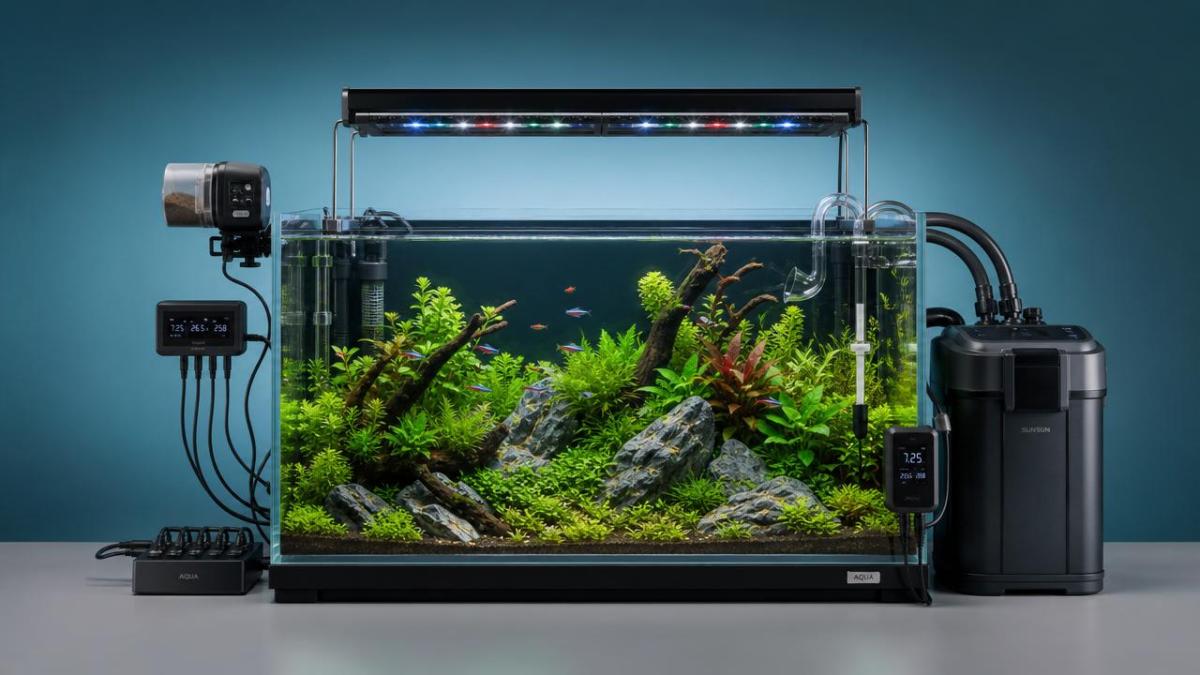
The complexity of aquarium equipment has increased for three main reasons: consumer demand for automation, the influence of reef-keeping technology on broader product lines, and the growing availability of lower-cost sensors and digital controllers. What was once premium equipment for advanced marine tanks is now appearing in mid-range freshwater setups sold for home use.
From a technical perspective, more components can improve stability. A filtration stack with mechanical, biological, and chemical media often performs better than a single-stage filter. A lighting system with 3 to 5 programmable channels can support specific plant or coral needs more accurately than a fixed-spectrum lamp. However, each added layer creates a new requirement for setup, calibration, replacement scheduling, or troubleshooting.
The shift from essential tools to integrated systems
Traditional aquarium equipment focused on 4 core functions: water movement, temperature control, filtration, and illumination. In contrast, many current systems bundle 8 to 12 functions into one ecosystem. That integration can be valuable for enthusiasts, but for average households it often means more connectors, more firmware updates, and more user decisions before the tank is even stable.
Where added features begin to affect adoption
- Setup time extends from 30–60 minutes to 2–4 hours.
- Routine maintenance can expand from weekly visual checks to 5–7 separate tasks.
- Replacement parts may include 3 or more proprietary consumables.
- User training needs increase when apps, dosing schedules, and alarm thresholds are involved.
For technical evaluators, these are not minor details. In pet and aquarium retail, a product that performs well in laboratory conditions may still fail commercially if the average user cannot install it correctly within the first weekend of ownership.
The table below outlines how aquarium equipment complexity typically increases as product architecture becomes more integrated and digitally managed.
The main takeaway is that advanced aquarium equipment is not inherently unsuitable for home use. The issue arises when feature density grows faster than user capability, service access, or willingness to maintain the system over 6 to 12 months.
When Aquarium Equipment Becomes Too Complex for Typical Households
Aquarium equipment becomes too complex for home use when operational demands exceed what most users can reliably sustain. In practical terms, this usually happens when a system requires specialized knowledge, frequent intervention, or high dependency on precise settings to avoid performance failure.
A technical evaluator should look beyond product specifications and assess behavioral fit. Many home users feed fish once or twice daily, perform partial water changes every 1 to 2 weeks, and expect equipment to operate with minimal recalibration. If a system needs weekly parameter tuning, app pairing resets, or sequential priming steps, it may already be outside mainstream home-use tolerance.
Five signs of excessive complexity
- Installation involves more than 10 steps or requires tool-assisted assembly.
- Routine maintenance requires more than 20–30 minutes per week for a small or medium tank.
- Performance depends on precise calibration that the user cannot verify visually.
- Core operation stops when one smart module, sensor, or app connection fails.
- Replacement media, parts, or accessories are proprietary and difficult to source locally.
The hidden burden of over-specification
Over-specification is a frequent issue in aquarium equipment sourcing. A home tank of 60 to 120 liters may be fitted with oversized flow systems, highly granular lighting control, or laboratory-style monitoring tools that offer little practical benefit for common tropical fish or beginner aquatic plants. The user pays more but does not necessarily gain a healthier aquarium.
This gap between capability and need often creates downstream business friction. Retail partners may see increased product inquiries, service teams may spend more time on onboarding, and warranty departments may encounter “faults” that are actually setup errors. For market-facing businesses, complexity therefore affects not only user satisfaction but also operational cost per unit sold.
Usability thresholds by household context
Not all homes use aquariums the same way. A single enthusiast maintaining a planted display tank may accept more advanced aquarium equipment than a family buying a first aquarium for children. Technical teams should map product fit by scenario instead of assuming all residential buyers value automation equally.
The table below compares typical household contexts and the point at which complexity often starts reducing adoption or long-term use.
This comparison shows that the same aquarium equipment can be either appropriate or excessive depending on user discipline, livestock sensitivity, and after-sales support. Complexity should always be evaluated relative to the end user, not in absolute terms.
Key Evaluation Criteria for Technical Assessors and B2B Buyers
For sourcing teams, importers, and category managers, the goal is not to avoid advanced aquarium equipment altogether. The goal is to match technical sophistication with market maturity, retail education capability, and lifecycle support. A strong evaluation model should cover functionality, maintenance burden, compatibility, and post-sale risk.
1. Installation and onboarding complexity
Assess how many actions are required before safe operation. A well-designed home-use product should ideally reach baseline functionality in 6 to 8 steps. If assembly involves tubing routing, controller synchronization, media layering, software registration, and threshold programming, the product may need a specialist retail channel rather than a mass-market one.
2. Maintenance frequency and failure points
Technical assessment should identify whether the system adds weekly, monthly, or quarterly tasks. Filters, UV lamps, dosing lines, impellers, sensors, and feed mechanisms all have different service cycles. When 4 or more maintenance intervals overlap, average home users are more likely to skip them, leading to performance decline or livestock stress.
3. Dependence on proprietary ecosystems
Some aquarium equipment performs best only when paired with brand-specific controllers, media cartridges, or app platforms. That can increase basket size, but it also raises replacement risk. If a distributor cannot ensure accessory continuity for 12 to 24 months, the product may create avoidable dissatisfaction in the home market.
4. Serviceability in local markets
A product should not be evaluated only by factory specifications. Spare part availability, multilingual instructions, voltage compatibility, and response time for technical support are equally important. In many regions, a 48-hour support delay can turn a manageable issue into fish loss, algae outbreaks, or complete system shutdown.
Practical evaluation checklist
- Can a first-time user complete setup in under 90 minutes?
- Are core consumables replaceable without brand-exclusive tools?
- Does failure of one module disable the full system or only one function?
- Are instructions visual, multilingual, and usable on mobile screens?
- Can retailers explain the main operating logic in 3 minutes or less?
- Are spare parts expected to remain available for at least 1 year?
These criteria help technical evaluators distinguish premium aquarium equipment from unnecessarily complicated products. High-value design usually simplifies critical tasks even when the internal engineering is advanced.
Market Positioning: Where Advanced Features Add Real Value
Advanced aquarium equipment can absolutely succeed in the pet supplies market when it is positioned for the right segment. The mistake is treating all innovation as mainstream demand. In reality, product-market fit may differ significantly between beginner freshwater buyers, serious aquascapers, and marine hobbyists.
For example, programmable spectrum control may be a real selling point in planted tanks or coral systems, where photoperiod and intensity affect growth. By contrast, in a low-maintenance community aquarium, a simple timer and stable output may deliver better customer satisfaction than 7-channel customization that most users never adjust after day 1.
Segmenting by user capability
A practical way to position aquarium equipment is to separate buyers into at least 3 groups: entry-level, committed hobbyist, and advanced specialist. Each group has different tolerance for setup time, maintenance frequency, and troubleshooting complexity. Products aimed at the wrong segment often generate low repeat purchase rates even if hardware quality is strong.
Recommended positioning logic
- Entry-level: prioritize reliability, presets, and easy cleaning.
- Committed hobbyist: offer modular upgrades and selective customization.
- Advanced specialist: support detailed control, monitoring, and expansion.
This structure helps importers and distributors reduce mismatch. It also supports clearer packaging, better product training, and lower return rates because the performance promise becomes more realistic for each buyer group.
Implications for exporters and category managers
For exporters, the best commercial opportunity may not be the most feature-heavy aquarium equipment. In many channels, products that reduce setup friction by 20% to 30% can outperform feature-rich alternatives because they convert better at retail and require less after-sales support. Simpler architecture can also shorten training time for dealers and improve listing clarity on e-commerce platforms.
For category managers, the key is to evaluate not just unit margin but total support burden. If one advanced SKU generates 3 times as many service tickets as a mid-range model, the operational cost may erase its premium pricing advantage. This is especially relevant in cross-border trade, where spare parts, user education, and returns handling can be more expensive than the initial product difference.
How to Balance Innovation, Practicality, and Adoption
The most successful aquarium equipment for home use typically follows a simple principle: advanced engineering should reduce user burden, not increase it. Technical complexity behind the product is acceptable if the user experience remains clear, stable, and forgiving.
Design and sourcing recommendations
- Favor preset operating modes for common tank sizes such as 30L, 60L, and 120L.
- Choose modular aquarium equipment where advanced functions can be added later.
- Reduce dependence on constant app connectivity for essential operation.
- Standardize consumables where possible to improve local replacement access.
- Provide maintenance intervals in clear weekly, monthly, and annual schedules.
A four-step practical approach
- Define the target user and tank type before selecting features.
- Test setup time with non-expert users under real home conditions.
- Calculate 12-month maintenance effort, not just purchase price.
- Validate spare parts and support workflow before market rollout.
When this process is followed, aquarium equipment portfolios become easier to manage and easier to sell. More importantly, end users are more likely to keep the product in service, which supports repeat sales in media, treatment products, food, lighting upgrades, and other pet supply categories.
For technical evaluators, complexity should be treated as a measurable commercial variable, not just an engineering trait. The right aquarium equipment is the one that delivers stable aquatic conditions with an acceptable workload, a realistic support model, and a clear value proposition for the intended home user.
If you are assessing aquarium equipment for sourcing, distribution, or market positioning, a disciplined review of usability thresholds, maintenance cycles, and feature-to-segment fit can reduce risk across the supply chain. To explore more practical product insights, category trends, and trade-focused analysis in the pet supplies sector, contact us today, request a tailored evaluation framework, or learn more about solution-focused market intelligence from TradeVantage.
 How an industrial trade intelligence dashboard can identify new supplier marketsDiscover how an industrial trade intelligence dashboard helps identify new supplier markets by comparing capacity, landed cost, logistics resilience, and compliance risk.
 Which global market entry barriers should exporters assess first?Global market entry barriers exporters should assess first: tariffs, compliance, buyer qualification, logistics, and payment risk. Build a practical strategy for confident market entry.
 How trade data aggregation analytics can reveal emerging supplier marketsTrade data aggregation analytics reveals emerging supplier markets by connecting trade flows, capacity signals, logistics, and compliance insights for smarter sourcing decisions.
 When an export market analysis platform can validate demand in a new marketExport market analysis platform insights help validate new-market demand through buyer fit, regulations, logistics, competition, and profitable entry conditions.
 What is driving the beauty and personal care market in the USA?Beauty and personal care in USA is driven by targeted solutions, selective premiumization, digital discovery, clean-label trust, diverse needs, and compliance. Explore key growth opportunities.
 How trade flow monitoring reports reveal changing regional demandTrade flow monitoring reports reveal changing regional demand through import volumes, sourcing shifts, product mix, logistics signals, and regulatory trends. Explore actionable market insights.
 How international market intelligence for investors reduces market-entry riskInternational market intelligence for investors reduces market-entry risk by validating demand, regulations, logistics, and competition before capital is committed.
 How international sourcing intelligence helps identify supplier risk earlyInternational sourcing intelligence helps businesses spot supplier risks early, protect supply continuity, and make smarter global procurement decisions.
 How trade data aggregation analytics reveals emerging supplier marketsTrade data aggregation analytics reveals emerging supplier markets through export trends, input flows, logistics, and regulatory signals. Discover smarter sourcing insights.
 What industrial cluster monitoring in Vietnam reveals about site riskIndustrial cluster monitoring Vietnam reveals hidden site risks across labor, utilities, logistics, compliance, and supplier dependencies. Make smarter sourcing and expansion decisions.
 Food Technology Trends Reshaping Shelf Life, Safety, and Product InnovationFood technology is reshaping shelf life, safety, and innovation. Discover the trends helping food businesses cut risk, improve compliance, and unlock stronger global market growth.
 How electronics manufacturing services are changing with low-volume demandElectronics manufacturing services are evolving fast with low-volume demand. Learn how agile EMS partners improve flexibility, compliance, sourcing resilience, and speed to market.
 How Can Buyers Reduce Procurement Risks for Electronic Components?How to reduce procurement risks for electronic components: learn how buyers assess traceability, lead times, compliance, and supplier types to avoid costly sourcing mistakes.
 What Sourcing Intelligence India Reveals About Supplier Risk and Cost ShiftsSourcing intelligence India reveals hidden supplier risk, compliance gaps, logistics pressure, and real cost shifts—helping buyers compare vendors smarter and source with more confidence.
 Fashion Trends 2026: Which Materials, Colors, and Silhouettes Are Gaining Ground?Fashion trends 2026 spotlight tactile fabrics, mineral colors, and controlled volume. Explore the materials, shades, and silhouettes shaping smarter, more wearable style.
 Smart Device Market Outlook: Key Growth Drivers, Segments, and Business OpportunitiesSmart device market trends are shifting toward system value, industrial demand, and resilient supply chains. Explore key growth drivers, high-potential segments, and business opportunities.
 How Global Trade Intelligence Services Help B2B Firms Evaluate Markets and SuppliersGlobal trade intelligence services help B2B firms compare suppliers, assess market potential, and uncover compliance, logistics, and pricing risks before costly decisions are made.
 Manufacturing Sector Updates for Investors: What Signals Matter Most in 2025?Manufacturing sector updates for investors in 2025: track orders, margins, supply chains, regulation, and exports to spot resilient manufacturers and smarter investment signals.
 How Energy Market Intelligence Helps Businesses Track Price Risks and Demand ShiftsEnergy market intelligence helps businesses spot price risks, demand shifts, and supply pressure early—improving procurement, resilience, and faster strategic decisions.
 Precision Hardware Tools Market: Key Demand Drivers, Segments, and Growth OutlookPrecision hardware tools market trends are reshaping sourcing, compliance, and automation. Explore key demand drivers, segment shifts, regional supply patterns, and growth opportunities.
 How to Use Customs Import Data to Find Buyers, Track Competitors, and Spot Demand?Customs import data helps you find real buyers, track competitors, and spot demand shifts early. Learn practical ways to turn trade records into smarter global business decisions.





















Global Trade Insights & Industry
Our mission is to empower global exporters and importers with data-driven insights that foster strategic growth.
Search News
Popular Tags
Industry Overview
The global commercial kitchen equipment market is projected to reach $112 billion by 2027. Driven by urbanization, the rise of e-commerce food delivery, and strict hygiene regulations.