

When do hotel room service carts slow staff down?
Hotel room service carts are built to save time, reduce walking, and support faster guest response.
Yet in many hotels, the same carts can quietly create friction across service, housekeeping, and corridor movement.
As guest expectations rise and staffing remains tight, operators are rethinking when hotel room service carts improve productivity and when they slow staff down.
The answer matters because delays affect labor cost, order accuracy, hallway safety, and the overall guest experience.
Hotel workflows are changing, and cart efficiency is under new pressure
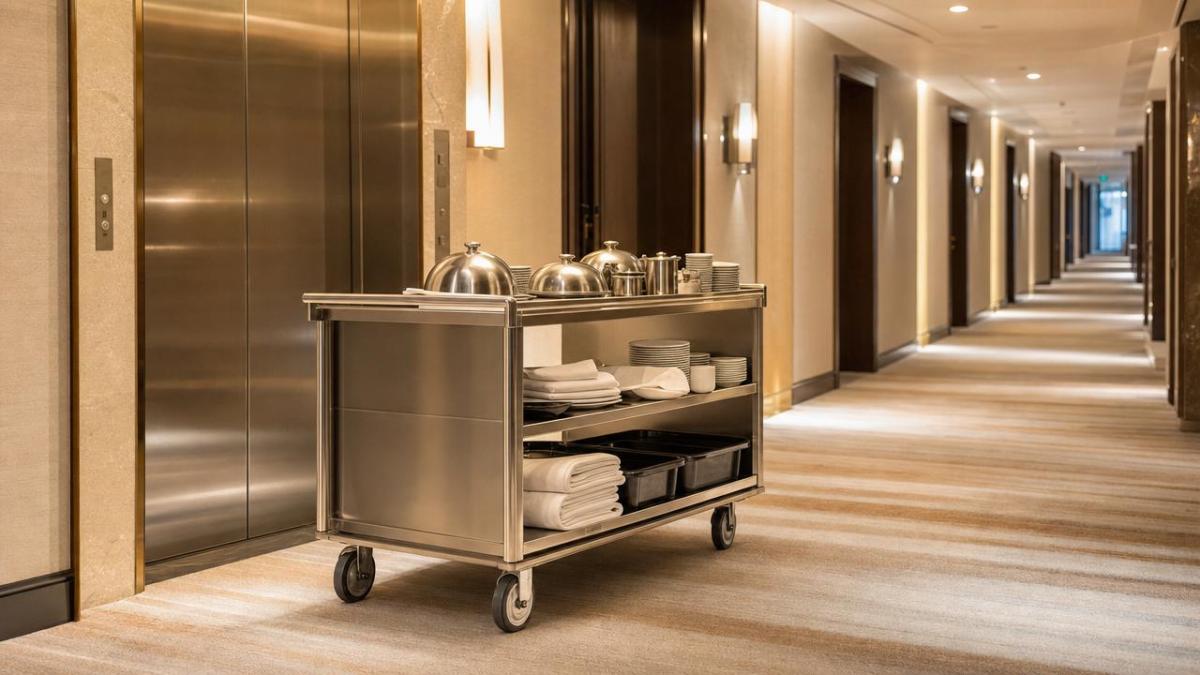
Hotel operations are no longer shaped by predictable meal rushes alone.
Today, hotels face overlapping service peaks from late check-ins, mobile ordering, event traffic, and shorter turnaround windows.
In this environment, hotel room service carts must move smoothly through tighter schedules and busier hallways.
A cart that worked well in a traditional full-service model may underperform in mixed-use, high-volume properties.
The pressure is strongest in urban hotels, resorts, and properties where room service intersects with housekeeping routes.
As a result, hoteliers are looking beyond cart capacity and focusing on maneuverability, loading logic, and route compatibility.
The warning signs appear when hotel room service carts stop matching real operations
Hotel room service carts usually slow staff down when their design no longer matches corridor conditions or service patterns.
The issue is rarely one feature alone.
More often, delays come from several small mismatches that add seconds to every task and minutes to every run.
Common slowdown signals
- Carts are too wide for guest traffic, housekeeping trolleys, or service elevator entrances.
- Shelves are poorly arranged, forcing repeated reaching, bending, and item reshuffling.
- Wheels create drag on carpet, thresholds, or uneven flooring.
- Loaded carts become unstable during turns or sudden stops.
- Dirty and clean items share space, creating confusion and extra handling.
- Storage volume encourages overloading, making movement slower instead of fewer trips faster.
When these signs appear, hotel room service carts stop acting as mobile workstations and become moving obstacles.
Several industry shifts are driving this problem more often
The growing mismatch between cart design and hotel use is linked to broader operational changes.
These changes explain why even established properties are reviewing their service equipment.
This is why hotel room service carts should be evaluated as part of workflow design, not only as a purchasing line item.
The biggest delays happen at specific points in the service journey
Not every trip is equally affected.
Hotel room service carts tend to create the most delay at handoff points, transitions, and recovery moments.
Where time loss builds up
- Loading at the service area when items lack assigned zones.
- Leaving the kitchen or pantry during peak traffic.
- Waiting for elevators with oversized hotel room service carts.
- Turning in guest corridors with decorative furniture or cleaning equipment present.
- Setting up in-room service when trays, lids, linens, and condiments are difficult to access.
- Clearing used items when no separate return section exists.
These recurring slow points can stretch a short delivery into a labor-intensive task.
Over a shift, the cumulative effect is significant.
The impact extends beyond room service and affects the whole property
When hotel room service carts slow staff down, the damage is operational before it becomes visible to guests.
Missed timing can disrupt kitchens, create hallway congestion, and reduce the number of completed service runs.
Staff fatigue also rises when pushing heavy carts over long distances or difficult surfaces.
That raises the chance of spills, damaged tableware, and inconsistent presentation.
Wider business effects
- Slower delivery times during peak occupancy
- Lower labor efficiency per shift
- More corridor obstruction and safety risk
- Reduced guest perception of premium service
- Higher wear on wheels, frames, and flooring
In competitive hospitality markets, these hidden losses matter as much as visible service errors.
The most useful evaluation standard is fit, not simply cart size or price
Many operators assume larger hotel room service carts are automatically more efficient because they hold more items.
In reality, fit-to-operation is a better measure than raw capacity.
The best cart is the one that reduces total task time, not the one that carries the biggest load.
Key points worth reviewing
- Corridor width compared with cart turning radius
- Elevator dimensions and door clearance
- Shelf height relative to frequent-use items
- Caster quality for carpet, tile, and threshold transitions
- Separate zones for hot food, amenities, linens, and returns
- Noise control for late-night service routes
- Cleaning ease and hygiene maintenance
This approach helps identify whether hotel room service carts are contributing to delay through design or through deployment.
A practical response starts with measurement, then equipment adjustment
Improvement does not always require immediate replacement.
Some hotels can improve performance by changing loading rules, staging methods, or route timing.
Others may need smaller or modular hotel room service carts for different zones.
A short time-and-motion review often reveals whether hotel room service carts are slowing movement, handling, or both.
The next decision should align equipment, layout, and service expectations
Hotels that want faster, smoother service should treat cart performance as part of a larger operating system.
That system includes property layout, staffing patterns, guest demand, and service standards.
When hotel room service carts fit those conditions, they reduce friction and support a more premium experience.
When they do not, they quietly consume time on every route.
A useful next step is to map one complete delivery cycle, identify every delay point, and compare those findings with current cart design.
For hospitality businesses seeking sharper operational insight and stronger global visibility, platforms like TradeVantage help connect equipment trends, market intelligence, and practical decision signals across the hotel supply chain.
 How an industrial trade intelligence dashboard can identify new supplier marketsDiscover how an industrial trade intelligence dashboard helps identify new supplier markets by comparing capacity, landed cost, logistics resilience, and compliance risk.
 Which global market entry barriers should exporters assess first?Global market entry barriers exporters should assess first: tariffs, compliance, buyer qualification, logistics, and payment risk. Build a practical strategy for confident market entry.
 How trade data aggregation analytics can reveal emerging supplier marketsTrade data aggregation analytics reveals emerging supplier markets by connecting trade flows, capacity signals, logistics, and compliance insights for smarter sourcing decisions.
 When an export market analysis platform can validate demand in a new marketExport market analysis platform insights help validate new-market demand through buyer fit, regulations, logistics, competition, and profitable entry conditions.
 What is driving the beauty and personal care market in the USA?Beauty and personal care in USA is driven by targeted solutions, selective premiumization, digital discovery, clean-label trust, diverse needs, and compliance. Explore key growth opportunities.
 How trade flow monitoring reports reveal changing regional demandTrade flow monitoring reports reveal changing regional demand through import volumes, sourcing shifts, product mix, logistics signals, and regulatory trends. Explore actionable market insights.
 How international market intelligence for investors reduces market-entry riskInternational market intelligence for investors reduces market-entry risk by validating demand, regulations, logistics, and competition before capital is committed.
 How international sourcing intelligence helps identify supplier risk earlyInternational sourcing intelligence helps businesses spot supplier risks early, protect supply continuity, and make smarter global procurement decisions.
 How trade data aggregation analytics reveals emerging supplier marketsTrade data aggregation analytics reveals emerging supplier markets through export trends, input flows, logistics, and regulatory signals. Discover smarter sourcing insights.
 What industrial cluster monitoring in Vietnam reveals about site riskIndustrial cluster monitoring Vietnam reveals hidden site risks across labor, utilities, logistics, compliance, and supplier dependencies. Make smarter sourcing and expansion decisions.
 Food Technology Trends Reshaping Shelf Life, Safety, and Product InnovationFood technology is reshaping shelf life, safety, and innovation. Discover the trends helping food businesses cut risk, improve compliance, and unlock stronger global market growth.
 How electronics manufacturing services are changing with low-volume demandElectronics manufacturing services are evolving fast with low-volume demand. Learn how agile EMS partners improve flexibility, compliance, sourcing resilience, and speed to market.
 How Can Buyers Reduce Procurement Risks for Electronic Components?How to reduce procurement risks for electronic components: learn how buyers assess traceability, lead times, compliance, and supplier types to avoid costly sourcing mistakes.
 What Sourcing Intelligence India Reveals About Supplier Risk and Cost ShiftsSourcing intelligence India reveals hidden supplier risk, compliance gaps, logistics pressure, and real cost shifts—helping buyers compare vendors smarter and source with more confidence.
 Fashion Trends 2026: Which Materials, Colors, and Silhouettes Are Gaining Ground?Fashion trends 2026 spotlight tactile fabrics, mineral colors, and controlled volume. Explore the materials, shades, and silhouettes shaping smarter, more wearable style.
 Smart Device Market Outlook: Key Growth Drivers, Segments, and Business OpportunitiesSmart device market trends are shifting toward system value, industrial demand, and resilient supply chains. Explore key growth drivers, high-potential segments, and business opportunities.
 How Global Trade Intelligence Services Help B2B Firms Evaluate Markets and SuppliersGlobal trade intelligence services help B2B firms compare suppliers, assess market potential, and uncover compliance, logistics, and pricing risks before costly decisions are made.
 Manufacturing Sector Updates for Investors: What Signals Matter Most in 2025?Manufacturing sector updates for investors in 2025: track orders, margins, supply chains, regulation, and exports to spot resilient manufacturers and smarter investment signals.
 How Energy Market Intelligence Helps Businesses Track Price Risks and Demand ShiftsEnergy market intelligence helps businesses spot price risks, demand shifts, and supply pressure early—improving procurement, resilience, and faster strategic decisions.
 Precision Hardware Tools Market: Key Demand Drivers, Segments, and Growth OutlookPrecision hardware tools market trends are reshaping sourcing, compliance, and automation. Explore key demand drivers, segment shifts, regional supply patterns, and growth opportunities.
 How to Use Customs Import Data to Find Buyers, Track Competitors, and Spot Demand?Customs import data helps you find real buyers, track competitors, and spot demand shifts early. Learn practical ways to turn trade records into smarter global business decisions.





















Global Trade Insights & Industry
Our mission is to empower global exporters and importers with data-driven insights that foster strategic growth.
Search News
Popular Tags
Industry Overview
The global commercial kitchen equipment market is projected to reach $112 billion by 2027. Driven by urbanization, the rise of e-commerce food delivery, and strict hygiene regulations.