

Survival Gear Bulk Orders: Where Quality Problems Usually Appear
In survival gear bulk orders, quality failures rarely come from one dramatic flaw. They usually appear in overlooked details like fabric consistency, seam strength, water resistance drift, hardware weakness, labeling errors, and uneven production between batches. For quality control and safety managers, the main task is not just finding defects after production, but building checkpoints early enough to prevent unsafe or non-compliant shipments from leaving the factory.
That is why evaluating survival gear bulk orders requires a different mindset from checking small retail samples. A product that looks acceptable in a showroom may fail in field use once exposed to moisture, abrasion, cold, impact, or repeated loading. At bulk scale, even a minor weakness can multiply into returns, safety incidents, brand damage, and customs or compliance problems.
Where quality problems usually appear first in survival gear bulk orders
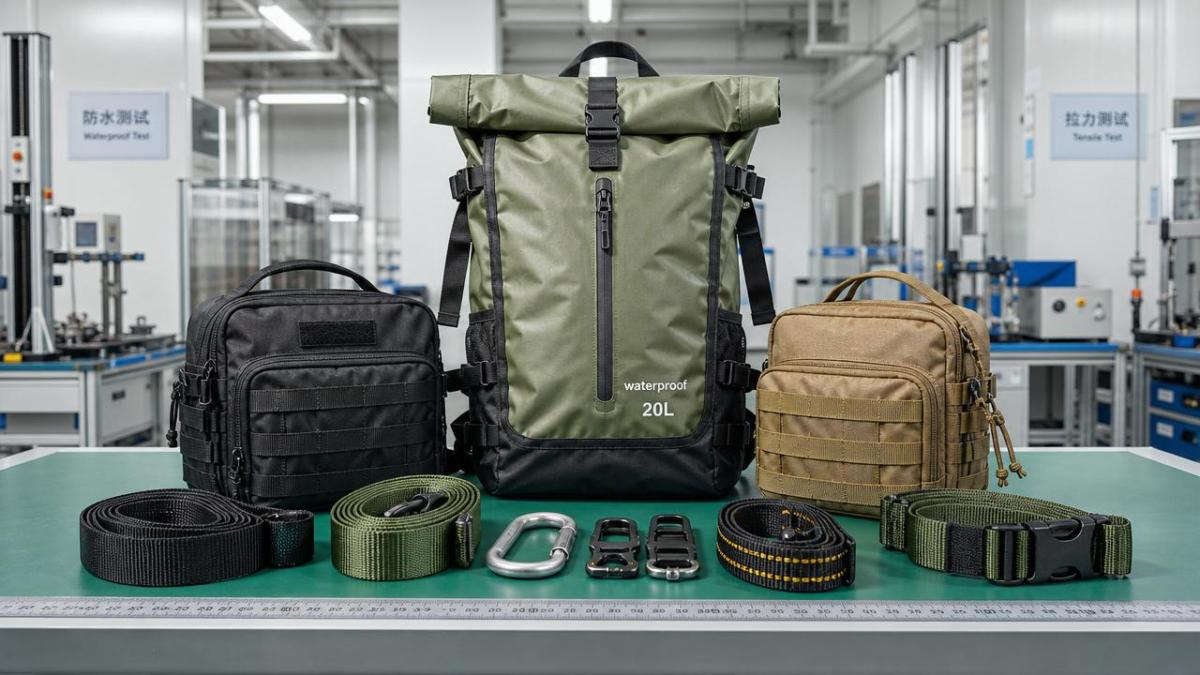
For most bulk buyers, the earliest warning signs appear in four places: materials, construction, protective performance, and documentation. These are also the areas where suppliers may pass sample approval but struggle during mass production.
Materials often become the first hidden risk. Suppliers may use a high-grade sample fabric, buckle, zipper, or foam insert for approval, then switch to a lower-cost alternative during production. The visual difference can be subtle, but the field performance gap may be significant.
Construction is the second major failure point. Stitch density, seam reinforcement, edge finishing, bar tacking, and load-bearing joint assembly often vary from line to line. In outdoor and emergency gear, these variations can quickly turn into breakage under stress.
Protective performance is another common weakness. Water resistance, thermal retention, tear resistance, flame behavior, corrosion resistance, and shock absorption are rarely judged correctly by visual inspection alone. A product can look finished and still fail under real environmental conditions.
Finally, documentation and compliance details create serious downstream risk. Missing batch traceability, incorrect material declarations, inconsistent warning labels, and unsupported test reports may not be visible on the product itself, but they can stop a shipment or expose the importer to liability.
Why material consistency creates the biggest hidden risk
In survival gear, materials determine whether the item can withstand field conditions over time. Bulk orders are especially vulnerable because factories may source from multiple upstream vendors, and consistency between lots is often weaker than expected.
Common material problems include thinner-than-specified fabric, recycled resin in plastic parts, low-grade webbing, inconsistent coatings, poor foam recovery, weak hook-and-loop performance, and rubber components that crack after heat or cold exposure. These are not always visible during incoming inspection.
For quality managers, the key question is not simply whether the material matches appearance. It is whether the approved specification can be maintained across all production lots. A single passed sample does not prove bulk stability.
Requesting a material control file is often more useful than relying only on finished-goods checks. This file should include supplier identity, lot numbers, thickness or weight tolerance, color variation allowance, coating type, and any required performance standard.
High-risk items such as waterproof bags, tactical pouches, emergency blankets, shelters, gloves, and load-bearing straps should also be linked to retained material swatches. This helps confirm whether substitutions occurred later in the production cycle.
Stitching and assembly failures are where field complaints begin
Even when materials are acceptable, survival gear bulk orders frequently fail in stitching and assembly. Outdoor users place repeated stress on handles, strap anchors, closures, corners, and fold points. These are the exact places where weak workmanship becomes visible first.
Typical problems include skipped stitches, low stitch density, uneven seam allowance, poor back-tacking, loose thread ends, needle damage on coated fabric, and misaligned reinforcement patches. In carrying systems, the most serious issue is often weak stitching at load-bearing junctions.
Safety managers should pay close attention to products that combine different material layers. For example, sewing webbing onto coated nylon, attaching buckles to laminated fabric, or joining thick padded sections can introduce hidden stress concentration. The seam may look clean but still tear under use.
This is why in-line inspection matters more than final random inspection alone. Once products are packed, subtle seam defects are harder to identify, and corrective action becomes costly. Checking assembly at early and mid-production stages reduces the chance of repeating the same defect across thousands of units.
Where possible, factories should be asked to define critical sewing points in the control plan. These include shoulder straps, drag handles, MOLLE attachment points, zipper ends, closure flaps, and hanging loops. These points deserve higher sampling frequency than low-risk decorative areas.
Waterproof and weather-resistance claims often fail at scale
One of the most misunderstood quality areas in survival gear bulk procurement is waterproof or weather-resistant performance. Buyers often approve products based on appearance, splash testing, or marketing language, but actual field exposure is much harsher and more variable.
Many survival products rely on coated fabrics, taped seams, roll-top closures, gasket seals, treated zippers, or water-repellent surface finishes. In bulk production, any inconsistency in coating thickness, seam sealing temperature, adhesive curing, or closure alignment can reduce protection sharply.
A common problem is that the base material passes a lab test, while the finished product fails because of assembly leakage. Needle holes, tape lifting, corner folds, and zipper transitions are typical leak points. This is especially important for dry bags, emergency shelters, packs, and protective pouches.
Another issue is durability loss after use simulation. A product may resist water when new, but fail after folding, abrasion, UV exposure, or repeated opening and closing. Quality teams should avoid relying only on initial performance claims if the product is intended for repeated outdoor use.
The best approach is to define realistic acceptance criteria before ordering. Instead of vague terms like “waterproof,” specify the test method, pass condition, and whether the claim applies to fabric only or the complete finished item. This prevents misunderstandings with suppliers and internal teams.
Hardware and accessory parts can undermine an otherwise acceptable product
In many survival gear bulk orders, failures come not from the main body but from small components. Buckles, clips, snaps, eyelets, zippers, cords, adjusters, D-rings, carabiner-style parts, and fasteners are often outsourced from secondary suppliers with uneven quality control.
These accessories matter because they experience concentrated force and repeated use. A bag with strong fabric still fails if the buckle cracks in cold weather. A shelter still underperforms if cord locks slip. A first-aid pouch becomes unreliable if the zipper separates after contamination by dust or moisture.
Plastic hardware should be reviewed for resin consistency, mold quality, burrs, brittleness, and dimensional fit. Metal parts should be checked for coating integrity, corrosion resistance, edge safety, and spring reliability. Zippers require both operation testing and seam integration review.
For safety-related products, compatibility between components is just as important as individual quality. A strap width that does not fit the buckle perfectly may slip under load. A pull tab that is too small for gloved use may reduce functionality in emergency conditions.
QC teams should identify components that are function-critical and treat them as separate inspection categories. These parts should not be buried inside a general appearance checklist, because their failure rate and risk profile are often much higher than cosmetic defects.
Compliance and labeling issues can create bigger losses than physical defects
For importers and distributors, some of the most expensive problems in survival gear bulk shipments are administrative rather than mechanical. A product can perform well and still trigger delays, claims, or rejection because of labeling, documentation, or regulatory errors.
Typical issues include incorrect fiber content declaration, missing safety warnings, unsupported waterproof or flame-resistance claims, absent country-of-origin marking, barcode mismatch, packaging instruction errors, and incomplete test reports. For some markets, chemical or material declarations are also critical.
Quality and safety managers should work closely with sourcing and compliance teams before production starts. If the artwork, user instruction, warning language, or certification basis remains unsettled until packing stage, the probability of shipment error rises sharply.
It is also important to verify whether the supplier understands the target market requirements. A factory experienced in domestic production may not automatically know the importer’s legal or retailer-specific standards. Assumptions here often lead to preventable rework and missed launch dates.
Batch traceability is another underused protection. If a defect appears after shipment, traceability helps isolate affected lots instead of widening the issue to the entire order. This can significantly reduce recall cost and support more accurate root-cause analysis.
How quality control teams should inspect survival gear bulk orders in practice
For this product category, a practical inspection framework should begin before production, continue during assembly, and end with shipment release only after functional and documentation checks are complete. Final inspection alone is not enough for high-risk outdoor gear.
Start with a clear product risk map. Identify which performance areas matter most in real use: load bearing, waterproofing, thermal function, abrasion resistance, visibility, closure reliability, or emergency accessibility. Then link these risks to measurable checkpoints.
Pre-production approval should include a golden sample, approved bill of materials, packaging standard, labeling file, and critical dimension list. If any of these remain informal, the factory may interpret them differently during scale-up.
During production, focus on process points that are hard to correct later. These include cutting accuracy, coating orientation, reinforcement placement, seam sealing, hardware installation, and logo or label attachment. In-line inspection is where systemic defects are most efficiently caught.
Before shipment, perform functional sampling, not only appearance review. Open and close all key mechanisms, apply tension to straps and handles, inspect likely leakage points, verify labeling against the approved artwork, and confirm count, carton marking, and packing integrity.
When possible, defect data should be grouped by root cause rather than by surface symptom. “Broken buckle,” “loose strap,” and “zipper failure” may all trace back to a component sourcing change. This kind of analysis supports supplier improvement instead of one-time correction only.
What separates a reliable supplier from a risky one
For buyers managing survival gear bulk procurement, the best suppliers are not those with the lowest defect rate on one order. They are the ones that can maintain specification discipline across changing material lots, production lines, and seasonal capacity pressure.
A reliable supplier usually shows four strengths: controlled upstream sourcing, documented process standards, honest communication about limitations, and willingness to define measurable acceptance criteria. These traits matter more than polished sales language or attractive prototypes.
Ask whether the factory keeps incoming material records, retained samples, process checkpoints, corrective action logs, and component traceability. If those systems are weak, quality performance may depend too much on individual workers rather than stable process control.
It is also useful to review how the supplier handles nonconformities. Factories that immediately offer replacement without explaining cause may still repeat the problem later. Strong partners can identify why the issue happened, what lot was affected, and what control was changed afterward.
For safety-sensitive products, supplier transparency is part of product quality. A factory that discloses realistic capability, testing boundaries, and lead-time constraints is usually less risky than one that promises every requirement without technical discussion.
Final takeaway for quality and safety managers
In survival gear bulk orders, quality problems usually appear where scale hides variation: material substitution, stitching inconsistency, weak waterproof construction, unreliable hardware, and incomplete compliance control. These issues often escape notice when teams rely too heavily on approved samples or end-stage visual checks.
The most effective response is to inspect according to actual field risk, not just standard factory routine. When QC and safety teams define critical failure points early, lock specifications before production, and verify both functional performance and documentation, they reduce the chance of expensive surprises after shipment.
For organizations buying survival gear bulk, the real goal is not merely passing inspection. It is building confidence that every unit shipped can perform consistently, safely, and compliantly in the conditions it was meant to face.
 How an industrial trade intelligence dashboard can identify new supplier marketsDiscover how an industrial trade intelligence dashboard helps identify new supplier markets by comparing capacity, landed cost, logistics resilience, and compliance risk.
 Which global market entry barriers should exporters assess first?Global market entry barriers exporters should assess first: tariffs, compliance, buyer qualification, logistics, and payment risk. Build a practical strategy for confident market entry.
 How trade data aggregation analytics can reveal emerging supplier marketsTrade data aggregation analytics reveals emerging supplier markets by connecting trade flows, capacity signals, logistics, and compliance insights for smarter sourcing decisions.
 When an export market analysis platform can validate demand in a new marketExport market analysis platform insights help validate new-market demand through buyer fit, regulations, logistics, competition, and profitable entry conditions.
 What is driving the beauty and personal care market in the USA?Beauty and personal care in USA is driven by targeted solutions, selective premiumization, digital discovery, clean-label trust, diverse needs, and compliance. Explore key growth opportunities.
 How trade flow monitoring reports reveal changing regional demandTrade flow monitoring reports reveal changing regional demand through import volumes, sourcing shifts, product mix, logistics signals, and regulatory trends. Explore actionable market insights.
 How international market intelligence for investors reduces market-entry riskInternational market intelligence for investors reduces market-entry risk by validating demand, regulations, logistics, and competition before capital is committed.
 How international sourcing intelligence helps identify supplier risk earlyInternational sourcing intelligence helps businesses spot supplier risks early, protect supply continuity, and make smarter global procurement decisions.
 How trade data aggregation analytics reveals emerging supplier marketsTrade data aggregation analytics reveals emerging supplier markets through export trends, input flows, logistics, and regulatory signals. Discover smarter sourcing insights.
 What industrial cluster monitoring in Vietnam reveals about site riskIndustrial cluster monitoring Vietnam reveals hidden site risks across labor, utilities, logistics, compliance, and supplier dependencies. Make smarter sourcing and expansion decisions.
 Food Technology Trends Reshaping Shelf Life, Safety, and Product InnovationFood technology is reshaping shelf life, safety, and innovation. Discover the trends helping food businesses cut risk, improve compliance, and unlock stronger global market growth.
 How electronics manufacturing services are changing with low-volume demandElectronics manufacturing services are evolving fast with low-volume demand. Learn how agile EMS partners improve flexibility, compliance, sourcing resilience, and speed to market.
 How Can Buyers Reduce Procurement Risks for Electronic Components?How to reduce procurement risks for electronic components: learn how buyers assess traceability, lead times, compliance, and supplier types to avoid costly sourcing mistakes.
 What Sourcing Intelligence India Reveals About Supplier Risk and Cost ShiftsSourcing intelligence India reveals hidden supplier risk, compliance gaps, logistics pressure, and real cost shifts—helping buyers compare vendors smarter and source with more confidence.
 Fashion Trends 2026: Which Materials, Colors, and Silhouettes Are Gaining Ground?Fashion trends 2026 spotlight tactile fabrics, mineral colors, and controlled volume. Explore the materials, shades, and silhouettes shaping smarter, more wearable style.
 Smart Device Market Outlook: Key Growth Drivers, Segments, and Business OpportunitiesSmart device market trends are shifting toward system value, industrial demand, and resilient supply chains. Explore key growth drivers, high-potential segments, and business opportunities.
 How Global Trade Intelligence Services Help B2B Firms Evaluate Markets and SuppliersGlobal trade intelligence services help B2B firms compare suppliers, assess market potential, and uncover compliance, logistics, and pricing risks before costly decisions are made.
 Manufacturing Sector Updates for Investors: What Signals Matter Most in 2025?Manufacturing sector updates for investors in 2025: track orders, margins, supply chains, regulation, and exports to spot resilient manufacturers and smarter investment signals.
 How Energy Market Intelligence Helps Businesses Track Price Risks and Demand ShiftsEnergy market intelligence helps businesses spot price risks, demand shifts, and supply pressure early—improving procurement, resilience, and faster strategic decisions.
 Precision Hardware Tools Market: Key Demand Drivers, Segments, and Growth OutlookPrecision hardware tools market trends are reshaping sourcing, compliance, and automation. Explore key demand drivers, segment shifts, regional supply patterns, and growth opportunities.
 How to Use Customs Import Data to Find Buyers, Track Competitors, and Spot Demand?Customs import data helps you find real buyers, track competitors, and spot demand shifts early. Learn practical ways to turn trade records into smarter global business decisions.





















Global Trade Insights & Industry
Our mission is to empower global exporters and importers with data-driven insights that foster strategic growth.
Search News
Popular Tags
Industry Overview
The global commercial kitchen equipment market is projected to reach $112 billion by 2027. Driven by urbanization, the rise of e-commerce food delivery, and strict hygiene regulations.